Claude Duet Agent Experience: A Bit Neurotic, Yet Surprisingly Useful

Anthropic launches consumer AI agent Claude Duet, combining neuroticism with practicality in exploring the path to agent popularization.
Anthropic's Claude Duet is a consumer-facing AI agent designed to let non-programmers leverage agent capabilities for everyday tasks. Testing shows that Duet displays "neurotic" traits of excessive caution and repeated confirmation during interactions, but also demonstrates surprisingly practical utility—it even proactively offered to help write the experience article, transcending the passive response model of traditional tools. This case reflects the trend of AI companies pushing agent technology beyond developer circles, while also revealing the core challenge facing consumer agents: how to strike a balance between agent autonomy and user control. Duet's attempt, though imperfect, provides important reference for future product design regarding the complexity of agent behavior in real user scenarios.
Anthropic's Claude Duet is a consumer-facing AI agent designed to bring agent capabilities to non-programmers. Unlike most products, Duet proactively offered to help write the experience report during testing—a detail that itself hints at its unique positioning: it's not just a tool, but more like a collaborative partner.
What Is Claude Duet?
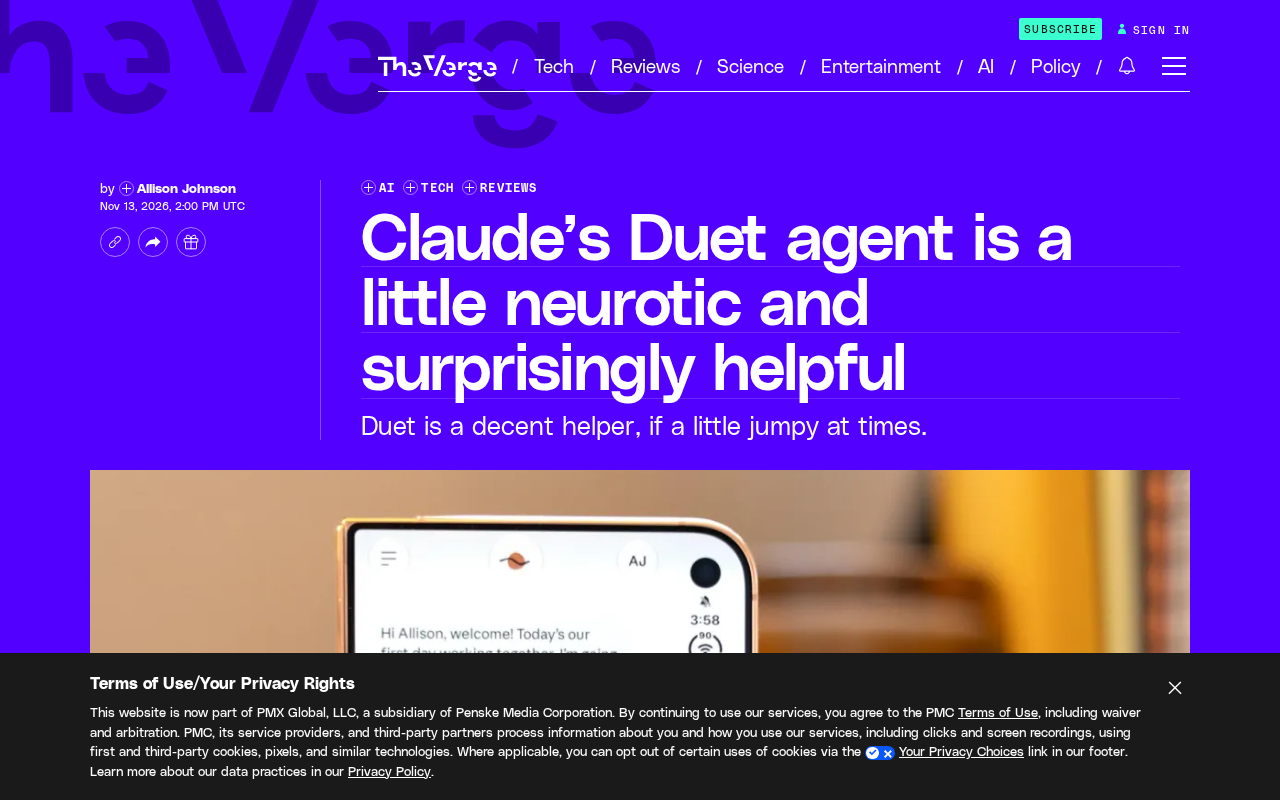
Claude Duet is Anthropic's consumer-oriented AI agent, representing the latest attempt to bring agent technology out of developer circles. Traditionally, AI agents have been used primarily for automating programming tasks, but Duet aims to let ordinary users leverage agents to handle everyday matters. According to the original experience description, Duet displayed a somewhat "neurotic" character during interactions, but also demonstrated surprisingly practical utility.
AI Agent is a key concept in the current AI landscape, referring to AI systems that can autonomously perceive their environment, formulate plans, and execute multi-step tasks to achieve goals. Unlike traditional chatbots that merely answer questions passively, agents can invoke tools, access external information, make reasoning-based decisions, and adjust behavior based on feedback during the process. In the developer domain, agents are often used to automate programming tasks, such as generating code from natural language requirements, debugging errors, or managing project dependencies. Anthropic itself has deep expertise in agent technology, and its Claude model series is widely used to build various agent applications. The launch of Claude Duet marks Anthropic's attempt to extend these capabilities—originally aimed at developers—to ordinary consumer scenarios, enabling non-technical users to direct agents via natural language to complete everyday tasks such as information organization, itinerary planning, or content creation assistance. This shift involves not only technical adaptation but also interaction design—how to make agent behavior both transparent and controllable for non-expert users is the core challenge of productization.
The "Neurotic" Side of the Agent
The reviewer described Duet's behavior as "a bit neurotic." This anthropomorphic description may stem from the agent's tendency toward excessive caution or repeated confirmation during task execution—for example, it might ask for details multiple times before offering help, or frequently report status during execution. While this trait may feel verbose to some users, it also reflects the agent's emphasis on task accuracy.
In the context of AI agents, "excessive caution" or "repeated confirmation" often stems from trade-offs in agent design between task accuracy and safety. Agents are typically granted a degree of autonomous decision-making authority, but to avoid misoperations or harmful outputs, developers introduce confirmation mechanisms, constraints, or self-reflection loops. For example, an agent might repeatedly verify intent with the user before executing critical steps, or frequently report status during tasks to maintain transparency. At the technical level, this behavior may reflect repeated validation between the agent's planning and execution modules, or it may stem from the model's conservative handling of uncertainty. For users accustomed to the instant responsiveness of traditional tools, this trait may seem "neurotic" or verbose, but from a safety perspective, it reduces the risk of the agent deviating from user intent. How to minimize unnecessary interaction friction while ensuring reliability is an area requiring fine-tuning in consumer agent design.
A Surprisingly Useful Collaborative Experience
Despite its somewhat "neurotic" behavior, Duet's practicality was affirmed. The most obvious evidence is that it proactively offered to help write the experience article—a move that transcends the scope of traditional tools and demonstrates the agent's potential in content creation assistance. For non-technical users, this proactivity and collaborative nature may be exactly what they need: the agent no longer responds passively to instructions but can anticipate needs and provide support.
Challenges and Prospects for Consumer Agents
Duet's attempt reflects the trend of AI companies pushing agent popularization. However, how to balance agent autonomy with user control remains a key issue. The "neurotic" behavior may well be a byproduct of this balancing process. As agents gradually enter the consumer market, products like Duet that combine personality with practicality will provide important references for future design.
Overall, Claude Duet has taken an interesting step in the consumer agent space. It may not be perfect, but its coexisting traits of "neurotic" and "helpful" precisely reveal the complex nature of AI agents in real user scenarios.
The balance between agent autonomy and user control is a core design challenge facing consumer-grade AI agents. Too much autonomy may lead agents to act on their own, deviate from user expectations, or even raise privacy or safety concerns; too little autonomy reduces the agent to a passive tool, losing the meaning of "agent." Common approaches include: providing adjustable autonomy levels, setting human confirmation at key decision points, and designing clear "interrupt and takeover" mechanisms. Additionally, consumer agents must handle the ambiguity of non-expert user instructions—ordinary users often don't describe tasks as precisely as developers, so agents need a degree of intent inference and clarification capability. The "neurotic" tendency Claude Duet displayed during testing may well be a byproduct of its search for balance between autonomy and control. As more consumer agents enter the market, design experience from these interaction patterns will gradually accumulate, driving agent products toward more natural and trustworthy evolution.
One-line Summary
Anthropic launches consumer AI agent Claude Duet, combining neuroticism with practicality in exploring the path to agent popularization.
Paragraph Summary
Anthropic's Claude Duet is a consumer-facing AI agent designed to let non-programmers leverage agent capabilities for everyday tasks. Testing shows that Duet displays "neurotic" traits of excessive caution and repeated confirmation during interactions, but also demonstrates surprisingly practical utility—it even proactively offered to help write the experience article, transcending the passive response model of traditional tools. This case reflects the trend of AI companies pushing agent technology beyond developer circles, while also revealing the core challenge facing consumer agents: how to strike a balance between agent autonomy and user control. Duet's attempt, though imperfect, provides important reference for future product design regarding the complexity of agent behavior in real user scenarios.
Related articles

Van Hollen on Holding Trump Accountable: Hearings and Building the Evidentiary Record
Senator Chris Van Hollen on holding the Trump administration accountable: focused hearings to expose corruption and wrongdoing, plus building an evidentiary record now to preserve space for future criminal charges.

Generating SVG and 3D Models with the Codex Plugin: A Hands-On Guide for Developers with Zero Art Background
Codex's SVG & 3D Design plugin lets developers with zero art background generate vector graphics and 3D models via code—editable, Blender-ready, with best practices built in.
Why Recursive Self-Improvement Holds Up: Responding to Six Major Objections One by One
Dwarkesh Patel responds point by point to six major objections about recursive self-improvement and superintelligence by 2030: whether verifiable proxy metrics exist, the human-link threshold for RSI, whether the math explosion can be analogized to AI research, the experimental compute bottleneck, reward hacking and the motivation for power-seeking, and whether METR acceleration rates can be extrapolated.