Claude Fable 5.1 Hands-On: Generating Minecraft, Garry's Mod, and Mario 64 with a Single Prompt
Claude Fable 5.1 generates three classic games from single prompts in Claude Code with stunning results.
A hands-on test of Anthropic's Claude Fable 5.1 in Claude Code's Ultra Code mode demonstrates the model generating playable versions of Minecraft, Garry's Mod, and Super Mario 64 — each from a single prompt with no iteration. The results showcase impressive end-to-end code generation including voxel engines, physics simulations, and complex game mechanics, while also revealing limitations in physics details and edge cases.
Recently, a Chinese video creator put Anthropic's latest Claude Fable 5.1 model through an extreme stress test: using one-shot prompts in Claude Code to separately generate three vastly different classic games — Minecraft, Garry's Mod, and Super Mario 64. The results were so impressive that the creator gave it a 9.9 out of 10 — the highest score in their entire review career.
A one-shot prompt means the user sends a single, complete instruction to the AI model, which then completes the entire task in one pass without any multi-turn dialogue or corrections. This stands in stark contrast to traditional AI-assisted programming workflows, which typically require developers to interact with the model repeatedly and iterate on code incrementally. One-shot prompting places extremely high demands on the model, as it must handle requirement comprehension, architecture design, code writing, and module integration all within a single inference pass — with no opportunity to fix errors through follow-up conversation.
This article walks through the full hands-on test and analyzes Fable 5.1's real capabilities and limitations from an AI code generation perspective.
Test Environment: Claude Code with Ultra Code Mode
All tests were conducted in Claude Code with the model set to Fable 5.1, running at the highest Ultra Code mode to fully unleash the model's coding performance.
Claude Code is Anthropic's developer-facing command-line programming tool that allows Claude models to directly read and write files, execute commands, and run projects in a terminal environment — rather than simply outputting code snippets in a chat window. Ultra Code mode is its highest performance tier, typically meaning the model consumes more computational resources (higher token quotas, longer context windows, deeper reasoning chains) to produce higher-quality code output. This mode is particularly well-suited for complex tasks that require generating large-scale, multi-file projects.
The testing methodology was straightforward: paste a pre-prepared, complete game requirements prompt in one shot, wait for the model to automatically generate a runnable local project, then open it via localhost to experience the result.
Interestingly, the entire process involved no multi-turn iteration and no manual bug fixes — each game was generated from a single prompt in one pass. This is what makes this test so striking: it doesn't evaluate AI-assisted programming efficiency, but rather the model's end-to-end code generation capability from zero to a playable product.
Minecraft Clone "Hune": Highly Faithful Voxel Sandbox
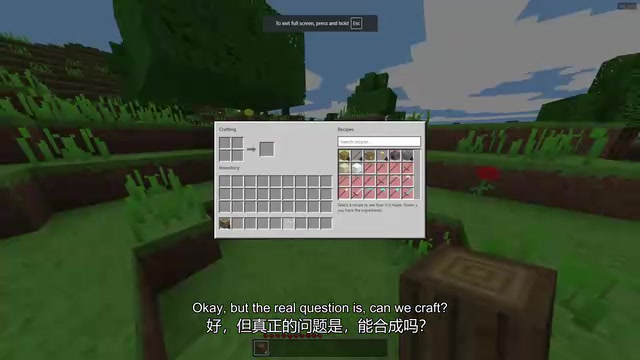
The generated voxel sandbox game was named "Hune." Upon entering creative mode, the tester's first reaction was: "This is the craziest one-shot Minecraft clone I've ever seen."
To appreciate this achievement, you need to understand the technical complexity of voxel engines. A voxel is the smallest cubic unit in 3D space, analogous to a pixel in a 2D image. While Minecraft-style voxel engines may look simple, they involve numerous technical challenges: efficient chunk loading and unloading mechanisms for memory management; greedy meshing algorithms to reduce rendered face counts; face culling (only rendering faces exposed to air) for performance optimization; and light propagation systems to calculate the brightness of each block. Generating a runnable voxel engine in one shot means the model must simultaneously handle all these interdependent subsystems.
Based on the hands-on results, Fable 5.1's attention to detail was truly remarkable:
- Terrain Generation: Proper procedural terrain, including "giant mountains" and realistic cave generation
- Block System: Diamond sword appearance and functionality faithfully reproduced; glass blocks are see-through
- Interaction: Mining was described as "very satisfying, just like Minecraft"; axes mine faster and deal more damage
- Survival Mode: Day-night cycle, swimming, mobs (chickens, pigs) all implemented, even a search bar for finding blocks
- Crafting System: Fully functional crafting table
Procedural Terrain Generation is a classic technique in game development. Its core idea is to automatically create terrain through mathematical algorithms rather than manual modeling. Minecraft uses multi-layered algorithms based on Perlin noise and Simplex noise, combining noise functions of different frequencies and amplitudes to generate naturally undulating mountains, plains, and caves. Cave generation typically uses Perlin Worm algorithms or 3D noise threshold cutting. The fact that Fable 5.1 could implement these algorithms in a single generation pass demonstrates the model's deep understanding of both the mathematical foundations and engineering implementation of procedural generation.
Of course, there were notable flaws: water doesn't flow — it's just static single blocks; torch placement was slightly misaligned; sand doesn't fall after being broken. But for a one-shot generation, the tester considered these issues "negligible."
Garry's Mod Physics Sandbox "Construct": A Real Working Physics Engine
The second generated game, a physics sandbox called "Construct," significantly exceeded expectations in scope — the map was much larger than in previous tests, with a complete background scene and a dedicated "Fall Test Center."
The most surprising aspect was the in-game text rendering quality. The tester noted that AI-generated game text in the past was typically distorted and awkward, but this time the UI text "looks really great" — reflecting Fable 5.1's improvement in structured interface generation.
On the physics side, all signature Garry's Mod features were present: tool gun, weld gun, thrusters, balloons, ropes, duplicator, and spray paint. Objects could be grabbed, frozen, rotated, and scaled. The tester welded thrusters to metal barrels to attempt "liftoff" — boxes got smashed and vehicles failed repeatedly during the process, but eventually a flyable vehicle was assembled using welded seats and thrusters.
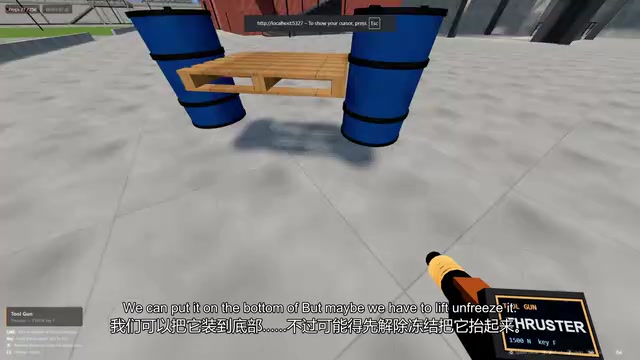
Next, they tried attaching wheels to a refrigerator to make a car, encountering issues with insufficient wheel radius and unbalanced weight distribution — but this actually proved that the physics engine was genuinely functioning, not just playing back simple animations.
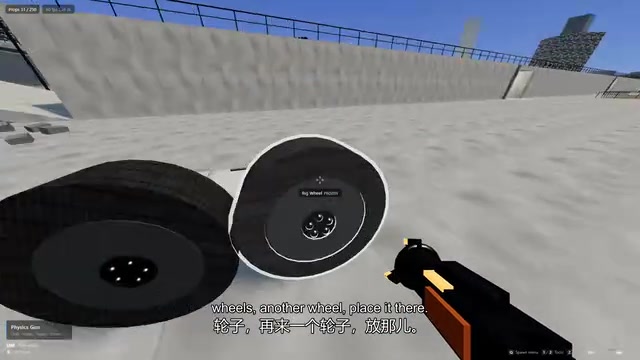
A physics engine is a software system that simulates real-world physical laws (gravity, collision, friction, rigid body dynamics, etc.). The original Garry's Mod uses Valve's Source engine with its built-in VPhysics system, capable of simulating rigid body collisions, constraint connections (welds, ropes, hinges), and force propagation. The "insufficient wheel radius and unbalanced weight distribution" issues encountered during testing actually prove the generated physics system was performing real mechanical calculations — objects had mass properties, and torque and center of gravity affected motion outcomes. If it were just playing preset animations, these physically intuitive "failures" wouldn't occur. This is the key indicator distinguishing genuine physics simulation from visual fakery.
Ultimately, the tester achieved the "flying car" feat using thrusters and a ramp, calling it "the strongest one-shot prompt generation result I've seen so far."
Super Mario 64 Recreation: Complete Levels from Backflips to Boss Fights
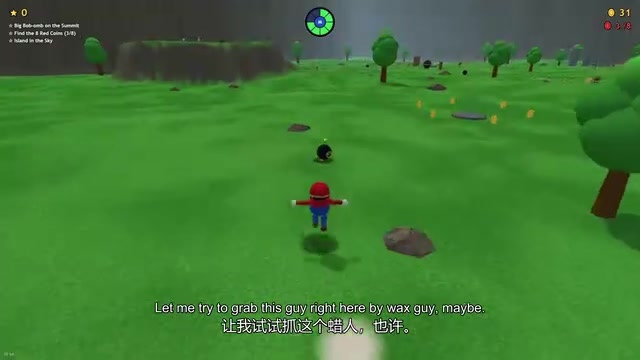
The third game was Super Mario 64, which the tester had previously failed to generate successfully. This time, Fable 5.1's version was unexpectedly complete.
Super Mario 64, released in 1996, is the pioneering title of 3D platforming games, and its movement system is still considered textbook-level design. Mario has over 20 different movement states (walking, running, jumping, backflipping, side-flipping, wall-kicking, diving, etc.), with transitions controlled by a complex finite state machine. Backflips require detecting jump input while the character is in a crouching state; stomping enemies requires precise collision detection to determine attack direction. The boss fight mechanic of "circling behind, grabbing, and throwing" involves NPC AI tracking logic, grab detection zones, and throw physics calculations. Generating all these complex interaction systems in a single pass is a severe test of both the model's game design knowledge and code implementation capabilities.
The initial version had a minor bug with inverted controls, which was easily fixed for normal gameplay. Features discovered during testing included:
- 3D Movement System: Backflips, turning, and Goomba head-stomping all triggered correctly
- Level Design: Complete climbable mountain levels, red coin collection, and moving platforms
- Boss Fight: The classic boss mechanic requiring circling behind, grabbing, and throwing was faithfully recreated
- Cannon System: Cannons that need to be activated by Bob-omb Buddies, with aiming and launching mechanics fully implemented
- Collection and Completion: Stars could be collected and the entire level could be completed
After completing the full playthrough, the tester called it "a genuinely fun game," with solid controls and well-paced level design.
The Significance and Boundaries of AI One-Shot Code Generation
While this test was clearly entertaining in nature, the technical signals it reveals deserve attention.
Breakthrough in End-to-End Product Generation
Previously, when evaluating AI coding models, we focused on their ability to complete functions, fix bugs, or assist with refactoring. What Fable 5.1 demonstrated is the ability to go from a natural language requirement directly to a runnable, interactive, complete game-loop complex application — involving the coordinated implementation of rendering, physics, UI, game logic, and multiple other systems.
Generating a complete runnable game typically involves thousands to tens of thousands of lines of code, spanning rendering modules, input handling, physics calculations, game state management, UI systems, audio systems, and many other interdependent subsystems. This requires the model to maintain awareness of the overall architecture throughout the generation process — data structures defined earlier must be consistent with how they're used later, function interfaces must match between call sites and definitions, and global state modifications must stay synchronized across all relevant modules. This "long-range consistency" is one of the core challenges facing large language models, since models fundamentally generate token by token, making it increasingly difficult for later code to maintain strict alignment with earlier sections. The fact that Fable 5.1 can produce three complete games in single passes indicates significant progress in planning and consistency maintenance during long-sequence code generation.
That three stylistically different games could all be generated in single passes demonstrates substantial improvements in the model's long-context planning and code organization capabilities.
Real Limitations That Must Be Acknowledged
As the test revealed, the model's output still has clear deficiencies in physics details (water doesn't flow, sand doesn't fall) and edge cases (inverted controls, vehicle weight imbalance). These games are "highly faithful prototypes," not "shippable products." Additionally, this test comes from a single creator's hands-on demonstration without systematic benchmark comparisons, so claims of "crushing all benchmarks" should be treated as marketing rhetoric rather than rigorous conclusions.
Practical Implications for Developers
AI can already compress the cost of proof-of-concept and rapid prototyping to extremely low levels. Game demos that previously took days to build can now be obtained as playable versions with a single prompt and a few minutes of waiting. This has real value for indie developers, educational demonstrations, and creative validation — but the journey from prototype to polished commercial product still requires deep involvement from human engineers.
Conclusion
Claude Fable 5.1 delivered a performance in this three-game one-shot generation test that was impressive enough to astonish the reviewer. It clearly demonstrates the progress of today's top AI coding models in end-to-end generation of complex applications, while also exposing real-world limitations in physics precision and edge case handling. For those following AI programming developments, hands-on tests like these provide a far more intuitive sense of a model's true capability boundaries than abstract benchmark numbers.
Related articles

iPhone Duo Battery Life Tested: One Charge a Day Is Unavoidable, and the Large Screen Is the Culprit
iPhone Duo battery test: heavy use needs at least one charge a day, and about 30% remains after 6.5 hours of screen-on time. How often the large screen is unfolded is key; a MagSafe battery pack helps, and long-term degradation is also worth watching.

Kimi K3.1 Pro Open-Sourced: 2.8 Trillion Parameters Close In on Opus
Moonshot releases the open-source MoE model Kimi K3.1 Pro, with 2.8T total parameters and 104B activated, trailing Opus 5.5 by under 1 point on Terminal Bench 4.0.

Costco Tech Price Guessing: Are Monitors, Keyboards, Mice, and Bose Speakers Worth It?
A YouTube blogger guesses prices of Costco tech products: 2K 180Hz monitor, Logitech keyboard and mouse, Bose speaker, and CyberPower UPS, revealing warehouse-store selection and brand premium.