Claude Fable 5.1 Service Degradation Incident: Full Recovery Confirmed

Claude Fable 5.1 experienced an approximately 14-minute service degradation affecting multiple product lines, now recovered.
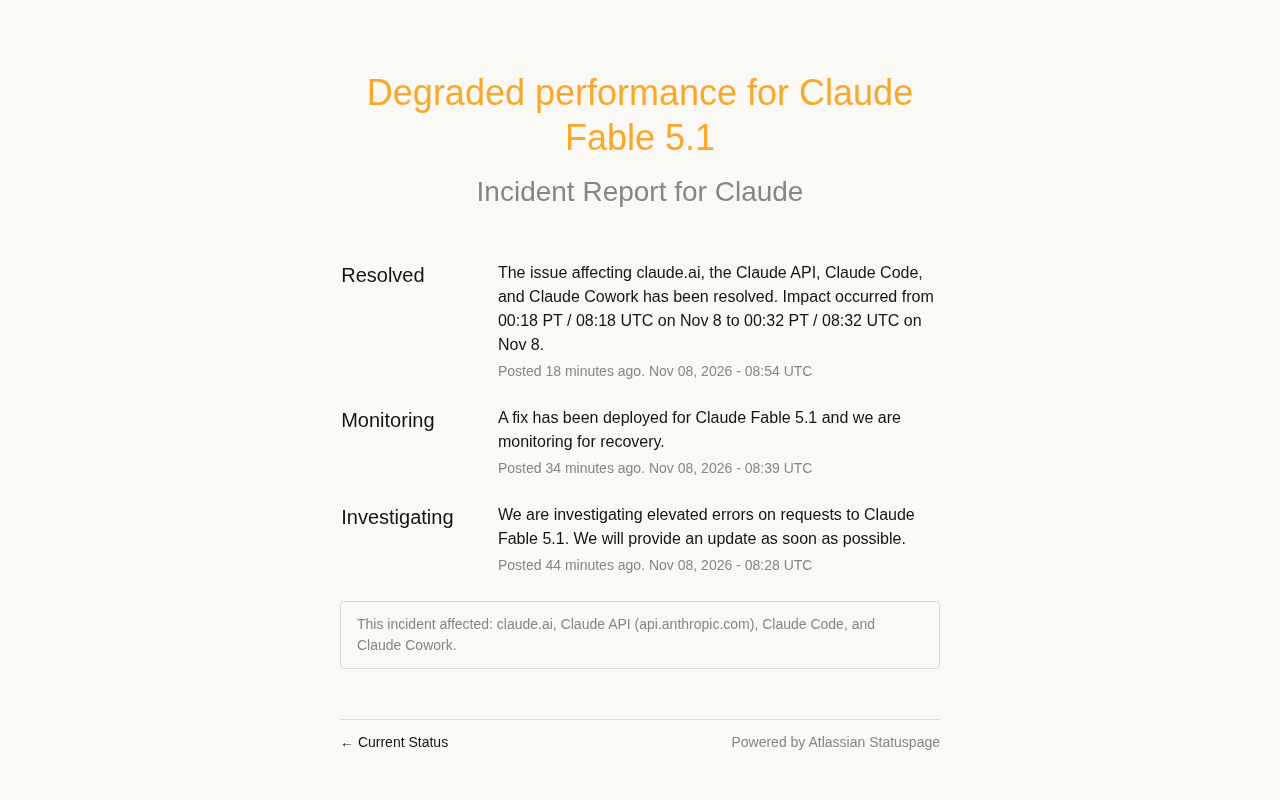
Claude Fable 5.1 recently experienced a service degradation affecting claude.ai, Claude API, Claude Code, and Claude Cowork. The incident began at 00:18 Pacific Time and ended at 00:32, lasting about 14 minutes. The official team first posted "Investigating" at UTC 08:28, moved to "Monitoring" at 08:39 after deploying the fix, and officially marked "Resolved" at 08:54. Since multiple product lines were affected, the issue likely originated at the model service layer or shared inference infrastructure. Developers are advised to configure exponential backoff retries, subscribe to status page notifications, and prepare degradation plans such as multi-model routing.
Incident Overview
Claude Fable 5.1 recently experienced a service degradation affecting multiple product entry points, including claude.ai, Claude API, Claude Code, and Claude Cowork. According to official status page updates, the issue went through "Investigating" and "Monitoring" phases before being marked "Resolved."
Looking at the timeline, the incident began at 00:18 Pacific Time (UTC 08:18) and ended at 00:32 (UTC 08:32), lasting approximately 14 minutes. The official team first published an "Investigating" status at UTC 08:28, confirming they were looking into elevated error rates on Claude Fable 5.1 requests; at UTC 08:39 they moved to "Monitoring," indicating the fix had been deployed and recovery was being observed; and at UTC 08:54 the incident was officially marked "Resolved."
Scope and Symptoms
The degradation was not limited to a single interface. The official notice explicitly listed affected products as claude.ai (web), Claude API (developer access), Claude Code (coding assistant tool), and Claude Cowork (collaboration scenarios). This means regular users, developers, and enterprise collaboration teams alike could have encountered failed requests or abnormal responses during the incident window.
The official description characterized the problem as "elevated errors on requests." While the status page did not disclose specific error types or the proportion of affected requests, the fact that multiple product lines were impacted simultaneously suggests the issue likely originated at the model service layer or shared inference infrastructure, rather than an isolated failure of any single frontend entry point.
Status page severity levels: Major cloud services and API platforms typically use a fixed set of status semantics on their status pages, and Anthropic is no exception. The common levels, from low to high, are "Investigating" (anomaly confirmed, root cause being located), "Identified" (cause found, fix being developed), "Monitoring" (fix deployed, observing whether metrics are stable), and "Resolved" (recovery confirmed, incident closed). This incident skipped the "Identified" stage and went directly from Investigating to Monitoring, indicating a very short gap between root cause identification and fix deployment. Understanding these levels helps assess which phase an incident is in: being in Monitoring does not mean recovery — it means "the fix is live but stability has not yet been confirmed," and residual errors may still occur.
Response Process and Recovery
The official response cadence was relatively tight: after detecting the anomaly, they first published the "Investigating" status, then deployed the fix and moved to monitoring, and finally confirmed recovery. You may not have noticed that approximately 15 minutes elapsed between fix deployment and official recovery confirmation, indicating the team took a conservative observation approach when verifying the fix.
For developers relying on Claude API and Claude Code, the practical impact of such short-lived incidents depends on retry mechanisms and fault-tolerance design. It is recommended to configure exponential backoff retries during integration and to subscribe to official status page notifications so you can quickly become aware of similar events.
Exponential Backoff: This is the standard client-side strategy for handling short-term service unavailability. The basic approach: after a failed request, do not retry immediately — instead wait for an initial delay (e.g., 500 milliseconds) before trying again; if it fails again, multiply the wait time (typically by 2) and add random jitter to prevent many clients from retrying simultaneously and causing a "retry storm." You should also set a maximum retry count and total timeout limit, and give up immediately on 4xx-type non-retryable errors. For a degradation lasting around ten-plus minutes like this one, reasonable backoff parameters will typically allow requests to recover automatically once the incident window ends, without manual intervention.
Recommendations for Users
In the short term, this incident has been closed and users need take no additional action. In the long term, any product dependent on a single model service should have a degradation plan: critical business functions may consider multi-model routing, while non-critical tasks can tolerate brief unavailability. The official status page is the primary channel for this type of information, and developers are advised to incorporate it into their monitoring systems.
Overall, this was a widely-impacted but short-duration availability incident. The official response process was complete, and information disclosure from investigation to resolution was fairly transparent.
Multi-model routing and degradation plans: Multi-model routing refers to abstracting a unified model invocation interface at the application layer, with multiple models — from different providers or the same provider at different specifications — connected behind it, dynamically selecting a backend based on availability, latency, cost, or task type. Its value was demonstrated very directly in this incident: when the primary model's request error rate rose, the routing layer could automatically shift traffic to a backup model or degrade to a less capable but more stable version, ensuring critical paths remained uninterrupted. In practice, several points require attention: different models differ in prompt format, context length, and output style, so output post-processing and quality validation are needed when switching; and clear switching thresholds and failback conditions should be defined to avoid remaining on the backup path long after the primary service recovers.
One-line Summary
Claude Fable 5.1 experienced an approximately 14-minute service degradation affecting multiple product lines, now recovered.
Paragraph Summary
Claude Fable 5.1 recently experienced a service degradation affecting multiple product entry points including claude.ai, Claude API, Claude Code, and Claude Cowork. The incident began at 00:18 Pacific Time and ended at 00:32, lasting approximately 14 minutes. The official team first published an "Investigating" status at UTC 08:28, confirming investigation of elevated request error rates; at 08:39 they moved to "Monitoring," indicating the fix was deployed and recovery was being observed; and at 08:54 the incident was officially marked "Resolved." Since multiple product lines were affected simultaneously, the issue likely originated at the model service layer or shared inference infrastructure rather than a single frontend entry point. For developers, the impact of such short-lived incidents depends on retry and fault-tolerance design; it is recommended to configure exponential backoff retries, subscribe to status page notifications, and prepare degradation plans such as multi-model routing for critical business functions.
Related articles
 Tech Frontiers
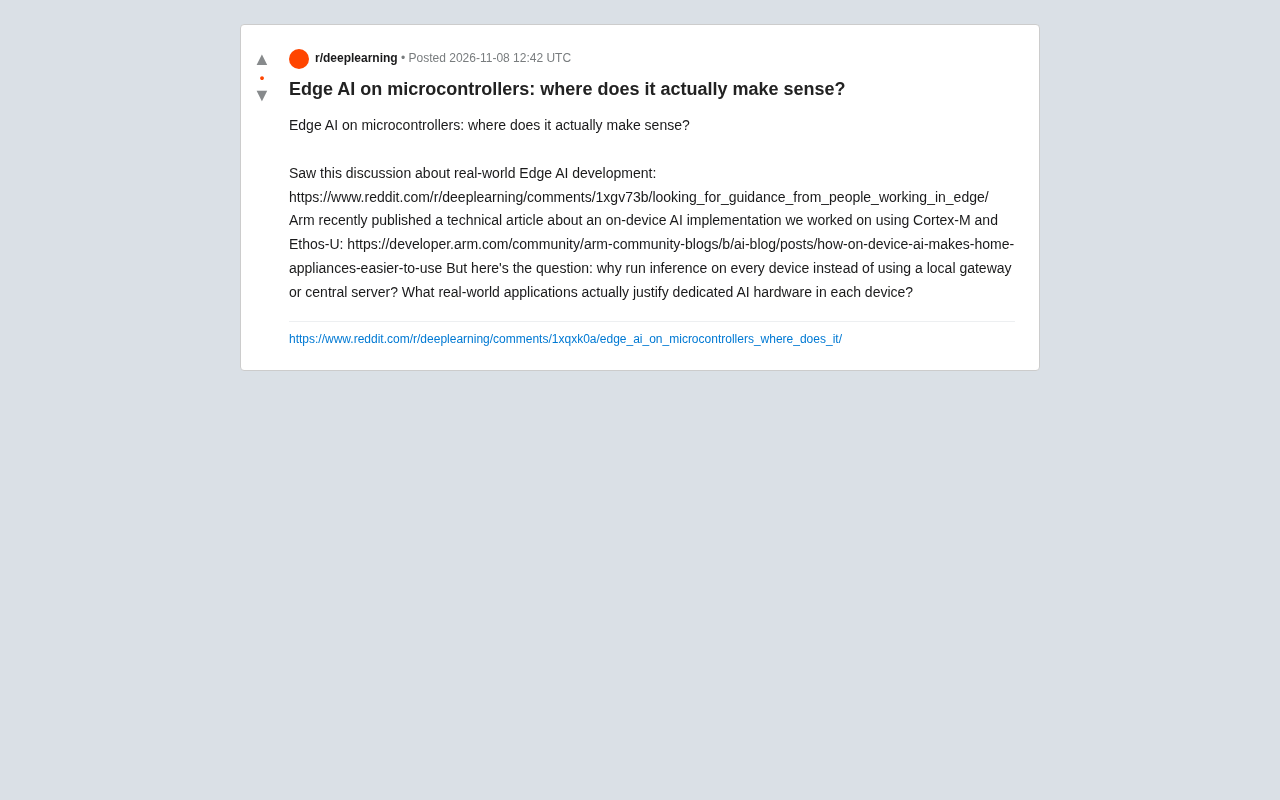
Edge AI on Microcontrollers: When Is It Actually Worth Deploying?
Drawing on Reddit discussions and Arm case studies, this article analyzes the real-world use cases for edge AI on microcontrollers: when each device needs independent inference, when a gateway or cloud is more reasonable, and the costs and boundaries of specialized hardware.
 Tech Frontiers
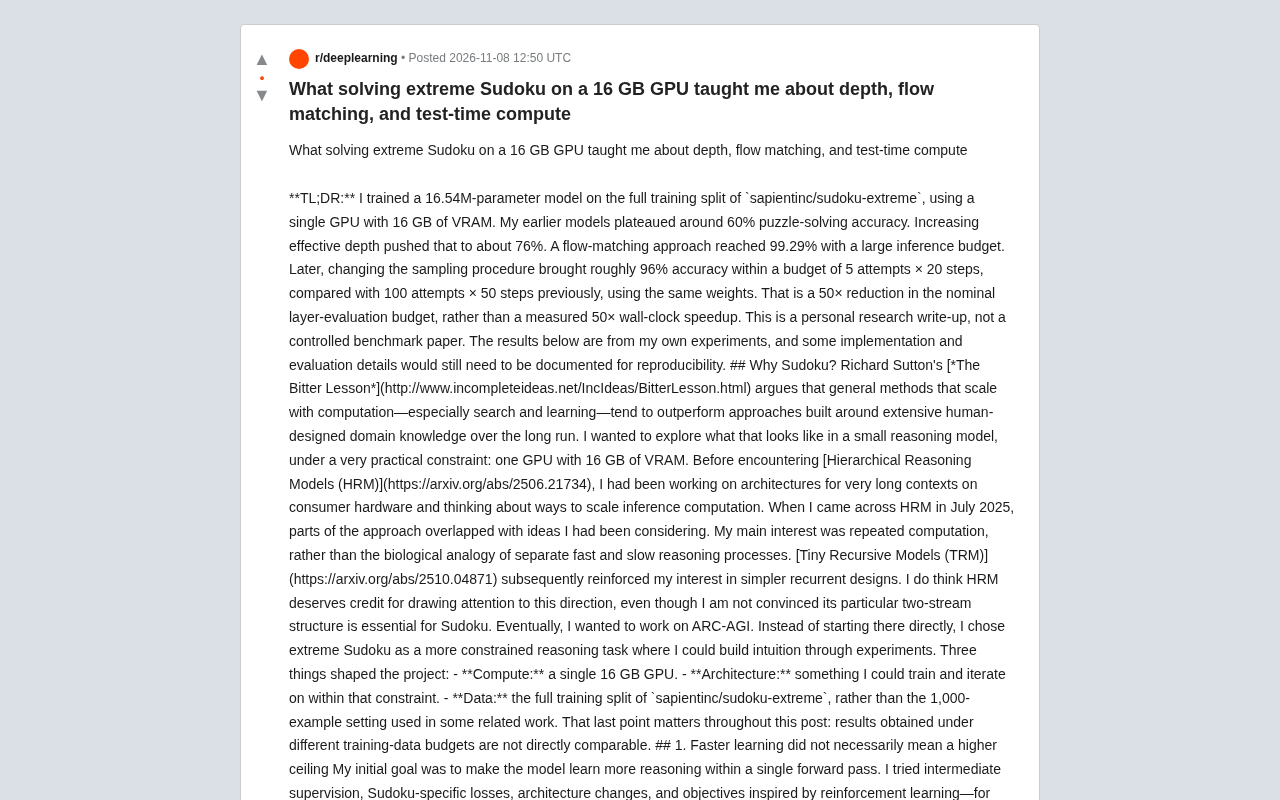
Pushing the Limits of Extreme Sudoku on a 16GB GPU: Insights from Depth and Flow Matching
A researcher trained a 16.54M-parameter model on a 16GB GPU to solve extreme Sudoku, finding effective depth breaks the 60% plateau and flow matching with improved sampling pushes accuracy past 99% with ~50× lower layer-evaluation budget.
 Tech Frontiers
AI Agent Approval Workflows: Why Human Confirmations Always Get Mindlessly Clicked
Why do AI agent approval workflows always get mindlessly clicked? A Reddit discussion shows that separating rules from keys, low-frequency high-risk approvals, and GitHub Environments-style gates are the keys to effective approvals.