Claude Fable 5.2 Service Degradation: Troubleshooting and Recovery

Claude Fable 5.2 error rates spiked for ~20 minutes; fix deployed in 6 minutes.
Based on official status page notices, this article reconstructs a brief Claude Fable 5.2 service degradation: the failure began at 02:20 PT (UTC 10:20), was confirmed and root-caused at UTC 10:34, fixed and monitored at 10:40, and resolved at 10:49—about 20 minutes total. The fix was deployed within ~6 minutes of confirmation, though a ~14-minute gap remained between onset and detection. It recommends exponential backoff retries, sensible timeouts, and degrading critical requests to backup models or async queues.
Event Overview
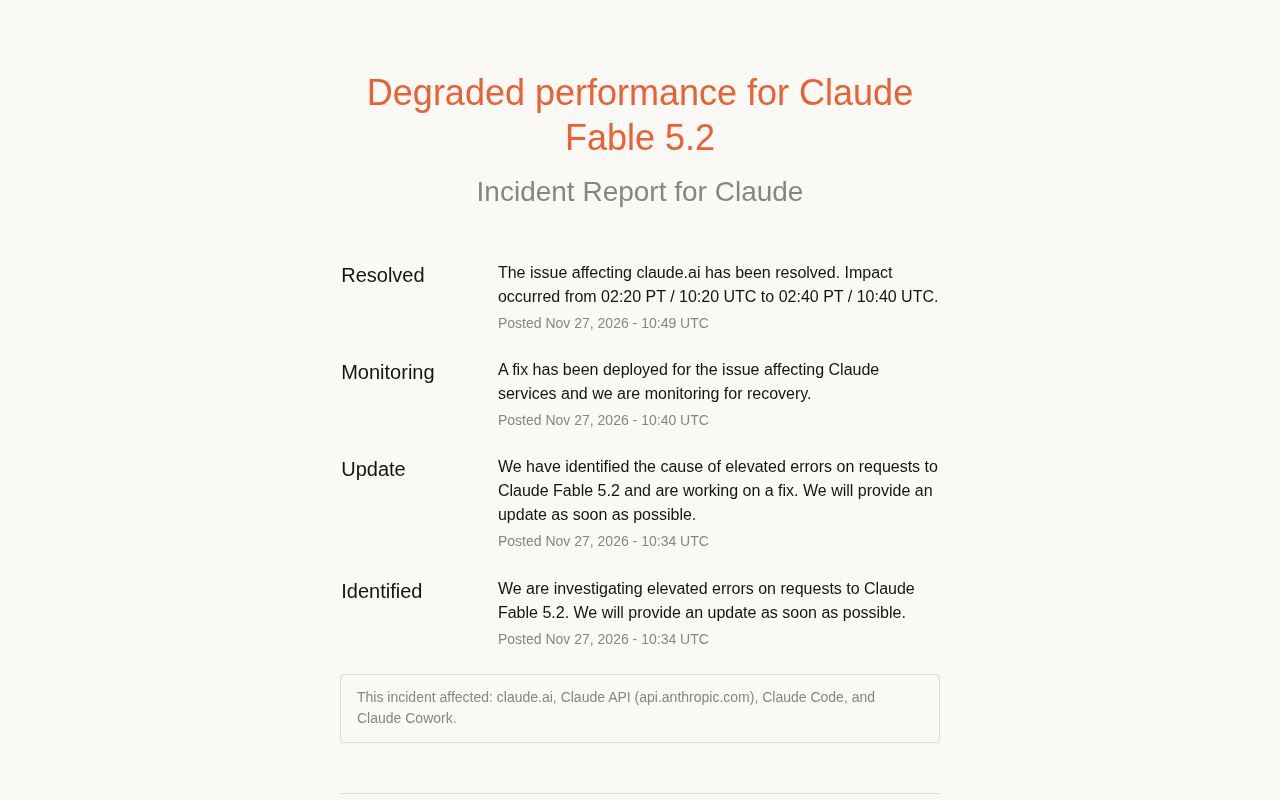
According to the official status page, Claude Fable 5.2 recently experienced a service degradation marked by elevated request error rates. The status page records show the issue began at 02:20 Pacific Time (UTC 10:20) and ended at 02:40 (UTC 10:40), lasting approximately 20 minutes. The team first confirmed it was investigating the elevated error rates at UTC 10:34, then deployed a fix and entered the monitoring phase at 10:40, and finally declared the issue resolved at 10:49.
Timeline Reconstruction
The cadence of status page updates clearly shows a typical incident response flow:
- UTC 10:34 (Identified): The team confirmed reports of elevated request error rates on Claude Fable 5.2 and launched an investigation.
- UTC 10:34 (Update): At nearly the same time, the team stated it had identified the root cause, was working on a fix, and promised further updates as soon as possible.
- UTC 10:40 (Monitoring): The fix was deployed and the recovery monitoring phase began.
- UTC 10:49 (Resolved): The team confirmed the issue was resolved and specified the impact window as 02:20–02:40 Pacific Time (UTC 10:20–10:40).
Interestingly, it took only about 6 minutes from identification to fix deployment—a relatively fast response compared with similar cloud service incidents. However, the actual start of the errors (UTC 10:20) preceded the first official confirmation (UTC 10:34), meaning there was roughly a 14-minute window between the onset of the failure and its proactive detection.
Impact on Users and Recommendations
For developers and enterprise users relying on Claude Fable 5.2, a brief spike in error rates can cause API request failures or response delays. Before the official fix, common mitigation strategies include implementing exponential backoff retry logic on the client side, setting reasonable timeout thresholds, and degrading critical business requests to a backup model or processing them asynchronously in a queue.
This incident also reminds users to regularly monitor updates on the official status page. The Resolved notification explicitly states the impact time window, which is valuable for post-incident reviews and SLA verification.
Exponential backoff retry is a common strategy in distributed systems for handling transient rate limiting and short-lived failures: instead of resending immediately after each failure, the client waits for an exponentially increasing interval (e.g., 1s, 2s, 4s, 8s…) before retrying, with random jitter added to prevent many clients from retrying simultaneously and causing secondary congestion. In practice, a maximum retry count (e.g., 3–5) and a backoff cap (e.g., 30s) are typically set, after which the request transitions to failure alerting or a degraded path. Compared with fixed-interval retries, exponential backoff significantly reduces request amplification during failure windows and is a standard practice in idempotent and fault-tolerant API client design.
SLA (Service Level Agreement) is a formal commitment between a service provider and its users regarding availability and performance, usually measured as a monthly uptime percentage. For example, 99.9% (commonly known as "three nines") corresponds to about 43 minutes of allowed downtime per month, while 99.95% is about 22 minutes. Most cloud service SLAs also include a service credit mechanism: when actual availability falls below the committed threshold, users can request fee reductions based on the duration and severity of the incident. Therefore, the precise impact time window recorded on the status page is key evidence for filing claims and conducting internal post-incident reviews. Users are advised to establish a process for regularly archiving status page notices.
Lessons for Incident Response
Based on the public update records, the handling chain for this incident was complete: identification, root cause analysis, fix, monitoring, and resolution confirmation—each step with a clear timestamp. This transparent communication approach helps users assess the scope of impact and adjust their own system strategies. For service providers, shortening the window between the onset of a failure and the first public confirmation remains a key area for improving reliability.
Status page incident severity levels typically follow a standardized state flow: Investigating, Identified, Monitoring, and Resolved. The value of this classification system is that it tells external users "which step we're currently at" rather than merely "whether the service is available." The Identified and Monitoring stages are particularly critical: the former indicates the team has grasped the root cause and a fix can be expected; the latter indicates the fix has been completed but still needs observation, at which point users can gradually restore traffic rather than switching back fully at once. Understanding this semantics helps users more accurately judge when to retry and when to switch to a backup solution.
One-line Summary
Claude Fable 5.2 experienced elevated error rates for about 20 minutes; the team deployed a fix within 6 minutes.
Paragraph Summary
Based on official status page notices, this article reconstructs a brief service degradation incident on Claude Fable 5.2: the failure actually began at 02:20 Pacific Time (UTC 10:20), the team first confirmed and identified the root cause at UTC 10:34, deployed a fix and entered monitoring at 10:40, and declared resolution at 10:49—lasting about 20 minutes. The article notes that the fix was deployed only about 6 minutes after confirmation, a relatively fast response compared with similar cloud service incidents, but there was roughly a 14-minute window between the onset of the failure and its proactive detection—still a key area for reliability improvement. For affected users, the article recommends implementing exponential backoff retries on the client side, setting reasonable timeout thresholds, and degrading critical requests to backup models or asynchronous queues, while emphasizing the value of regularly monitoring status page notices for post-incident reviews and SLA verification.
Related articles

Nothing CMF Buds 2A Drops to $17.89 on Black Friday: A New Low for ANC Earbuds
Nothing CMF Buds 2A wireless earbuds Black Friday deal: just $17.89 on Amazon, about $11 off retail and a record low. ANC earbuds at an entry-level price.

When AI Creation Gets Accused of "Spitting": Hacker News Heats Up Over the Glaude Controversy
A Hacker News post, "Spitting in the Face of Glaude," sparks debate on AI creation transparency and attribution ethics. This analysis examines the blurred creator identity behind the controversy and offers practical advice for AI content production.

Akai Embraces Custom Firmware: MPC Sample 1.4 Lets Users AI-Program Their Sampler
Akai embraces the modding community with MPC Sample 1.4 firmware, supporting vibe-coded custom firmware and effects. We analyze the impact of this open strategy on music hardware and AI-assisted programming.