Claude Full-Service Outage Postmortem: Lessons from a 40-Minute Error Rate Spike

Anthropic's entire Claude product line was down for about two hours due to two compounding issues, exposing AI infrastructure stability challenges.
Anthropic's official status page documented a roughly two-hour outage across the entire Claude product line. From first confirmation at 14:21 UTC to full resolution at 16:27 UTC, the outage showed a clear "full-stack" pattern: error rates spiked simultaneously across Claude.ai, Claude Code, Claude Cowork, and the Claude API, indicating the problem lay in a shared infrastructure or authentication layer. The outage consisted of two compounding issues—the first affecting conversation services, the second blocking login, new sessions, purchases, and file uploads. The company confirmed some messages sent between 14:00 and 14:59 UTC may have been lost and advised logged-in users not to log out. The article analyzes the response cadence and notes that single-provider availability risk must be factored into architectural design.
A roughly two-hour outage left the entire Claude product line simultaneously unavailable. According to Anthropic's official status page, the incident—from initial report to full recovery—exposed the stability challenges AI infrastructure faces amid rapid expansion.
Reconstructing the Outage Timeline
Based on updates on Anthropic's official status page, the arc of this incident is clearly traceable.
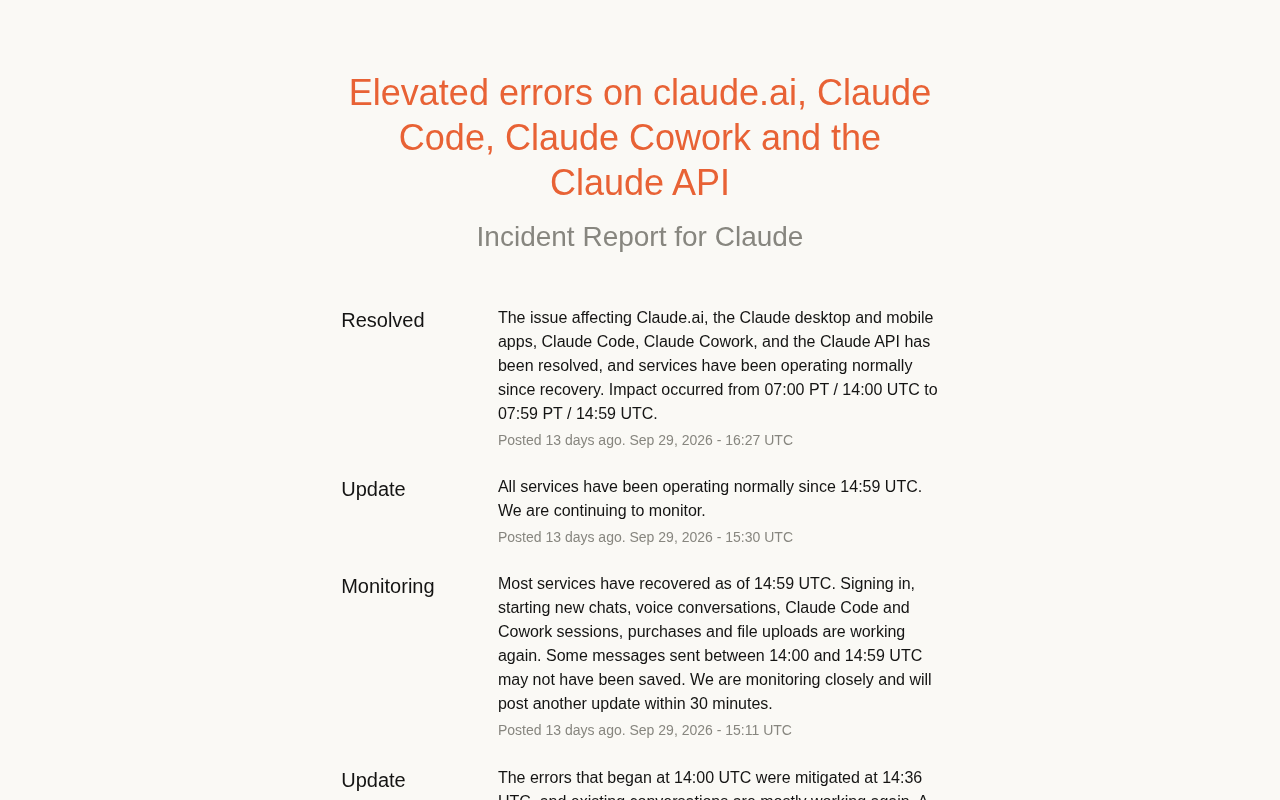
At 14:21 UTC, the company first confirmed receiving a large volume of error reports, affecting Claude.ai on web, desktop, and mobile, as well as Claude Code and Claude Cowork. On the user side, requests failed, conversations wouldn't load or send, and some users were even asked to log in again.
At 14:28 UTC, the scope was expanded to the Claude API, with confirmation that some API requests were also returning errors. This meant the outage wasn't just affecting end users—it was also hitting the developer ecosystem that relies on Claude's capabilities.
At 14:36 UTC, mitigation measures were implemented and error rates dropped sharply. But the problem wasn't fully resolved—some messages sent between 14:00 and 14:59 UTC may not have been saved.
At 14:59 UTC, most services recovered. However, a second, independent issue then surfaced: single sign-on and Apple login were unavailable, and new conversations, voice calls, purchases, and file uploads all failed to work. The official update specifically advised: logged-in users should not log out.
Finally, at 16:27 UTC, all issues were declared resolved, with services running normally since recovery.
UTC (Coordinated Universal Time) is a globally used time standard, converted to Beijing time as UTC+8. The 14:21 UTC mentioned here corresponds to 22:21 Beijing time, and 16:27 UTC corresponds to 00:27 the next day. Tech companies commonly use UTC for outage announcements because it isn't affected by daylight saving time and avoids ambiguity in cross-timezone team communication. When converting to local time, readers simply need to add the appropriate offset for their timezone.
Anthropic's official status page is a service monitoring page that runs independently of the main site, used to disclose real-time availability, performance degradation, and planned maintenance information across product lines. Status pages are typically hosted on different infrastructure from the main site to ensure the company can still communicate externally during a main-site outage. These pages generally offer subscription notifications, allowing developers to receive status change pushes via email, SMS, or Webhook, triggering internal alerting processes as soon as an outage occurs.
What It Means for Multiple Product Lines to Fail Simultaneously
The most noteworthy feature of this incident was the "full-stack" nature of the failure.
Claude.ai as a consumer product, Claude Code as a developer tool, Claude Cowork as an enterprise collaboration feature, and the Claude API as the underlying capability interface—error rates spiking across all four layers simultaneously suggests the problem likely originated in a shared infrastructure or authentication layer.
Looking at how the incident evolved, the two problems had a compounding effect. The first was mitigated at 14:36 UTC, mainly affecting conversation services; the second wasn't fully resolved until after 14:59 UTC, mainly affecting login and session creation. This "one wave hasn't subsided before another rises" pattern posed a severe test for the incident response team.
For developers building products on the Claude API, this outage is a reminder of a reality: the availability risk of a single model provider needs to be factored into architectural design.
Single Sign-On (SSO) is a centralized identity authentication mechanism that lets users access multiple mutually trusting applications with a single login. In enterprise environments, SSO is typically managed by identity providers (IdPs) such as Okta or Azure AD, with applications verifying user identity via SAML or OIDC protocols. When the SSO chain breaks, users who already hold valid session tokens are often unaffected, but all new login requests fail—this is precisely the technical reason behind the official advice that "logged-in users should not log out."
Session Token is a temporary credential issued by the server after a successful login, typically stored on the client as a Cookie or JWT. Tokens have an expiration period, after which re-authentication is required. During an outage, if the authentication service is unavailable, expired tokens can't be refreshed, and users are forced to log out with no way to log back in. This also explains why login failures were deprioritized behind core conversation services—the former only affects new session creation, while the latter affects all active users.
Analyzing the Incident Response Cadence
From the first public confirmation of the problem at 14:21 UTC to the announcement of full resolution at 16:27 UTC, Anthropic's response cadence is worth breaking down.
The problem confirmation phase took about 7 minutes (from 14:21 to expanding scope at 14:28); mitigation measures were implemented within 15 minutes of first confirmation (14:36); and most services recovered within 30 minutes (14:59). The company committed to updates every 30 minutes, and execution largely matched that cadence.
This level of transparency and responsiveness is fairly standard practice among AI service providers. By comparison, some similar services provide less frequent updates and vaguer information when hit by outages.
Real Impact on Users and Developers
The company explicitly stated that some messages sent between 14:00 and 14:59 UTC may have been lost. That means for a full hour, user conversation content was at risk of being unrecoverable.
For engineers using Claude Code for development, work interruptions during the outage could have caused code-generation sessions to be lost. Claude Cowork users may have experienced stalls in collaboration workflows. API developers faced failing requests and a test of their retry logic.
One notable detail: in the outage updates, the company proactively advised users "do not log out." This tip seems simple, but it reflects that the login system's recovery priority was lower than core conversation services—with limited resources, the team chose to restore service capability first, then fix the authentication chain.
Industry Reflections on AI Infrastructure Stability
Claude's outage is not an isolated case. As AI services carry ever-growing user volumes and request complexity, stability is becoming an issue the entire industry must confront.
From a technical standpoint, the stability challenges of large-model services have their own particularities. Inference compute is resource-intensive, context management is complex, and multiple products share underlying capabilities—these factors compound, dramatically amplifying the blast radius of a single point of failure.
For enterprise users, this incident offers clear guidance for action: when introducing AI capabilities into critical business processes, degraded-mode plans and backup channels need to be designed. For AI service providers, how to safeguard infrastructure reliability while rapidly iterating on products will be an ongoing balancing act.
Anthropic's transparent communication during this outage deserves recognition, but the emergence of two independent problems in succession also suggests the system may have more weak points than expected.
Graceful Degradation refers to a strategy in which a system proactively disables non-core functions to preserve core capabilities when some components fail. In AI service scenarios, typical degradation includes: switching to a smaller, faster backup model; limiting concurrent requests; and pausing non-critical file uploads or voice features. For developers relying on a single model provider, degradation plans should also include multi-provider routing—for example, automatically switching to a backup model when the Claude API is unavailable. Output quality may differ, but business continuity is preserved.
Inference compute intensity is a core characteristic that distinguishes large-model services from traditional web services. A single conversation request can consume dozens of times the GPU compute of an ordinary API call, and the inference process is extremely sensitive to memory bandwidth and interconnect latency. When request volume surges or a node fails, load rapidly shifts to remaining nodes, potentially triggering cascading overload. This resource coupling makes failure propagation in large-model services far faster than in traditional stateless services, and places higher demands on the design of isolation and circuit-breaking mechanisms.
One-line Summary
Anthropic's entire Claude product line was down for about two hours due to two compounding issues, exposing AI infrastructure stability challenges.
Paragraph Summary
Anthropic's official status page documented an outage lasting roughly two hours across the entire Claude product line. From first confirmation at 14:21 UTC to full resolution at 16:27 UTC, the outage showed a clear "full-stack" pattern: error rates spiked simultaneously across four product lines—Claude.ai, Claude Code, Claude Cowork, and the Claude API—indicating the problem lay in a shared infrastructure or authentication layer. The outage consisted of two compounding issues: the first affected conversation services, and the second blocked login, new session creation, purchases, and file uploads. The company confirmed that some messages sent between 14:00 and 14:59 UTC may have been lost, and advised logged-in users not to log out. The article analyzes the incident response cadence and notes that single model provider availability risk must be factored into architectural design.
Related articles

Why Does the Tesla Roadster Need to Fly? A Deep Dive into Musk's Wild Demo
Tesla's Roadster launch showed wall-climbing, upside-down driving, and flying stunts—but The Vergecast notes the demo car may lack a battery, the Rocket version is invite-only and not street-legal, and the website terms don't guarantee delivery. After nine years of delays, why does this car still need to exist?

AI Is Not a Replacement: Human-AI Collaboration Through the Lens of Factory Root Cause Analysis
Starting from factory root cause analysis, this article explains how AI accelerates evidence chain construction rather than replacing human experts, exploring the pragmatic implementation logic and business value of 'AI supporting people rather than replacing them.'

AI Agent Decision Auditing: Building an Evidence Chain in Regulated Workflows
Starting from a Reddit discussion, this article analyzes three core issues in AI agent decision auditing within regulated workflows: what fields audit records should contain, how to handle feedback latency for erroneous decisions, and how to continuously calibrate LLM judge consistency with human judgment.