Claude Haiku 4.5 Released: Double the Speed at One-Third the Price, Setting a New Cost-Efficiency Benchmark for AI Coding

Anthropic releases Claude Haiku 4.5, achieving near-flagship coding performance at one-third the cost.
Anthropic released Claude Haiku 4.5, a distilled version of its flagship Claude Sonnet 4.5. It scored 73.3 on SWE-Bench, close to Sonnet 4.5's 77.2, while costing only one-third as much and running at double the speed. Called one of Anthropic's safest models to date, it features strict restrictions in high-risk areas. This release confirms the 2025 AI industry trend of models becoming more capable while costing less.
Anthropic recently released Claude Haiku 4.5, a distilled version of its flagship model Claude Sonnet 4.5. The new model maintains near-flagship coding performance while compressing costs to one-third and doubling speed, once again confirming the industry trend that large models are becoming "more capable and less expensive."
Claude Haiku 4.5 Core Highlights: Coding Performance Preserved, Cost-Efficiency Soars
Claude Haiku 4.5 is a distilled version of Claude Sonnet 4.5, which Anthropic released five months ago. Knowledge Distillation refers to "compressing" a large model's capabilities into a smaller, faster model, dramatically reducing inference costs while preserving as much of the original capability as possible.
This technique was first proposed by Geoffrey Hinton et al. in 2015. The core idea is to have a smaller "student model" learn from the output distribution of a larger "teacher model," rather than learning directly from raw training data. The "soft labels" output by the teacher model contain information about relative relationships between categories, carrying richer knowledge than hard labels. In recent years, as large language model parameters routinely reach hundreds of billions, distillation has become a key technique for balancing performance with deployment costs. Anthropic's distillation of Sonnet 4.5 into Haiku 4.5 represents a mature industrial application of this technical approach.
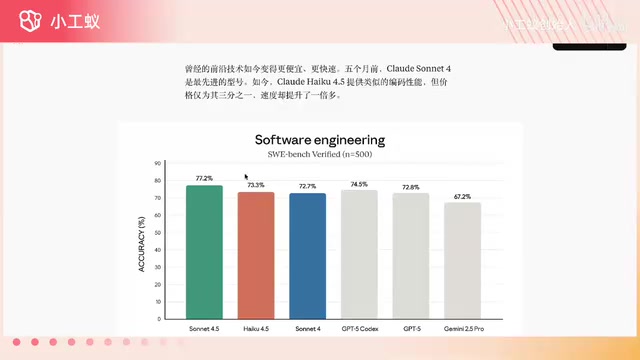
Looking at the specific numbers, Claude Haiku 4.5's performance is quite impressive:
- Coding Performance: Approaches Claude Sonnet 4.5 levels
- Inference Speed: Twice as fast as Sonnet 4.5
- Usage Cost: Only one-third that of Sonnet 4.5
This means that for developers and enterprises heavily relying on AI-assisted programming, they can obtain nearly equivalent code generation quality at a lower budget while enjoying faster response times.
SWE-Bench Score of 73.3: Claude Haiku 4.5 Firmly in the Top Tier of AI Coding
Anthropic released Claude Haiku 4.5's scores on the SWE-Bench benchmark. SWE-Bench is currently one of the most authoritative benchmarks for evaluating AI coding capabilities, published by a Princeton University research team in 2023. It primarily assesses a model's ability to solve real software engineering problems.
Unlike traditional code generation benchmarks (such as HumanEval, which only tests function-level code completion), SWE-Bench collected 2,294 real Issue-Pull Request pairs from 12 mainstream Python open-source projects on GitHub (including Django, Flask, scikit-learn, etc.). It requires AI models to autonomously locate relevant files in a codebase given a problem description and generate correct fix patches. This means models need multi-dimensional software engineering capabilities including code comprehension, cross-file reasoning, and test verification, making evaluation results more reflective of AI's practical value in real development scenarios.
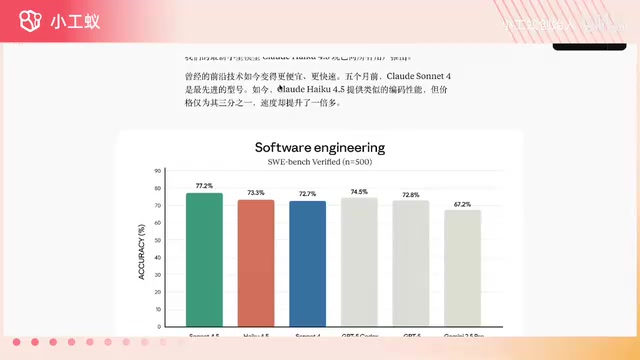
Claude Haiku 4.5 achieved a score of 73.3 on SWE-Bench. While there's a slight gap compared to Claude Sonnet 4.5's 77.2, considering it costs only one-third the price and runs at double the speed, the cost-efficiency is already outstanding.
What you might not have noticed is that compared to Claude Sonnet 4 (not the 4.5 version) in the same family, Haiku 4.5 actually outperforms it in coding capability. This demonstrates that model distillation technology has reached a fairly mature level of optimization in specific domains — a carefully distilled smaller model can completely surpass a larger but less optimized model in vertical domains.
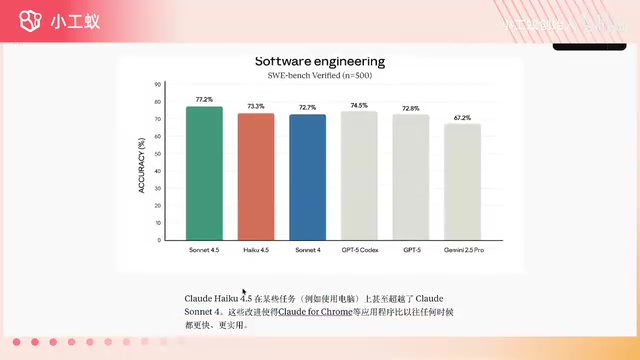
Anthropic has consistently maintained a top-tier position in the AI coding space. From Claude 3.5 Sonnet to Claude Sonnet 4.5, and now Haiku 4.5, their performance in code generation, code comprehension, and software engineering tasks has remained at the leading edge.
Safety Assessment: One of Anthropic's Safest AI Models to Date
Anthropic has always been known for prioritizing AI safety, and Claude Haiku 4.5 is no exception. The company states this is one of their safest models to date.
Anthropic was co-founded in 2021 by former OpenAI VP Dario Amodei and his sister Daniela Amodei, with AI safety as a core mission from the very beginning. Anthropic introduced the "Constitutional AI" training method, which has models self-critique and revise based on a set of predefined principles, reducing dependence on human-annotated feedback. The company also published a Responsible Scaling Policy, establishing corresponding safety evaluation standards for AI models at different capability levels. This "safety-first" philosophy has given Anthropic a differentiated advantage in the enterprise market, particularly appealing to clients in finance, healthcare, government, and other industries with strict compliance requirements.
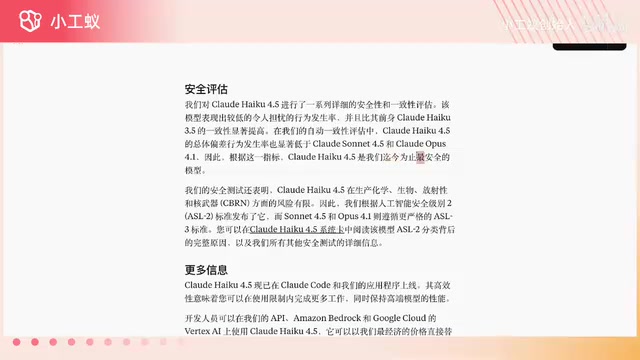
Regarding safety assessment, Anthropic specifically emphasized strict restrictions on the following high-risk areas:
- Generation of information related to biochemical weapons
- Dangerous knowledge related to radioactive materials
- Sensitive content such as weapons manufacturing
These safety measures are particularly important for enterprise applications. When AI models are deployed at scale in production environments, the reliability of safety guardrails directly impacts an organization's compliance risk. Especially as regulatory frameworks like the EU AI Act progressively take effect, model safety has shifted from being a "nice-to-have" to a "market entry requirement."
AI Coding Enters the Cost-Efficiency Era: Cost Reduction Becomes the Main Theme for Large Models
The release of Claude Haiku 4.5 reflects an important trend in the 2025 AI industry — model capabilities are increasing while usage costs are rapidly declining.
Looking back over the past year, this trend line has become very clear:
- Model distillation technology is maturing: Large model capabilities can be efficiently transferred to smaller models; high-performance AI is no longer synonymous with "burning money"
- AI-assisted programming is advancing by leaps and bounds: Progress in AI coding in 2025 has far exceeded expectations, with capability boundaries expanding from code completion to autonomously solving complex engineering problems
- Vendor competition is driving prices down: Fierce competition among OpenAI, Anthropic, Google, and others has objectively accelerated the decline of large model pricing
The 2025 AI coding tools market has formed a multi-player competitive landscape. Beyond Anthropic's Claude series, OpenAI's GPT-4o and o3 series demonstrate strong performance in code reasoning, while Google's Gemini 2.5 Pro has unique advantages in long-context code comprehension. At the application layer, IDE-integrated tools like GitHub Copilot, Cursor, and Windsurf have become standard developer equipment, while AI software engineering agents like Devin and OpenHands are attempting to autonomously complete more complex development tasks. Cost-efficiency improvements in underlying models directly benefit the entire ecosystem — cheaper API calls mean these tools can invoke models more frequently, provide more refined code suggestions, while maintaining commercial sustainability.
For developers and software companies, Claude Haiku 4.5 offers an extremely attractive option: use Haiku 4.5 for daily coding tasks to save costs, and switch to Sonnet 4.5 when maximum quality output is needed. This Tiered Model Strategy can reduce AI usage costs by over 50% while maintaining quality.
In fact, some forward-thinking enterprises have already begun incorporating "Model Router" components that automatically select the most appropriate model by analyzing input task complexity. For example, high-frequency, low-complexity tasks such as code completion, simple refactoring, and documentation generation are handled by Haiku 4.5, while tasks requiring deep reasoning — such as architecture design, complex bug fixes, and security audits — are automatically routed to Sonnet 4.5, achieving a dynamically optimal balance between cost and quality.
Summary: Developers Should Integrate Claude Haiku 4.5 into Their Toolchain Early
The release of Claude Haiku 4.5 once again proves that AI large models are moving toward "democratization." Faster speed, lower prices, near-flagship performance — this is good news for the entire AI coding ecosystem.
If you're looking for a high cost-efficiency AI coding tool, Claude Haiku 4.5 deserves priority consideration. Developers are encouraged to test and evaluate it early, flexibly switching between Haiku 4.5 and Sonnet 4.5 based on task complexity to build the most cost-effective AI-assisted programming workflow.
Key Takeaways
- Claude Haiku 4.5 is a distilled version of Sonnet 4.5, with costs reduced to one-third and speed doubled
- SWE-Bench score of 73.3, close to Sonnet 4.5's 77.2, with coding capability surpassing Sonnet 4
- Anthropic calls it one of their safest models to date, with strict restrictions in high-risk areas like biochemical weapons and radioactive materials
- Confirms the 2025 industry trend of large models becoming "more capable and less expensive," as AI coding enters the cost-efficiency era
Related articles
 Tech Frontiers
A Rare Quiet Day in AI: Recursive Self-Improvement Stirs Beneath the Surface
A rare quiet day in AI sees multiple sources go silent simultaneously. Behind the calm, Recursive Self-Improvement (RSI) research continues. What this means for the industry.
 Tech Frontiers
Reve 2 vs. Ideogram 4: A Deep Dive into Layout Control in AI Image Generation
A deep comparison of Reve 2 and Ideogram 4's layout control capabilities, covering technical approaches, real-world use cases, and industry trends for designers and creators.
 Tech Frontiers
In the Weights: Check Your Influence Score in the AI World
In the Weights is an AI influence search engine that quantifies your presence in the AI world with a score. Explore how it evaluates practitioners and what it means for digital identity.