Claude Haiku 5.5 Error Incident Review: An 18-Minute Outage and AI Service Reliability
Claude Haiku 5.5 saw 18 minutes of elevated errors, revealing the real operational rhythm of large model services and fault-tolerance lessons.
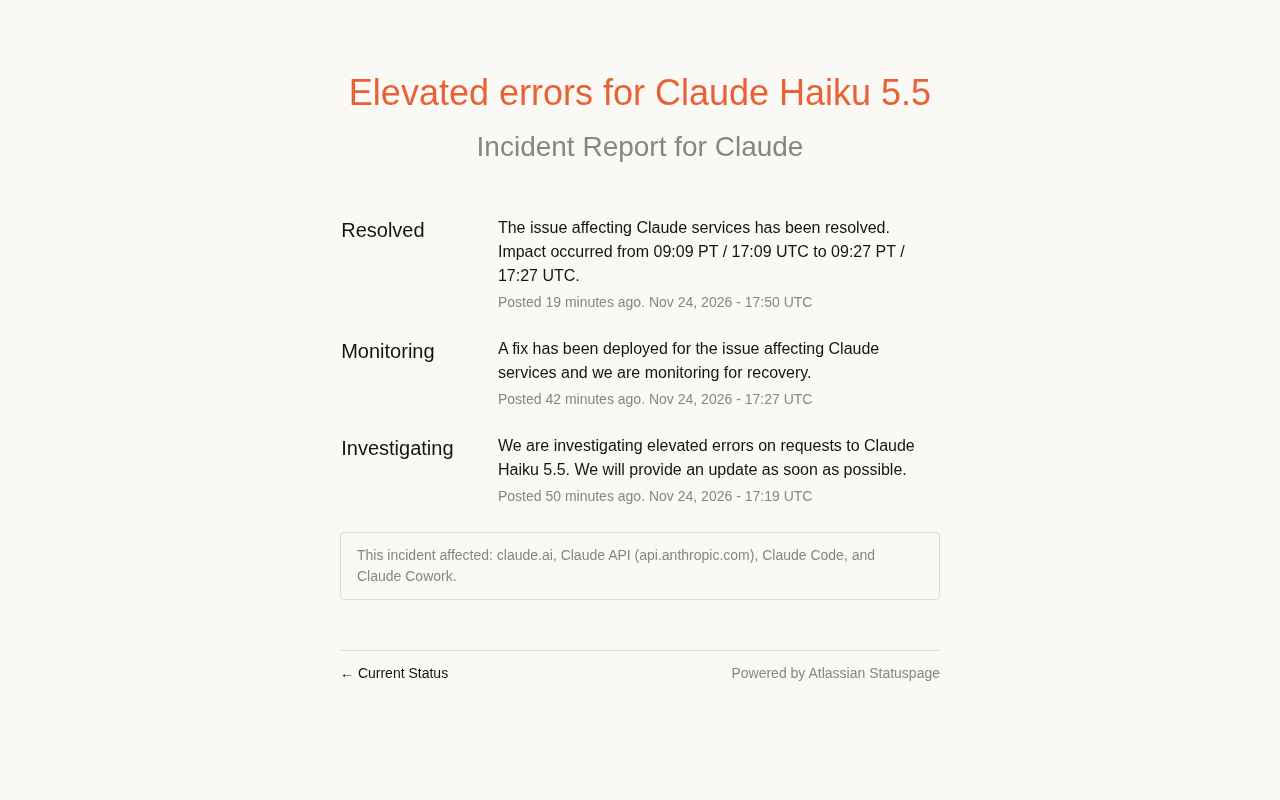
Anthropic's status page recorded elevated errors on Claude Haiku 5.5, with impact starting at 17:09 UTC, a fix deployed at 17:27 UTC, and resolution announced at 17:50 UTC — an 18-minute impact window. The wording "elevated errors" rather than "outage" means some requests errored or timed out rather than total unavailability. The article argues that transparent status pages, model-version-specific reports, and callers' own retry, backoff, and fallback designs determine the real impact of brief outages.
Title
Claude Haiku 5.5 Error Incident Review: An 18-Minute Outage and AI Service Reliability
Meta Description
Anthropic's status page recorded elevated errors on Claude Haiku 5.5, with investigation, fix, and resolution confirmation completed within 18 minutes. This article reviews the incident timeline, analyzes what "elevated errors" actually means, and discusses what AI service reliability teaches developers.
Article Content
The reliability of AI services is becoming a more realistic competitive advantage than model capability itself. Anthropic's status page recorded an error incident on Claude Haiku 5.5 that took only 18 minutes from detection to resolution — yet this brief timeline reveals the real operational rhythm of large model services.
Incident Timeline: Three Milestones, an 18-Minute Loop
According to the public record on Anthropic's status page, the incident went through three standard stages:
- Investigating (17:19 UTC): The company confirmed it was investigating "elevated errors on requests to Claude Haiku 5.5."
- Monitoring (17:27 UTC): A fix had been deployed, and the service entered an observation period for recovery.
- Resolved (17:50 UTC): The issue was resolved, with the impact window defined as 09:09 PT / 17:09 UTC to 09:27 PT / 17:27 UTC.
Looking at the timestamps, the actual affected window was 18 minutes, while the span from first public confirmation to resolution announcement was about half an hour. For an API service serving global developers, this is a fairly measured response: confirm first, then fix, then observe — rather than rushing to declare recovery.
What "Elevated Errors" Means
The status page's wording was "elevated errors," not "service outage." That distinction is worth noting.
In the API context, an elevated error rate typically manifests as some requests returning error codes, timing out, or responding abnormally — not total unavailability. For callers, this kind of problem often feels subtler than a full outage: the error rate curve on the monitoring dashboard suddenly spikes, retry logic starts firing frequently, but the service overall still appears to be "up."
The Haiku series is positioned toward lightweight, low-latency scenarios within the Claude product line, and is often used for high-concurrency batch tasks, classification, extraction, and lightweight conversation. Once the error rate rises, what's affected isn't just individual requests but potentially the throughput of an entire pipeline.
Retries and Exponential Backoff: When an API returns 5xx errors or timeouts, callers typically retry the request. But simple immediate retries can exacerbate server-side pressure, creating a "retry storm." Exponential Backoff means waiting progressively longer before each retry (e.g., 1s, 2s, 4s, 8s), usually combined with random Jitter to prevent many clients from retrying simultaneously. For the 18-minute error window mentioned in this article, callers with a backoff strategy can often absorb the impact as increased latency rather than surfacing errors directly to end users.
Fallback Model: A strategy of automatically switching to a backup model (which could be a smaller version in the same series or a model from another provider) when the primary model is unavailable or its error rate exceeds a threshold. The fallback model may be slightly less capable, but it ensures service continuity — a key design in fault-tolerant engineering.
What a Minor Incident Reveals About AI Service Operations
The incident itself isn't dramatic, but it offers a window for observation.
First, status pages are becoming part of AI infrastructure. When developers choose a model provider, beyond benchmarks and pricing, they also look at the status page's history, incident frequency, and response speed. An 18-minute incident that is clearly recorded and quickly closed out can actually demonstrate credibility.
Second, the impact of a brief outage on production systems depends on the caller's design. Systems with retry and fallback strategies may merely incur a bit more latency; systems without these designs may see a single error rate spike propagate directly to users. No matter how high a model service's SLA, it cannot replace the caller's own fault-tolerant engineering.
Third, model-granular incident reporting is valuable. This notice specifically pointed to Haiku 5.5 rather than vaguely saying "Claude service anomaly." For teams calling multiple model versions simultaneously, this granularity helps quickly identify which path is affected and reduces troubleshooting costs.
The Relationship Between SLA and Status Pages: SLA (Service Level Agreement) is a provider's commitment to availability, usually expressed as a monthly uptime percentage (e.g., 99.9%). But an SLA is a retrospective statistical measure and doesn't reflect real-time status. A Status Page, by contrast, is a real-time operational communication channel that records the detection, investigation, fix, and resolution of incidents. For developers, the SLA determines the contractual basis for compensation, while the status page determines the basis for decisions when an incident occurs — the two are complementary and cannot substitute for each other.
Practical Takeaways for Developers
Treat this incident as a reminder: systems that depend on external model APIs need to treat "the provider will have outages" as a default assumption, not an exception.
Specifically, retries should include backoff, critical paths should have fallback models, and monitoring should be able to distinguish error rates across different model endpoints. These practices aren't new, but in an era of rapidly iterating model capabilities, they're easy to overlook.
Anthropic's handling rhythm in this incident was standard: investigate, fix, observe, confirm resolution, and provide a clear impact time window. For teams using Claude Haiku 5.5, it's worth checking your own logs to confirm whether any requests were affected during those 18 minutes, and whether your retry strategy worked as expected.
One-line Summary
Claude Haiku 5.5 experienced 18 minutes of elevated errors, revealing the real operational rhythm of large model services and lessons in fault tolerance.
Paragraph Summary
Anthropic's status page recorded an elevated error incident on Claude Haiku 5.5, with service impact beginning at 17:09 UTC, a fix deployed and observation period starting at 17:27 UTC, and resolution announced at 17:50 UTC — an actual impact window of 18 minutes. The official wording was "elevated errors" rather than "service outage," meaning some requests returned error codes or timed out rather than total unavailability. The article notes that the status page's transparent records, incident reports precise to the model version, and the caller's own retry, backoff, and fallback designs together determine the real impact of a brief outage on production systems. The core conclusion: systems relying on external model APIs should treat provider outages as a default assumption.
Related articles

Nvidia CEO Removal Saga: Trump Intervenes Over the Weekend, Jensen Huang Reinstated Monday
Vergecast podcast reveals Nvidia CEO drama: earnings call said he wouldn't return and a new CEO was being sought; Trump intervened over the weekend, with J.D. Vance brokering a security guarantee to the board; Jensen Huang reinstated at 9 a.m. Monday.
Semantic Caching Explained: Reusing the Same Answer for Similar Questions
Semantic caching uses embeddings to judge whether queries are similar in meaning and reuses cached results for similar prompts. This article explains how it works, the difficulty of threshold tuning (such as the risk of misjudging negations), and its applicable boundaries.

How Did Trump Personally Turn Nvidia into the "Twelfth Board Member"?
A YouTube political commentary offers a sharp view: behind Nvidia's market cap milestone, Trump's deep involvement earns him the title of "twelfth board member." The article breaks down the commentator's logic on stock market achievements, the break from small-government tradition, and power display.