Claude Haiku 5.5 Launched: The Cheapest, Fastest Small Model Yet

Claude Haiku 5.5 cuts prices by 75% while boosting computer use capability from 16% to 72%.
Anthropic has launched Claude Haiku 5.5, dropping input pricing to $0.10 per million tokens — roughly 75% cheaper than its predecessor and on par with OpenAI GPT-6 Luna. Capabilities have improved dramatically too: computer use task scores jumped from 16% to 72%, and the model debuts an effort setting that lets users balance cost against output quality. Anthropic positions it as a workhorse for Opus and Sonnet, handling high-frequency tasks like summarization, classification, and sub-agent execution. Max and Team plan users receive monthly API credits starting this week, and the model is available now on the Claude API and all three major cloud platforms.
Anthropic has introduced Claude Haiku 5.5, officially billing it as the "cheapest, fastest, and most capable" small model to date. The release continues Anthropic's recent push on efficiency, pricing it at a level that puts it in direct competition with industry rivals.
Price Drop: About 75% Cheaper Than the Previous Generation
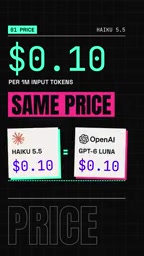
The most eye-catching change is the price. For most requests, Haiku 5.5 costs roughly one-tenth of what Haiku 4.5 did. Specifically, input pricing drops to $0.10 per million tokens — matching OpenAI GPT-6 Luna's pricing.
There's one pricing detail worth noting: only the first 100,000 tokens get the full discount; anything beyond that qualifies for just a half-price reduction. By Anthropic's own estimates, the blended average cost works out to roughly 75% cheaper. This tiered structure means the model is most cost-effective for short-context, high-frequency calls, while the actual savings on very long-context tasks will be somewhat smaller.
Not Just Cheaper: Capabilities Have Improved Dramatically
Price cuts typically come with capability trade-offs, but Haiku 5.5 bucks that trend. Anthropic reports that the model's score on computer use tasks jumped from 16% to 72% — a remarkably large leap.
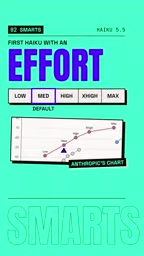
More notably, Haiku 5.5 is the first Haiku model to feature an "effort setting." This control lets users trade off between cost and intelligence — dial it up for higher-quality outputs, or dial it down for speed and lower cost. This adjustable design means a single model can serve vastly different business scenarios without requiring developers to juggle multiple models.
"Computer use" refers to an AI model's ability to directly control a graphical interface — moving a mouse, clicking buttons, taking screenshots, filling out forms — essentially letting the model operate a desktop or browser environment the way a human would. This capability is critical for automating complex workflows, but has historically been a weak point for smaller models because it demands simultaneous visual understanding, spatial reasoning, and multi-step planning. The jump from 16% to 72% means Haiku 5.5 now has genuine deployment-ready computer use ability, rather than being merely a technical proof of concept.
The "effort setting" is essentially a dial controlling the depth of the model's reasoning. Turned up, the model spends more computational steps thinking through a problem (similar to the chain-of-thought mechanism in OpenAI's o-series models), yielding higher quality outputs at the cost of increased latency and expense. Turned down, it takes a fast inference path suited to latency-sensitive, higher-tolerance scenarios. This design lets a single model span two extremes — from quick classification to complex analysis — reducing the overhead of maintaining separate model-calling logic for developers.
Positioned as a "Workhorse" Serving Larger Models
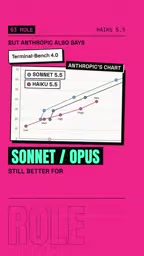
Anthropic positions Haiku 5.5 as the "workhorse" model for Opus and Sonnet, handling high-frequency, relatively standardized tasks like summarization, classification, and sub-agent work.
In other words, its role is closer to an execution layer within a larger model system — offloading heavy-but-not-complex tasks to reduce overall API costs significantly. That said, Anthropic also honestly acknowledges that for enterprise customers, the larger Opus and Sonnet models remain the better choice for complex tasks. This is a candid positioning that avoids misleading users into thinking a small model can fully replace a flagship one.
"Sub-agent" is a core concept in multi-agent architectures. In complex AI applications, a high-capability "orchestrator model" typically handles task decomposition and planning, then delegates specific subtasks to multiple specialized sub-agents for execution. Sub-agents don't need a global view — they only need to complete locally defined, well-scoped work, so their reasoning requirements are far lower than the orchestration layer. Using Haiku 5.5 as a sub-agent means the overall system only calls expensive Opus/Sonnet when truly necessary, while the vast majority of execution-level operations are handled by the much cheaper Haiku — dramatically lowering the total operational cost of complex AI workflows.
Competitive Landscape: Head-to-Head in the Efficiency Arena
Across its recent releases, Anthropic has consistently emphasized efficiency — and efficiency has been one of OpenAI's signature selling points. By matching GPT-6 Luna's input price, Haiku 5.5 signals that the two companies are now competing directly in the small model space.
For developers, this competition is good news: prices are falling, capabilities are rising, and there are more options than ever. Whoever can push further along the "cheap + capable" curve will win over more developers building AI applications.
Perks and Availability
Anthropic is also offering a bonus for Max and Team plan users — starting this week, these subscribers will receive a monthly API credit allowance. For existing subscribers, this is essentially a free resource to experiment with the new model.

Haiku 5.5 is available today on the Claude API and across all three major cloud platforms. The real question worth watching now is whether its real-world production performance can live up to those impressive benchmark numbers.
Related articles

Gemini 4 Argon Hands-On: AI Builds Board Games, Constructs Temples, and Trains Robots Autonomously
Gemini 4 Argon hands-on roundup: AI autonomously builds a desk racetrack and temple in Blender, writes a ray tracing engine, trains a humanoid robot to sink 7 shots, plus API pricing and developer access.

The Magic Octagonal Coin: Why Only 9% of People Can Predict Its Flip?
Only 9% of people can correctly predict the Magic Octagon coin flip. This article explains its spatial rotation mechanism, common cognitive pitfalls, and a new hypothesis based on Relevance Theory, exploring the limits of human spatial reasoning.

Sam Altman: AI Is Entering the Era of Scientific Discovery — Math Breakthroughs Will Replicate in Biology and Energy
Sam Altman says AI is entering the era of scientific discovery — math breakthroughs will replicate in biology, materials science, and energy to help develop new drugs and energy sources.