Claude iOS App Apple Sign-In Glitch: How New Users Can Cope
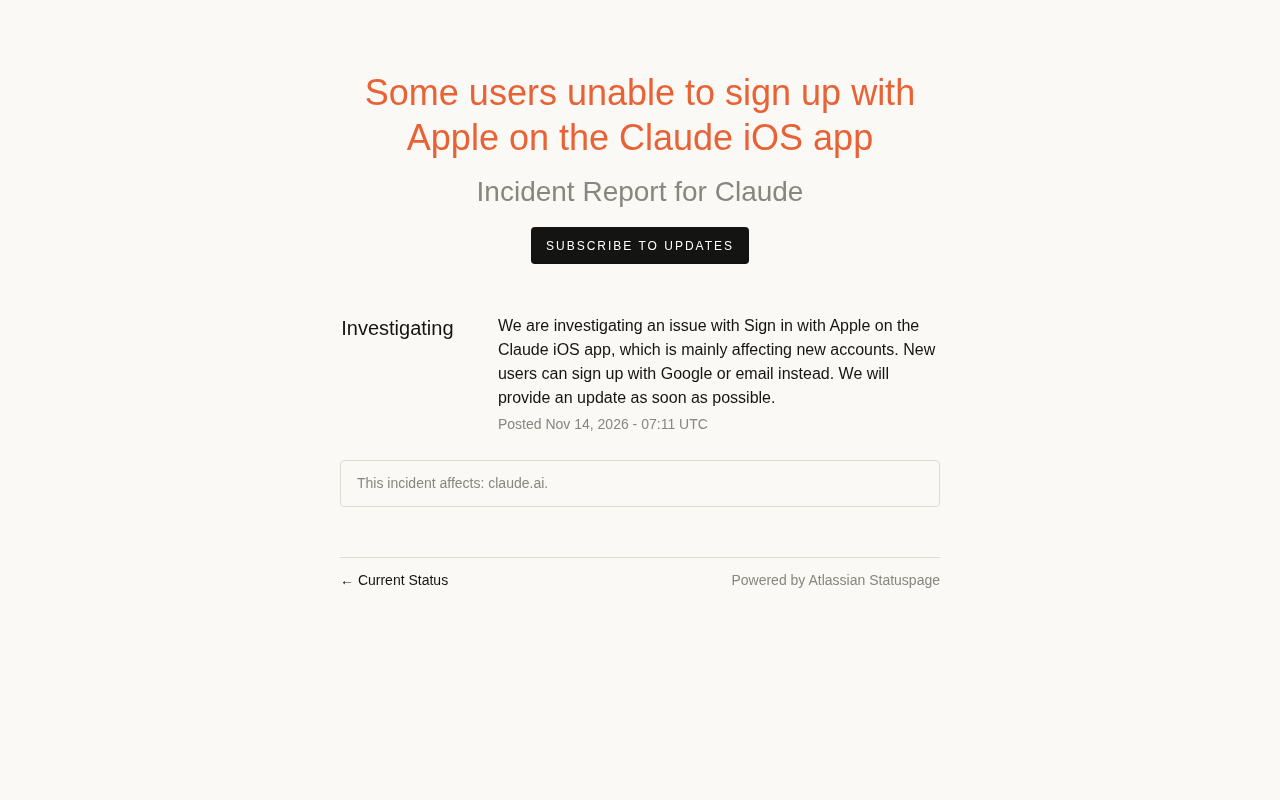
Claude iOS Apple sign-in glitch hits new users; use Google or email instead.
The Claude iOS app's Sign in with Apple feature is malfunctioning, mainly affecting new account registration. The official status page marks it as investigating and recommends affected users register with Google or email. Existing accounts are likely unaffected. The incident highlights the fragility of relying on third-party identity providers: any interface anomaly can block new users and hurt conversion. Officials providing alternatives is a reasonable stopgap, and it underscores the need for redundant login channels and authentication monitoring. No repair timeline has been given.
Title
Claude iOS App Apple Sign-In Glitch: How New Users Can Cope
Meta Description
The Claude iOS app is experiencing an Apple sign-in glitch, mainly affecting new user registration. Officials are investigating and recommend using Google or email sign-up instead. This article analyzes the glitch details, third-party login risks, and impact on users.
Article Content
The Claude iOS app recently experienced an Apple sign-in glitch, primarily affecting new user registration. According to an announcement on the official status page, the development team has launched an investigation and recommends affected users register with Google or email instead. Although this is a technical glitch, it reflects the fragility of relying on third-party login and the stability challenges AI apps face during user growth periods.
Glitch Details: Limited to New iOS Users
According to information posted on the official status page, the issue is concentrated on the "Sign in with Apple" feature of the Claude iOS app and mainly affects new account creation. Whether login for existing accounts is affected is not explicitly stated in the announcement, but it emphasizes that new users can temporarily use Google or email to complete registration.
Officials marked the status as "Investigating" and promised to provide updates as soon as possible. Judging from the wording of the announcement, the glitch is characterized as a localized issue rather than a full-platform service outage. For iOS users who rely on Apple sign-in, this undoubtedly raises the registration barrier, but the availability of alternatives reduces the actual impact.
How Sign in with Apple Works
"Sign in with Apple" is a privacy-friendly authentication framework introduced by Apple starting with iOS 13. Its core mechanism is that the app does not directly access the user's Apple ID credentials; instead, the system pop-up completes authentication and then returns an irreversible user identifier and a one-time authorization code to the app. Users can choose "Hide My Email," in which case Apple generates a one-time forwarding address at @privaterelay.appleid.com, and the app can only communicate with the user through Apple's relay servers.
This mechanism means that the app-side new user registration flow is highly dependent on Apple's authentication servers, token validation interfaces, and public/private key configurations (such as Service ID, Key ID, and Team ID). Any issue in any link—such as certificate expiration, interface changes, or service degradation—could interrupt the registration chain. This is also why such glitches often "only affect new users"—existing accounts usually have local session tokens saved and do not need to go through the full Apple authentication flow again.
The Hidden Costs of Third-Party Login
Apple sign-in is favored by many users for its privacy protection features (such as hiding email), but this glitch exposes the risk of relying on a single login method. When an app relies heavily on an external identity provider, any interface change or service anomaly on either side can block user access.
As an AI assistant, Claude's user growth is directly related to its registration conversion rate. New users who encounter obstacles at the first barrier are likely to churn immediately. Officials quickly providing alternatives is a reasonable measure to limit losses, but it also reminds developers that redundant design for multiple login channels is not optional.
OAuth 2.0 and Identity Provider Dependence
"Sign in with Apple," Google sign-in, and similar methods are all essentially based on the OAuth 2.0 / OpenID Connect protocols. As the relying party, the app delegates authentication to an external identity provider (IdP), exchanges the authorization code, and then the backend exchanges tokens and obtains user information. The advantage of this architecture is that it eliminates password management and reduces credential-stuffing risks, but the cost is handing over part of availability to third parties.
For AI apps, the first step of the registration conversion funnel is authentication. If an IdP experiences regional outages, rate limiting, or API version deprecation, relying parties usually can only wait passively or switch temporarily. Mature engineering practices include configuring multiple IdPs with fallback routing, setting up health checks and alerts for authentication interfaces, retaining backup channels such as email verification codes, and caching logged-in states on the client to reduce real-time dependence on the IdP.
Implications for Existing Users and Developers
For registered users, this glitch is unlikely to affect daily use, but if account binding or device switching is involved, they should still watch for official updates. For developers, this case once again confirms the importance of monitoring and alerting in the authentication process.
Competition among AI apps has extended from model capabilities to every detail of user experience. A single sign-in glitch may seem minor, but it can affect users' overall judgment of product reliability. Officials transparently disclosing the issue and providing alternative paths is a positive example of crisis communication, but the fundamental solution still depends on the speed of technical fixes.
Outlook
Officials have not yet provided a repair timeline. New users planning to register are advised to prioritize Google or email and to follow updates on Claude's official status page. Users accustomed to Apple sign-in can wait until the fix is complete before registering to avoid potential account-linking issues.
This incident also reminds us that as AI tools become increasingly integrated into daily work, service continuity and availability are also core components of product experience.
One-line Summary
Claude iOS app Apple sign-in glitch affects new user registration; officials recommend using Google or email instead.
Paragraph Summary
The "Sign in with Apple" feature of the Claude iOS app is experiencing a glitch that mainly affects new account registration. The official status page marks it as under investigation and recommends affected users complete registration with Google or email. Whether existing accounts are affected is not explicitly stated, but based on the nature of the glitch, they are likely unaffected. The article notes that although this is a localized technical issue, it exposes the fragility of AI apps that rely heavily on third-party identity providers: any interface anomaly on either side can block new users and directly affect registration conversion. Officials quickly providing alternatives is a reasonable loss-control measure and also reminds developers of the importance of redundant login channels and monitoring and alerting in authentication. Officials have not yet provided a repair timeline.
Related articles

Jensen Huang Returns to Nvidia: The Power Game Behind an "Aggro Reset"
Nvidia's board reappointed Jensen Huang as CEO less than two weeks after his scandal-driven resignation. This analysis explores the board's decision-making, Trump's political intervention, media power failure, and market reaction behind the dramatic return.

Why Voice AI Can't Understand Kenyans' Everyday Conversations
Swahili speech recognition hits 3.24% error on read text, but everyday Kenyan speech mixes English, Sheng slang, and accents—leaving mainstream voice AI struggling.

Data Centers Build Their Own Natural Gas Plants: AI Compute's Breakout Around a Decade-Long Grid Wait
Grid interconnection approvals can take a decade, so xAI and others are building off-grid natural gas plants to power AI clusters. This article analyzes the drivers, costs, and impact of behind-the-meter generation on AI infrastructure.