Claude Memory Compiler: An Open-Source Solution for Giving AI Coding Assistants Persistent Memory

claude-memory-compiler builds an evolving memory system for Claude Code, solving AI coding assistant amnesia.
claude-memory-compiler is an open-source project that builds a persistent memory system for Claude Code through a three-layer automated pipeline (Hooks session capture, Claude Agent SDK knowledge extraction, and LLM Compiler structured organization). Inspired by Karpathy's LLM Knowledge Base architecture, it supports incremental updates and cross-references, enabling AI assistants to remember project architectural decisions, coding conventions, and evolutionary history—ideal for team collaboration and long-term project maintenance.
Project Overview: Solving the "Amnesia" Problem of AI Coding Assistants
In the daily practice of AI-assisted programming, there's a problem that frustrates developers: after each conversation ends, the AI assistant completely "forgets" everything. You're forced to repeatedly explain project context, architectural decisions, and coding conventions, significantly reducing efficiency.
The root cause lies in how current large language models work—they are fundamentally stateless. Each session is an independent reasoning process, and the model cannot automatically retain project knowledge gained from previous interactions. While some tools mitigate this through conversation history or system prompts, these solutions are either limited in capacity or require manual maintenance by developers, making them difficult to scale.
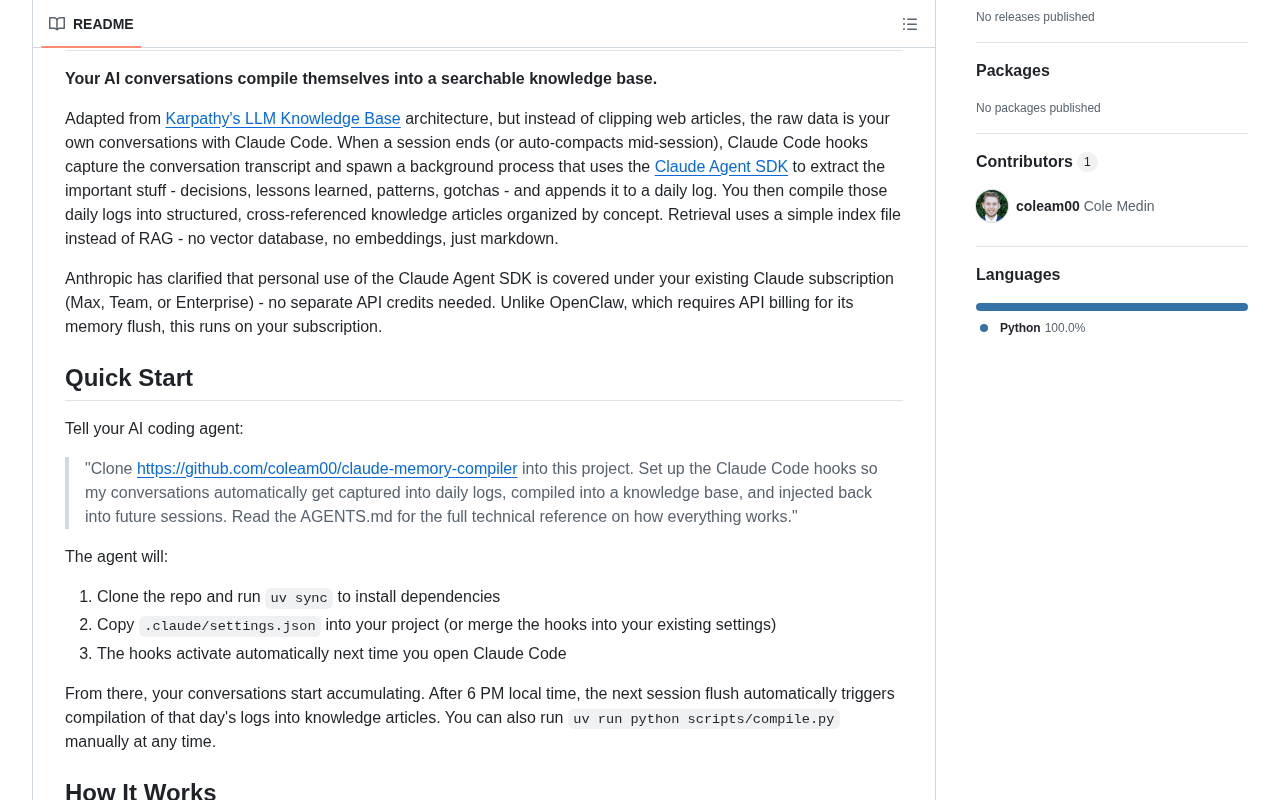
The open-source project claude-memory-compiler on GitHub was created precisely to solve this pain point—it builds a memory system for Claude Code that evolves alongside your codebase, allowing the AI assistant to truly "remember" your project.
Created by developer coleam00, the project quickly garnered nearly 1,000 Stars and 261 Forks after launch, demonstrating the community's urgent demand for AI programming memory management solutions.
Core Design Philosophy
Inspiration: Karpathy's LLM Knowledge Base Architecture
The project's design draws inspiration from the LLM Knowledge Base architecture proposed by Andrej Karpathy. Karpathy is the former Tesla AI Director, one of OpenAI's co-founders, and widely recognized as one of the most influential researchers and educators in the deep learning field. The core idea behind his architectural vision is that large language models' capabilities should not be limited to static knowledge from their training data, but should be dynamically extended through external knowledge bases. This philosophy is closely aligned with RAG (Retrieval-Augmented Generation) technology, but places greater emphasis on structured knowledge organization and continuous evolution rather than simple vector similarity retrieval.
The core concept is straightforward: rather than having LLMs understand a project from scratch each time, build a structured knowledge base that allows AI to continuously accumulate and retrieve project context.
This approach transforms ephemeral conversational memory into persistent, organizable project knowledge, fundamentally changing how human-AI collaborative programming works.
Three-Layer Automated Pipeline Architecture
The project's technical architecture consists of three key layers, forming a complete memory compilation pipeline:
1. Session Capture Layer (Hooks Mechanism)
Automatically captures every Claude Code programming session through the Hooks mechanism. Hooks are an event-driven programming pattern that allows custom logic to be inserted at specific lifecycle points of an operation. In the Git ecosystem, Git Hooks (such as pre-commit and post-commit) are widely used for code quality checks and CI/CD pipeline triggers. Claude Code's Hooks mechanism works similarly—it provides callback interfaces at key points in AI sessions (such as session start, end, code commits, etc.), enabling third-party tools to non-invasively capture interaction data.
Developers don't need to manually record or organize anything—the system silently collects all interaction data in the background, including code changes, Q&A content, and decision-making processes.
2. Knowledge Extraction Layer (Claude Agent SDK)
Leverages the Claude Agent SDK to intelligently analyze captured sessions and automatically extract key decisions and lessons learned. The Claude Agent SDK is a development toolkit provided by Anthropic that allows developers to build autonomous agents based on Claude models. Unlike simple API calls, the Agent SDK supports multi-step reasoning, tool calling, and state management, enabling developers to orchestrate complex AI workflows. In this project, the Agent SDK is used to perform multi-round analysis on unstructured session text, identifying which information has long-term value and which is merely a temporary debugging process.
This layer is responsible for converting unstructured conversation flows into meaningful knowledge fragments.
3. Knowledge Compilation Layer (LLM Compiler)
The most innovative core component is the "LLM Compiler." Traditional compilers transform high-level language source code into machine-executable target code through processes including lexical analysis, syntax analysis, semantic analysis, and code generation. The LLM Compiler borrows this metaphor: it takes scattered knowledge fragments (analogous to source code) and compiles them into structured knowledge articles (analogous to target code) through semantic analysis and relationship building. This process involves deduplication, conflict resolution, hierarchical organization, and cross-reference generation—far more complex than simple text concatenation.
It organizes extracted knowledge fragments into structured, cross-referenced knowledge articles. This isn't simple text concatenation but a genuine knowledge compilation process that ensures information interconnectedness and retrievability.
Technical Implementation Details
The project is developed in Python with a clean architecture that's easy to integrate:
- Automatic Triggering: Through Git hooks or Claude Code's extension mechanisms, the memory compilation process is automatically initiated when a session ends
- Incremental Updates: Rather than rebuilding the entire knowledge base each time, new knowledge is incrementally merged into the existing structure, avoiding redundant computation. This is similar to incremental compilation—only processing changes, dramatically improving efficiency
- Cross-References: Semantic relationships are established between knowledge articles, forming a networked knowledge graph that enables AI to quickly locate relevant context. For example, a knowledge article about "database selection" would automatically link to related articles on "performance optimization strategies" and "data model design"
- Version Evolution: Memory updates as the codebase evolves, with outdated knowledge automatically flagged or archived. This solves the knowledge decay problem—when code is refactored, decision records based on the old architecture won't mislead the AI
Practical Application Scenarios
Team Collaborative Development
When multiple developers use Claude Code to collaboratively develop the same project, the memory system accumulates the team's collective wisdom. When new members join, the AI assistant already "knows" the project's historical decisions and best practices, dramatically shortening onboarding time. This essentially converts tacit knowledge (experience stored in team members' minds) into explicit knowledge (structured, retrievable documentation), addressing the long-standing knowledge transfer challenge in software engineering.
Long-Term Project Maintenance
For projects spanning months or even years, the memory compiler ensures that early architectural decisions and technical selection rationales aren't lost. The AI can provide more accurate recommendations based on a complete understanding of the full context. In actual development, "why was this approach chosen originally" is often more valuable than "what approach was chosen," and these decision rationales are precisely the type of information most easily lost over time.
Project Knowledge Preservation
The compiled knowledge articles themselves serve as valuable project documentation that team members can read directly. This achieves the leap from "AI-assisted programming" to "AI-assisted knowledge management."
Industry Significance and Future Outlook
This project represents an important direction in the evolution of AI programming tools: from stateless Q&A tools toward intelligent collaborative partners with memory and contextual awareness.
Current mainstream AI coding assistants (such as GitHub Copilot, Cursor, etc.) primarily rely on immediate context windows. Although current LLM context windows have expanded from the initial 4K tokens to 128K or even longer, this is still far from sufficient for large codebases. A medium-sized project might contain hundreds of thousands of lines of code and hundreds of historical decisions. Even if context windows were unlimited, cramming all information in at once would lead to attention dilution and degraded reasoning quality. Therefore, how to intelligently select and organize context has become one of the core challenges for AI programming tools.
claude-memory-compiler demonstrates a deeper solution—letting AI truly "understand" a project's complete evolutionary history rather than struggling within limited context windows each time.
As AI programming tools become more widespread, how to manage and leverage the knowledge generated during AI interactions will become an increasingly important topic in software engineering practice. We can foresee that future AI programming environments will be more than just code completion tools—they will be intelligent development platforms with project-level memory, team-level knowledge sharing, and cross-project experience transfer capabilities. claude-memory-compiler provides a noteworthy open-source reference implementation for this direction.
Key Takeaways
- claude-memory-compiler automatically captures programming sessions through Hooks, extracts key decisions using the Claude Agent SDK, and organizes them into structured knowledge articles via the LLM Compiler
- The project is inspired by Karpathy's LLM Knowledge Base architecture, aiming to solve the "amnesia" problem of AI coding assistants
- The system supports incremental updates and cross-references, with memory evolving alongside the codebase rather than being statically stored
- The project earned nearly 1,000 Stars and 261 Forks after launch, reflecting strong community demand for AI programming memory management
- It represents an important direction in AI programming tools evolving from stateless Q&A toward intelligent collaborative partners with memory
Related articles
 Tech Frontiers
A Rare Quiet Day in AI: Recursive Self-Improvement Stirs Beneath the Surface
A rare quiet day in AI sees multiple sources go silent simultaneously. Behind the calm, Recursive Self-Improvement (RSI) research continues. What this means for the industry.
 Tech Frontiers
Reve 2 vs. Ideogram 4: A Deep Dive into Layout Control in AI Image Generation
A deep comparison of Reve 2 and Ideogram 4's layout control capabilities, covering technical approaches, real-world use cases, and industry trends for designers and creators.
 Tech Frontiers
In the Weights: Check Your Influence Score in the AI World
In the Weights is an AI influence search engine that quantifies your presence in the AI world with a score. Explore how it evaluates practitioners and what it means for digital identity.