Claude Mods: Flipping the Agent Harness to Make AI Tools Truly Human-Oriented

Claude Mods flips the Agent Harness to serve humans rather than machines.
The article introduces Claude Mods, an early form of the Attention Interface that flips the Agent Harness from machine-oriented to human-oriented. Traditional Harnesses handle tool calling and execution feedback; Claude Mods emphasizes modifiability, observability, and intervenability, letting humans adjust rules, observe decisions, and intervene during execution—lowering the barrier to AI control and reducing reliance on prompt engineering.
Introduction: When the Harness Starts Facing Humans
In AI Agent development, the Harness (toolbelt/execution framework) has always been seen as the bridge connecting models to the machine environment. But the emergence of Claude Mods proposes a subversive perspective: it flips the Harness from "machine-oriented" to "human-oriented." This flip is not a simple interface adjustment, but a rethinking of the Agent interaction paradigm.
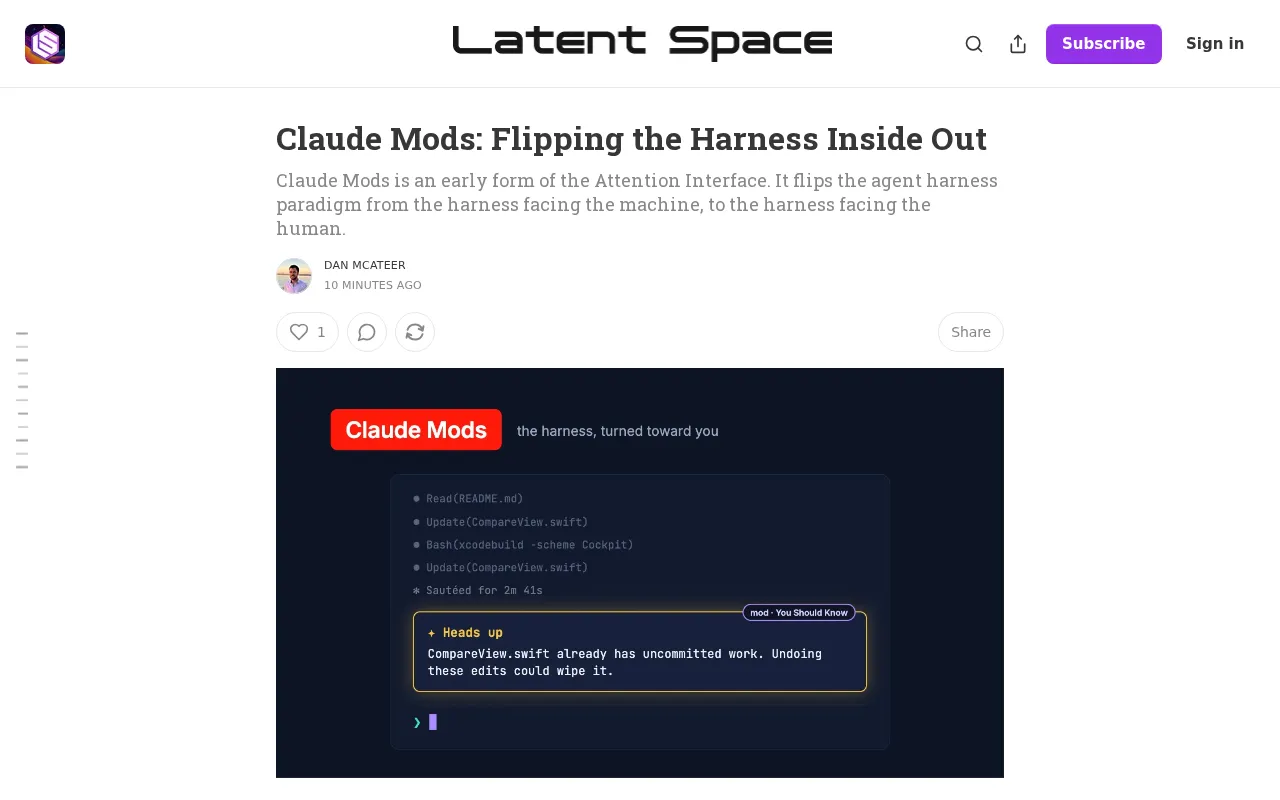
Harness (execution framework/toolbelt) in the AI Agent context refers to the software layer wrapping the language model, responsible for translating the model's abstract intentions into concrete operations on tools, APIs, command lines, and file systems. It typically includes components such as tool descriptions and registration, parameter validation, execution sandboxing, error handling, and result feedback. It can be compared to the system call layer between an operating system and applications: the model itself only generates text, and it is the Harness that actually "takes action." Precisely because the Harness bears the responsibility of converting intentions into actions, its design orientation—whether to prioritize the reliability of machine execution or the human understanding and intervention—directly determines the controllability and transparency of the Agent. This is also the premise that makes the notion of "flipping the Harness" tenable.
What Is Claude Mods?
Claude Mods is an early form of the Attention Interface. Its core design philosophy comes from a simple observation: traditional Agent Harnesses focus on how to make models call tools, execute commands, and complete tasks, but rarely consider how humans can intervene in, customize, and extend this process. Claude Mods shifts the focus to the human side, making the Harness an interface for humans to express intentions and adjust behavior.
This approach resonates with the current direction of AI programming tools. When developers use AI to generate code, what they need is not just autocompletion, but an interaction method that understands context, allows fine-tuning, and preserves human control.
Flipping the Harness: From Machine-Oriented to Human-Oriented
The design logic of traditional Harnesses is to "let the model better operate the machine": providing tool descriptions, parameter validation, and execution feedback. The flip represented by Claude Mods means the Harness's primary service target becomes the human user.
Specifically, this flip is reflected at three levels:
- Modifiability: Humans can directly adjust the Harness's behavior rules without modifying the model itself.
- Observability: The Harness shows its decision-making process to humans, rather than only outputting results.
- Intervenability: During Agent execution, humans can insert instructions or correct direction at any time.
This design approach is in line with the "hackable, customizable" culture of the open-source tool community, but applies it at the Agent framework level.
Prompt Engineering refers to the practice of carefully constructing input text to guide models toward desired outputs. Its limitation is that all control signals are squeezed into the single channel of natural language, making it difficult to precisely express structured intentions, and requiring repeated description at every interaction, with high debugging costs and unstable results. The human-oriented Harness is exactly an alternative approach proposed to address this pain point—shifting control from "writing better prompts" to "adjusting framework behavior and interface parameters." Modifiability corresponds to editing rules rather than text, observability corresponds to presenting process rather than results, and intervenability corresponds to real-time feedback at runtime. Together, the three constitute a migration from "language-level control" to "framework-level control."
An Early Form of the Attention Interface
Claude Mods is described as an early form of the Attention Interface. The concept of the attention interface points to a more natural way of interaction: humans guide the model's attention allocation through the interface, rather than through complex prompt engineering.
The significance of this direction lies in lowering the threshold for humans to control AI. When the Harness is human-oriented, users do not need to understand the underlying tool-calling protocols; they only need to express intentions through the interface. This is consistent with the trend in the AI application field of pursuing "natural interaction," and also provides new ideas for the design of AI programming tools.
In the Attention Interface, "attention" can refer both to the attention allocation mechanism within the model and metaphorically to the guidance of human attention. In the Transformer architecture, attention weights determine which tokens the model focuses on when processing input; the idea of the attention interface is to let humans directly or indirectly influence this distribution of focus through the interface—for example, highlighting key context, specifying reference ranges, or circling objects that need focused processing. Compared to repeatedly describing "please focus on a certain passage" in prompts, interface-based attention guidance is more intuitive, more reusable, and closer to the natural human collaborative action of "pointing over there." It is therefore seen as a possible alternative or supplement to prompt engineering.
Potential Impact on the Agent Ecosystem
The flip approach of Claude Mods may affect multiple aspects of the Agent ecosystem. For developers, a human-oriented Harness means easier debugging and customization of Agent behavior. For end users, it means a more transparent AI execution process and a stronger sense of control.
Of course, this concept is still at an early stage. The original article does not provide specific implementation details or performance data, so its actual effectiveness remains to be verified. But the very notion of "flipping the Harness" provides a direction worth watching for Agent framework design.
Conclusion
The value of Claude Mods lies not in what it has already achieved, but in the key question it raises: should the Agent's Harness serve the machine, or serve humans? When this question is flipped, the design space for AI tools also opens up.
One-line Summary
Claude Mods flips the service target of the Agent Harness, making the framework human-oriented rather than machine-oriented.
Paragraph Summary
The article introduces the concept of Claude Mods, regarded as an early form of the Attention Interface, whose core proposition is to flip the Agent Harness from "machine-oriented" to "human-oriented." Traditional Harnesses focus on tool calling, parameter validation, and execution feedback, serving the model's operations on machines; Claude Mods emphasizes three levels—modifiability, observability, and intervenability—allowing humans to directly adjust framework rules, observe decision-making processes, and intervene at any time during execution. This approach lowers the threshold for humans to control AI, reduces reliance on complex prompt engineering, and echoes the trend of AI programming tools pursuing natural interaction. The article also notes that the concept is still at an early stage and lacks implementation details and performance data, but the question it raises opens up new thinking space for Agent framework design.
Related articles

Will GitHub Die? Open Source Maintainer Burnout and the Collaboration Crisis in the AI Era
Lex Fridman podcast discussion on open source maintainer burnout and GitHub's predicament: massive pull requests overwhelm core maintainers, and AI worsens code bloat. Using math journal peer review and Poincaré conjecture verification as analogies, the article analyzes why verification in knowledge production must be deliberately slow, and how open source communities can avoid the failure mode of maintainers exiting.

Stop Building Cookie-Cutter AI Websites: 3 Tools That Transform Your Coding Agent
Three tools that boost AI coding agents: FFmpeg skill for local video editing in Claude Code and Cursor, Hallmark's 50 design themes to fix cookie-cutter AI sites, and Jailbreaks' 25+ model prompts.

How America's Gerontocracy Squeezes the Younger Generation
Americans over 55 hold nearly three-quarters of national wealth, alongside an 80-year-old president and elderly congressional leaders. The Atlantic's Idrees Kahloon explains how gerontocracy drives up housing costs, squeezes opportunities for the young, and explores zoning reform and child poverty reduction as practical fixes.