Claude Multi-Model Error Rates Spike, Anthropic Identifies Root Cause
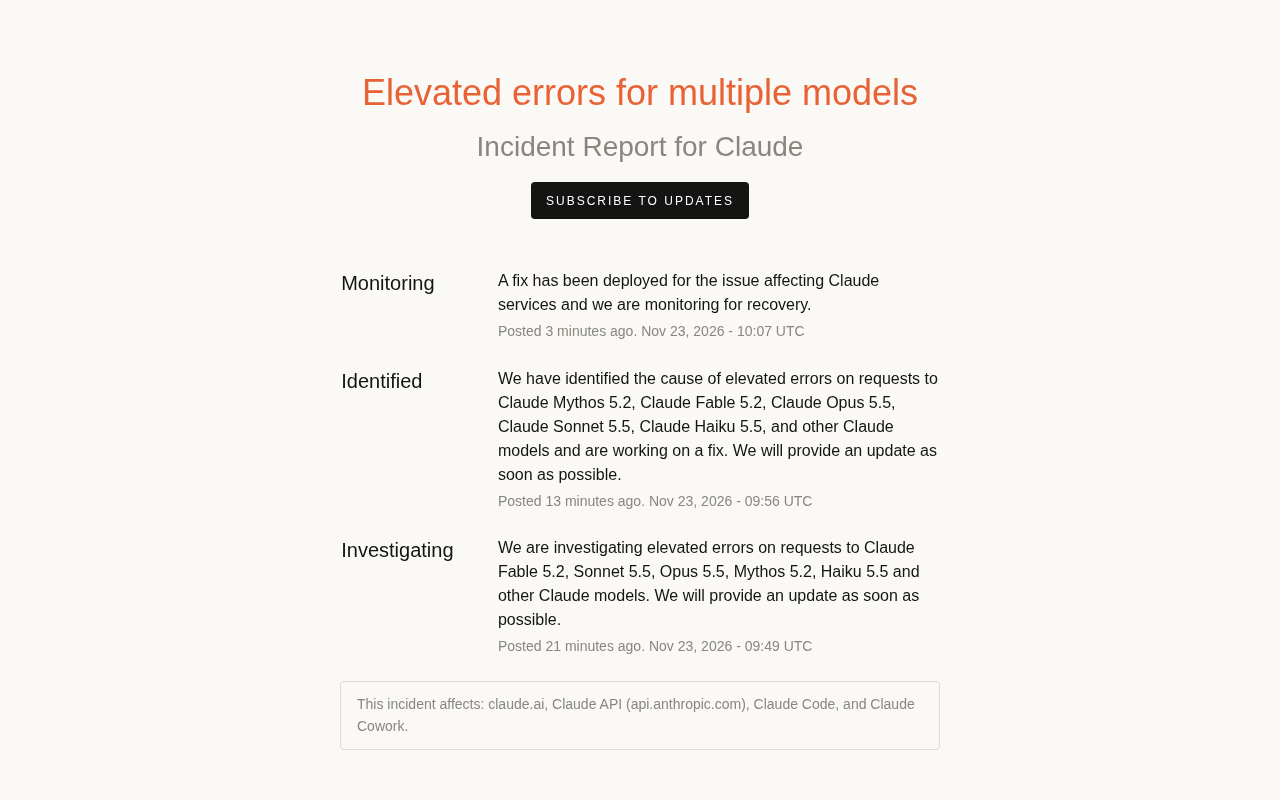
Claude multi-model error rates spiked; Anthropic identified the cause within seven minutes but service is not yet restored.
Anthropic's status page reports elevated request error rates across Claude Mythos 5.2, Fable 5.2, Opus 5.5, Sonnet 5.5, Haiku 5.5, and other models. The status moved from Investigating at 09:49 UTC to Identified at 09:56 UTC—root cause located in about seven minutes—but recovery is unconfirmed, leaving a risk window. The scope spans multiple product lines, suggesting a shared infrastructure or request scheduling issue rather than a single model deployment. The article recommends exponential backoff with jitter, multi-level fallbacks from in-model retries to cross-provider backup, async queues for non-real-time tasks, and integrating the official status page into alerting.
Incident Overview
According to information disclosed on the status page, multiple Claude models under Anthropic are experiencing an abnormal increase in request error rates, affecting Claude Mythos 5.2, Claude Fable 5.2, Claude Opus 5.5, Claude Sonnet 5.5, Claude Haiku 5.5, and other Claude models. The company issued two consecutive status updates in a short period, progressing from "Investigating" to "Identified," indicating the issue has entered the remediation phase.
Status page updates like this typically mean the scope of impact has been clarified but service has not yet fully recovered. For developers and enterprise users who rely on the Claude API to build products, request failures, timeouts, and abnormal responses will increase in frequency during this window, so fallback and retry strategies should be prepared in advance.
What "Investigating" and "Identified" Mean on a Status Page
Major cloud service and API providers (such as AWS, Cloudflare, OpenAI, and Anthropic) maintain public status pages that use a standardized set of status terms to describe the incident lifecycle. Common statuses include: Investigating (alerts received, diagnosis underway), Identified (root cause located, fix in progress), Monitoring (fix deployed, under observation), and Resolved (recovery confirmed). The value of this terminology lies in providing a predictable severity signal: only after entering Monitoring does it typically mean the service has largely recovered and entered an observation period; while stuck at Identified, the incident is often still ongoing. Therefore, developers should not treat "root cause identified" as a recovery signal, but rather use Resolved or Monitoring as the reference point for lifting fallbacks.
Incident Timeline and Official Response
Based on public information, the official timeline was fairly tight:
- At 09:49 UTC, the status page was marked "Investigating," confirming an investigation into elevated request error rates across multiple Claude models.
- At 09:56 UTC, the status was upgraded to "Identified," indicating the cause of the errors had been found and remediation was underway.
Only about seven minutes separated the two updates, suggesting the monitoring alert and fault diagnosis process responded quickly. However, "root cause identified" does not equal "service restored," and the company explicitly stated it would continue to update as progress is made. For production workloads, this phase remains a risk window.
Which Models Are Affected
The scope of impact is not limited to a single model but spans multiple product lines:
- Claude Mythos 5.2
- Claude Fable 5.2
- Claude Opus 5.5
- Claude Sonnet 5.5
- Claude Haiku 5.5
- and other Claude models
The company summarized the remaining affected scope with "and other Claude models," implying this may not be an isolated issue with a specific model deployment but rather closer to an anomaly at the shared infrastructure or request scheduling layer. Of course, the company has not yet disclosed the specific root cause, and any inference about underlying causes should be treated as reference only.
Why Shared Infrastructure Failures Span Multiple Models
Large model services typically do not deploy a completely isolated set of physical resources for each model. Instead, they route requests to different model instances through a unified inference cluster, API gateway, authentication and billing layer, and request scheduler. This architecture improves resource utilization and elasticity, but it also means that once a common component—gateway, scheduler, authentication, rate limiting—fails, all models passing through that path are affected simultaneously, manifesting as "multiple models showing elevated error rates at the same time." Conversely, if a failure affects only a single model, it more likely points to a deployment or weight-loading issue specific to that model. Therefore, the fact that the affected scope spans multiple product lines is itself an important clue for judging the level at which the fault occurred.
Practical Impact on Developers
Simultaneous elevated error rates across multiple models directly impact several typical scenarios:
API call chains. Clients with inadequate retry mechanisms will see concentrated request failures, and overly aggressive retry policies may further exacerbate server-side pressure. It is recommended to use exponential backoff with random jitter to control retry pacing during the incident window.
Multi-model routing architectures. Many teams dynamically route between Sonnet, Haiku, and Opus based on cost or task type. When multiple models are affected simultaneously, a simple "switch to a backup model" strategy may fail, and cross-provider fallback plans are needed.
Products dependent on real-time inference. Customer service bots, code assistants, content generation, and similar scenarios are sensitive to latency and success rates. During incidents, user experience degrades noticeably, and the product side should ideally provide clear degradation notices rather than leaving users facing unresponsive requests or errors.
Exponential Backoff and Random Jitter
Exponential backoff means retry intervals grow by a multiplier (e.g., 1s, 2s, 4s, 8s, usually with a cap), preventing clients from hammering a stressed server with high-frequency retries—a "retry storm." Random jitter adds a random amount to each backoff interval, preventing large numbers of clients from retrying in unison due to identical backoff rhythms and creating periodic spikes. A common approach is "full jitter," taking a random value between 0 and the current backoff cap. Combined, the two spread retry traffic across the incident window and significantly reduce additional pressure on an already impaired service.
Recommended Actions
Based on this incident, several fairly general practices can be outlined:
- Subscribe to official status page updates and incorporate the status page into your alerting system rather than relying solely on your own monitoring to detect anomalies.
- Design multi-level fallbacks for critical paths: in-model retries, same-provider backup models, and cross-provider fallback, triggered in stages.
- Record request failure rates and error types during the incident window for post-incident evaluation of whether retry parameters and timeout settings are appropriate.
- Use asynchronous queues for non-real-time tasks, deferring requests that accumulate during the incident to avoid synchronous blocking that drags down upstream services.
Summary
In this incident of elevated error rates across multiple Claude models, the company took a relatively short time to move from investigation to root cause identification, but service recovery has not yet been confirmed. It once again reminds teams relying on large model APIs: improvements in model capability do not automatically bring availability guarantees, and resilient design and failure drills remain fundamental practices for production environments. Further developments should continue to be based on official status page updates.
Related articles

Nothing CMF Buds 2A Drops to $17.89 on Black Friday: A New Low for ANC Earbuds
Nothing CMF Buds 2A wireless earbuds Black Friday deal: just $17.89 on Amazon, about $11 off retail and a record low. ANC earbuds at an entry-level price.

When AI Creation Gets Accused of "Spitting": Hacker News Heats Up Over the Glaude Controversy
A Hacker News post, "Spitting in the Face of Glaude," sparks debate on AI creation transparency and attribution ethics. This analysis examines the blurred creator identity behind the controversy and offers practical advice for AI content production.

Akai Embraces Custom Firmware: MPC Sample 1.4 Lets Users AI-Program Their Sampler
Akai embraces the modding community with MPC Sample 1.4 firmware, supporting vibe-coded custom firmware and effects. We analyze the impact of this open strategy on music hardware and AI-assisted programming.