Claude Opus 4 Hit by Bugs on Launch Day, Anthropic Issues Fix in Under 24 Hours

Claude Opus 4's launch-day bugs fixed by Anthropic in under 24 hours
Anthropic confirmed that Claude Opus 4 experienced numerous bugs on its launch day, affecting many early users' experiences. The team completed fixes in under 24 hours and proactively apologized. The article notes that LLM deployment involves complex subsystems including inference clusters and load balancing, where edge cases under real traffic are nearly impossible to fully simulate in testing. "Ship and iterate" has become industry standard, with rapid response and transparent communication being what truly matters.
Incident Overview
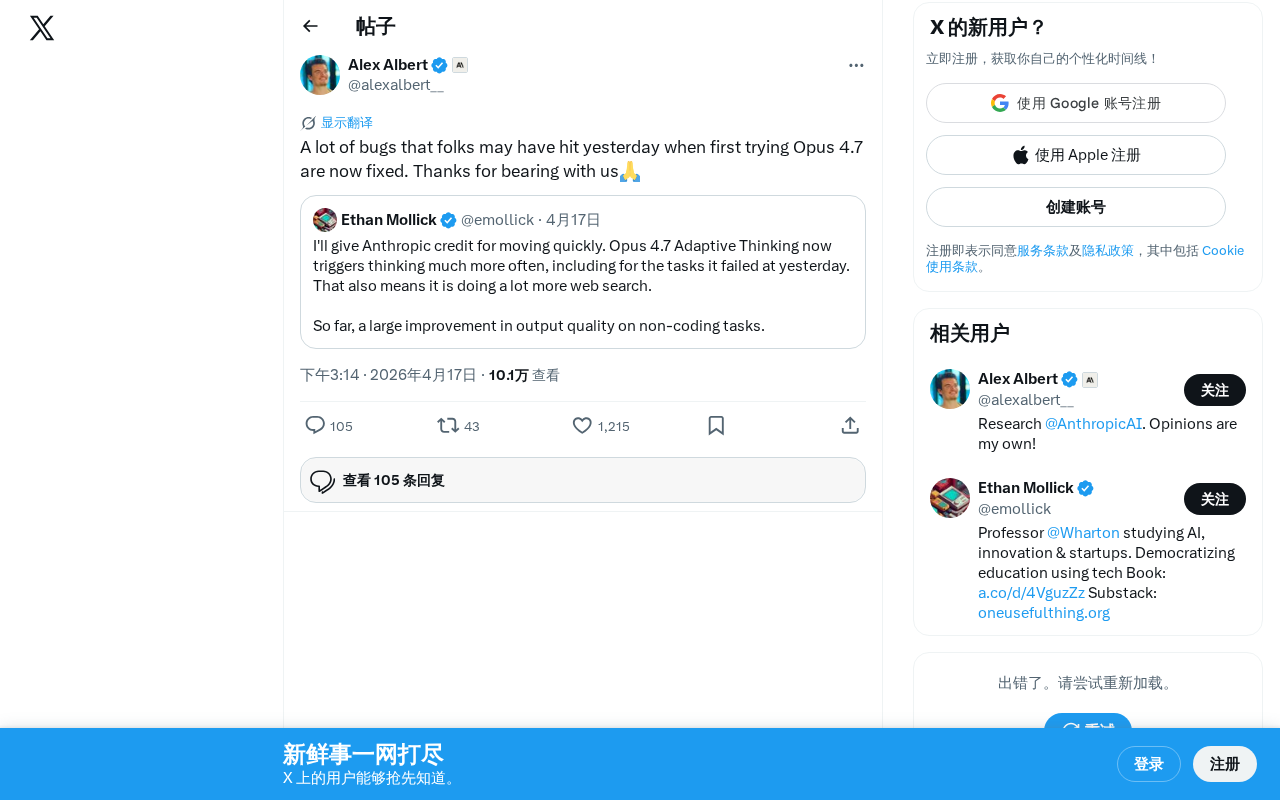
The Anthropic team posted an announcement on social media confirming that Claude Opus 4 experienced numerous bugs on its launch day, which have now been resolved. Behind this brief tweet lies a reflection of the engineering challenges faced during major model releases.
What Problems Did Claude Opus 4 Encounter on Day One
According to Anthropic's official statement, many users encountered various issues when first trying Claude Opus 4 yesterday. While the company didn't disclose specific bug types in detail, the phrasing "a lot of bugs" suggests the problems were wide-ranging, affecting a significant number of early users' experiences.
This situation isn't uncommon in large model product launches. Production deployment of large language models is far more complex than traditional software — a modern LLM service must coordinate inference clusters (typically consisting of thousands of GPUs), load balancing layers, context caching systems, safety filtering pipelines, and API gateways among multiple subsystems. Top-tier models like Claude Opus 4 likely have hundreds of billions of parameters, requiring tensor parallel computation across multiple servers for a single inference call, meaning any configuration deviation in any component can trigger cascading failures.
When a new version is opened to a large-scale user base, the diversity of real user inputs follows a long-tail distribution — including multilingual mixed inputs, ultra-long contexts, special character encodings, concurrent API calls, and other scenarios. These edge cases are extremely difficult to fully simulate in controlled testing environments and often only surface under real traffic load. This is why the industry widely adopts "Canary Release" strategies, gradually expanding traffic percentages to reduce risk.
Anthropic's Rapid Fix Demonstrates Engineering Prowess
Fix Completed in Under 24 Hours
Looking at the timeline, the Anthropic team completed the major bug fixes in under 24 hours. This rapid response capability is enabled by the comprehensive observability systems that top AI companies typically establish, including real-time error rate monitoring, P99 latency tracking, user feedback aggregation analysis, and other toolchains. Being able to complete fixes and deploy them in such a short timeframe relies on mature CI/CD pipelines and hot deployment capabilities — no model retraining is needed, just fixing code at the inference service or API layer and deploying quickly, which aligns closely with modern DevOps engineering practices. This is specifically reflected in:
- Comprehensive monitoring systems: Enabling rapid identification and localization of user-facing issues
- Efficient engineering team: Completing fixes and deploying to production in a short timeframe
- Transparent communication: Proactively apologizing to users and informing them of fix progress
Impact on Early Users
For users who jumped in on day one, the initial experience may have been disappointing. However, the Anthropic team expressed gratitude for users' patience with "Thanks for bearing with us" — this kind of candor deserves recognition in the AI industry.
An Industry-Wide Challenge for AI Model Releases
Release strategies for major model version iterations have long been an industry challenge. On one hand, users want to experience new capabilities as soon as possible; on the other hand, thorough testing takes time. How to strike the right balance between speed and stability is a challenge every AI company is navigating.
In fact, there are multiple precedents of major models encountering issues at launch: GPT-4 experienced context truncation anomalies in its early release, Google Gemini Ultra's launch demo sparked controversy and exposed capability boundary issues, and Meta's Llama series open-source versions suffered performance degradation due to quantization configuration errors. These cases collectively demonstrate that in the fiercely competitive AI arms race, the "Ship and Iterate" strategy has become industry standard — the importance of market timing sometimes outweighs perfectionist engineering standards. From OpenAI to Google to Anthropic, virtually every company has encountered similar day-one issues during major releases. What matters is whether the team can respond quickly, communicate transparently, and accumulate experience to improve future release processes.
Now Is a Good Time to Try Claude Opus 4
For users wanting to experience Claude Opus 4, now should be a better time. The day-one bugs have been fixed, and the model's actual performance can be evaluated in a more stable environment. Users are advised to follow subsequent performance benchmarks and community feedback to gain a comprehensive understanding of this new version's capability improvements.
Key Takeaways
- Claude Opus 4 experienced numerous bugs on launch day, affecting many early users
- The Anthropic team completed major fixes in under 24 hours
- The company proactively apologized on social media and communicated fix progress
- Balancing stability and speed during large model product launches remains a shared industry challenge
Related articles
 Tech Frontiers
A Rare Quiet Day in AI: Recursive Self-Improvement Stirs Beneath the Surface
A rare quiet day in AI sees multiple sources go silent simultaneously. Behind the calm, Recursive Self-Improvement (RSI) research continues. What this means for the industry.
 Tech Frontiers
Reve 2 vs. Ideogram 4: A Deep Dive into Layout Control in AI Image Generation
A deep comparison of Reve 2 and Ideogram 4's layout control capabilities, covering technical approaches, real-world use cases, and industry trends for designers and creators.
 Tech Frontiers
In the Weights: Check Your Influence Score in the AI World
In the Weights is an AI influence search engine that quantifies your presence in the AI world with a score. Explore how it evaluates practitioners and what it means for digital identity.