Claude Opus 5.5, GPT-6 Sol/Luna Launch Same Night: AI Enters the Tiered Model Era

Anthropic and OpenAI both launch new tiered models, shifting competition from flagship power to intelligence cost-per-unit.
In a single night, Anthropic released Claude Opus 5.5 and OpenAI unveiled GPT-6 Sol and Luna — all three models pointing to the same strategy: packing last-generation flagship capabilities into cheaper, faster packages. Opus 5.5 is priced at $4/million input tokens (roughly 40% cheaper than its predecessor), targeting high-frequency development tasks. Sol optimizes for execution speed and factual reliability at some aesthetic cost, while Luna targets massive batch automation at extreme scale. Both companies have shifted the competitive battleground from "whose flagship is stronger" to "who delivers more intelligence per dollar," giving rise to a practical tiering strategy: top tier for planning, mid-tier for daily work, budget tier for bulk tasks.
In a single night, OpenAI and Anthropic took the stage together again. Claude Opus 5.5, GPT-6 Sol, and Luna all made their debuts in quick succession. But the real story this round isn't about "who's the strongest" — it's about both companies doing the exact same thing at the exact same time: driving down the cost of intelligence and reshuffling their product tiers.
As analyzed by Bilibili creator "开水庆余年," rather than running the most expensive flagship model around the clock for everyday tasks, the smarter approach is to layer by need: reserve the top tier for complex planning, handle day-to-day work with mid-tier models, and route bulk background tasks to the cheapest option. This framework is quickly becoming the new paradigm for AI application development.
Opus 5.5: From Flagship Overkill to Value Workhorse
Claude Opus 5.5 is positioned as the value-for-money powerhouse within the Claude 5.5 series. API pricing sits at $4 per million input tokens and $20 per million output tokens. Compared to the previous Opus 5, typical usage costs drop by roughly 40%, while output speed improves by more than 30%.
For non-large-scale tasks, Opus 5.5 can match the performance of the tier above it. On the coding side, it reportedly scores around 66.4 on Terminal Bench — a notably competitive result.
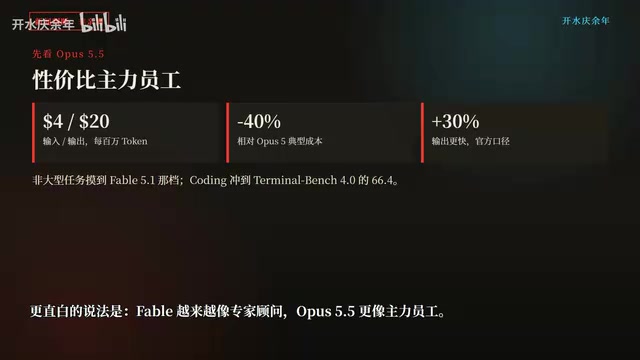
The positioning is straightforward: flagship models are increasingly like "expert consultants" — called in only at critical junctures — while Opus 5.5 acts more like a "core employee," handling high-frequency work like feature development, debugging, and code review. You only need to switch back to the flagship when the value of the output far exceeds the token cost, when the task requires extended unsupervised runs, or when the mid-tier model keeps failing.
Terminal Bench is a benchmark specifically designed to evaluate LLMs on real-world programming tasks in terminal environments, covering code generation, debugging, command-line operations, and multi-step engineering workflows. Unlike MATH (which focuses on mathematical reasoning) or MMLU (which emphasizes knowledge Q&A), Terminal Bench more closely mirrors a software engineer's actual workflow — making its scores particularly relevant for developers. A score of 66.4 sits at the edge of the top tier on this leaderboard, suggesting Opus 5.5 is capable of handling moderately complex engineering tasks at near-flagship performance levels.
The asymmetric pricing of $4 input / $20 output reflects the actual computational cost of model inference — generating tokens is significantly more compute-intensive than processing input tokens. For tasks with low output volume, such as code completion or short Q&A, the effective blended cost will be substantially lower than for long-form generation. Developers estimating monthly budgets should calculate costs separately by task type.
GPT-6 Sol and Luna: Capability Trickles Down, Costs Cut in Half
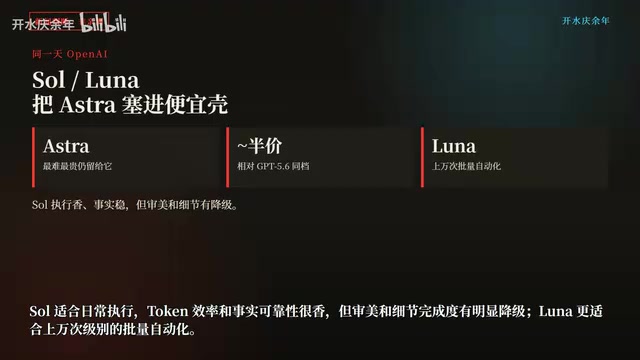
On the same day, OpenAI unveiled GPT-6 Sol and Luna. Within OpenAI's product lineup, the top flagship tier remains the most capable and most expensive, built for extreme-end performance.
Sol and Luna take a different approach: they pack this generation's flagship-level capabilities into faster, cheaper packages. Pricing for both is roughly half that of the equivalent previous-generation models.
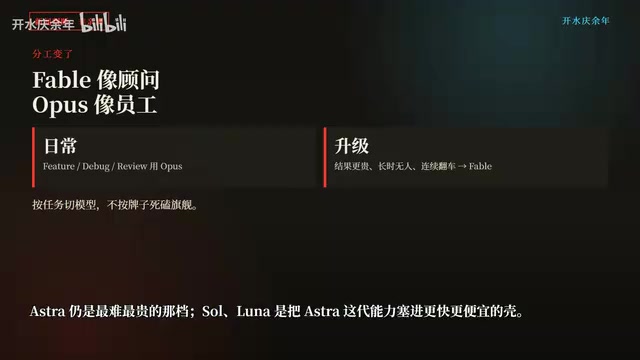
Sol is well-suited for everyday execution tasks — it excels at token efficiency and factual reliability, making it a reliable workhorse. The trade-off, however, is a noticeable step down in aesthetic output quality and fine-grained detail. In short, Sol is optimized for "getting things right, fast, and cheap" — not for "making things beautiful."
Luna goes even further down the cost curve, targeting massive batch automation at the tens-of-thousands-of-calls scale. When you need to run enormous volumes of repetitive tasks where single-call quality isn't critical, Luna's cost advantage becomes exponentially more valuable.
One important caveat: don't cut corners on complex planning tasks. Those should still go to OpenAI's top-tier or Pro models. The point of tiering isn't to always go cheap — it's to make every unit of compute count.
Sol's "step down in aesthetic quality and fine-grained detail" manifests in areas like flat creative writing style, sparse code comments, and reduced sensitivity to nuanced context in multi-turn conversations. These capabilities typically depend on model parameter scale and high-quality example density in training data — and are usually the first to be sacrificed during model compression. For use cases producing end-user-facing content (marketing copy, product descriptions), using Sol directly may require additional human editing, potentially offsetting the cost savings.
Luna's target of "tens-of-thousands-scale batch automation" is typically executed via asynchronous batch processing APIs, trading longer response times for lower unit costs. Typical use cases include: structured information extraction from large datasets, bulk product description generation, and automated test case generation. These tasks share a common profile — low per-call value, latency-insensitive, extremely high total call volume — and it's precisely under these conditions that Luna's cost advantage is fully realized.
The Bigger Picture: The Intelligence Cost-Per-Unit War
Looking at both companies' moves together, a clear signal emerges: the core of this competitive round has shifted from "build a stronger flagship" to "restructure tiers and drive down the unit cost of intelligence."
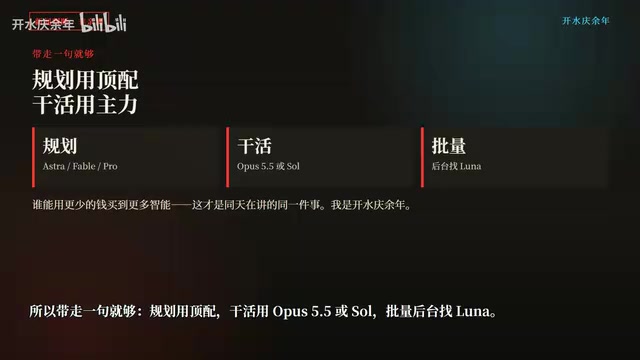
Who can let users buy more intelligence for less money — that's the shared message OpenAI and Anthropic chose to send on the same day. For developers and enterprises, this means model selection is becoming a discipline of careful cost engineering.
Practical Model Selection Guide
Based on all of the above, here's a task-based framework for allocating models:
- Complex planning and architecture design: Use the top-tier flagship (Claude top tier / GPT-6 flagship or Pro). Don't sacrifice quality on critical decisions just to save money.
- Day-to-day development work: Opus 5.5 or GPT-6 Sol — balancing capability and cost for high-frequency tasks like feature work, debugging, and code review.
- Large-scale batch automation: Cheaper models like Luna, suited for tens-of-thousands-scale repetitive tasks.
This "top tier for planning, mid-tier for execution, budget tier for batch" combination is becoming the go-to strategy for controlling AI usage costs. As capability gaps between tiers narrow while price gaps widen, rational tiering is far more cost-effective than "running the most expensive model all the time."
"Cost per unit of capability" is becoming the core metric for evaluating AI models at the application layer — analogous to the "cost per compute unit" competition of the cloud computing era. As the capability gap between flagship models narrows due to industry-wide progress, the slope of the pricing curve determines who wins in enterprise procurement decisions. OpenAI and Anthropic adopting nearly simultaneous tiered pricing strategies also creates a price anchoring effect — users will now benchmark against mid-tier pricing and reassess whether the flagship tier is truly "worth it." This competitive pressure will continue to drive down inference costs across the market, with far-reaching implications for the commercial viability of large-scale AI applications.
Related articles

iPhone Duo Battery Life Tested: One Charge a Day Is Unavoidable, and the Large Screen Is the Culprit
iPhone Duo battery test: heavy use needs at least one charge a day, and about 30% remains after 6.5 hours of screen-on time. How often the large screen is unfolded is key; a MagSafe battery pack helps, and long-term degradation is also worth watching.

Kimi K3.1 Pro Open-Sourced: 2.8 Trillion Parameters Close In on Opus
Moonshot releases the open-source MoE model Kimi K3.1 Pro, with 2.8T total parameters and 104B activated, trailing Opus 5.5 by under 1 point on Terminal Bench 4.0.

Costco Tech Price Guessing: Are Monitors, Keyboards, Mice, and Bose Speakers Worth It?
A YouTube blogger guesses prices of Costco tech products: 2K 180Hz monitor, Logitech keyboard and mouse, Bose speaker, and CyberPower UPS, revealing warehouse-store selection and brand premium.