Claude Opus 5.5 Lands on Perplexity Computer: Better Performance, Lower Cost

Claude Opus 5.5 becomes Perplexity Computer's standard tier with a 67.6% per-task cost drop.
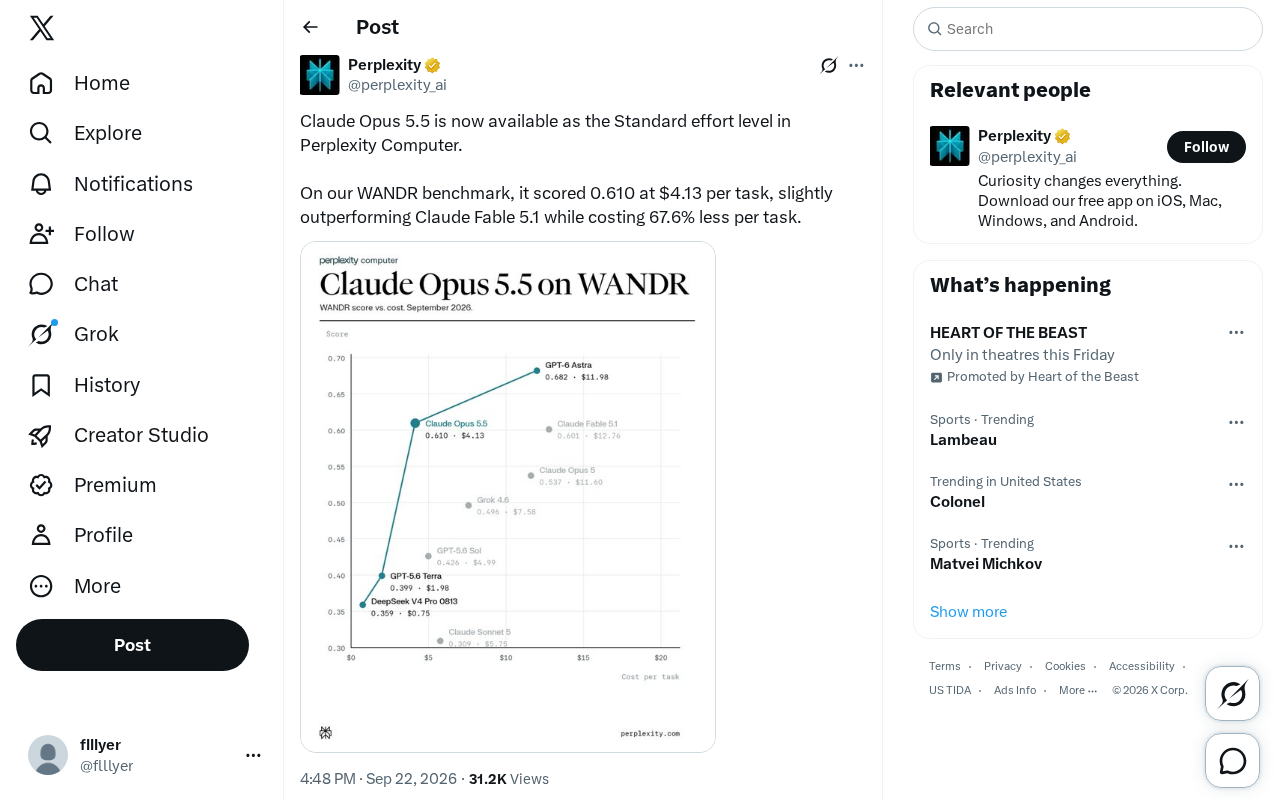
Perplexity has set Claude Opus 5.5 as the Standard effort level for its AI agent product, Perplexity Computer. According to Perplexity's internal WANDR benchmark, the model scores 0.610 at $4.13 per task — a slight performance improvement over the previous Claude Fable 5.1, but with a dramatic 67.6% cost reduction, cutting per-task spend to roughly one-third. This combination makes it viable as a default option for a broad user base: it retains the multi-step reasoning and tool-calling capabilities agent tasks demand, while significantly lowering the economic bar for large-scale deployment.
Claude Opus 5.5 Becomes the Standard Tier on Perplexity Computer
Perplexity has announced that Claude Opus 5.5 is now available as the Standard effort level on Perplexity Computer. This means users running tasks through Perplexity Computer will now default to this new version of Claude as the primary reasoning engine.
For users who rely on AI agents to handle complex tasks, the choice of model often determines both the quality of task completion and the cost ceiling. Setting Opus 5.5 as the standard tier reflects Perplexity's confidence in the model's overall performance in real production environments.
WANDR Benchmark: Marginal Performance Gains, Dramatic Cost Reduction
According to WANDR benchmark data published by Perplexity, Claude Opus 5.5 achieved a score of 0.610, with a per-task cost of $4.13.
Compared to the previous Claude Fable 5.1, Opus 5.5 edges ahead on score — but the real headline is cost efficiency: per-task cost dropped by 67.6%. This data reveals a trend with significant implications for real-world deployment: the new version doesn't sacrifice capability; instead, it maintains or improves performance while cutting operational costs to roughly one-third of what they were.
Why the Cost Reduction Matters More Than the Performance Bump
In today's AI agent deployment scenarios, tasks often require multi-step reasoning, tool calls, and long-context processing — meaning token consumption per task can be substantial. When a model is used at scale in automated workflows, dropping per-task cost from the $12 range down to $4 means the same budget can support nearly three times as many tasks.
This is also the underlying logic behind Perplexity's decision to position it as a "standard tier" rather than a "premium tier": strong enough performance combined with manageable costs is what it takes to become the default option for a broad user base.
The cost structure of AI agents differs significantly from that of standard conversational models. In single-turn Q&A, token consumption is relatively modest. But in agent tasks, models typically need to maintain long contexts across steps (including task history, tool return values, and intermediate reasoning chains), and generate lengthy chain-of-thought outputs at each decision node. Taking Anthropic's Extended Thinking feature as an example: the model generates a large volume of internal reasoning tokens before producing its final answer, a portion that can account for more than 50% of total cost in complex tasks. So the drop from $12 to $4 per task likely reflects improvements in reasoning efficiency, token compression strategy optimization, or architectural-level distillation — not simply a price cut. This is also worth keeping in mind when assessing how the model's actual capabilities have changed.
What the WANDR Benchmark Measures
WANDR is Perplexity's internal benchmark for evaluating agent task performance. Unlike traditional Q&A or coding benchmarks, this type of benchmark focuses on measuring a model's ability to complete real, multi-step task chains — including planning, execution, and result accuracy.
A raw score of 0.610 indicates that there's still meaningful room for improvement in current agent tasks, but in cross-model comparisons, Opus 5.5 demonstrates a superior "performance-per-dollar curve." For teams seeking a balance between cost and quality, this is a meaningful signal.
The design philosophy behind WANDR (Web Agent Navigation and Decision Reasoning)-style benchmarks is fundamentally different from traditional static benchmarks. Conventional benchmarks like MMLU or HumanEval test a model's single-turn Q&A or code generation capabilities, while agent benchmarks simulate real-world operational sequences: the model must autonomously break down goals, call browser or tool APIs, process feedback from intermediate steps, and complete end-to-end task verification. The challenge with this type of test is that errors compound along the chain of steps — a misjudgment at one step can cause the entire task to fail. So a score of 0.610 doesn't mean the model "fully succeeds" on 60% of tasks; the actual partial-completion rate is closely tied to the distribution of task complexity. For this reason, cross-vendor comparisons between internal agent benchmarks are of limited value — longitudinal iteration comparisons within the same benchmark are the more reliable reference.
Impact on Users and the Industry
For everyday Perplexity Computer users, this update means access to a more capable, more cost-efficient model with no additional configuration required. For the industry at large, Opus 5.5's "better and cheaper" profile once again validates a clear direction in large model development: the era of simply stacking parameters to chase benchmark scores is fading. How to compress inference costs while maintaining capability is becoming the critical battleground for model providers.
It's worth noting that the data in this article comes from information Perplexity published on social platforms. WANDR is an internal benchmark, so its cross-vendor comparability is limited — actual performance still needs to be validated through real-world use.
Summary
Claude Opus 5.5 has landed on Perplexity Computer as the standard tier, achieving a WANDR score of 0.610 and a per-task cost of $4.13 — a marginal performance improvement over the previous Claude Fable 5.1, alongside a dramatic cost optimization. This is both a reflection of iterative model capability improvements and a signal that cost efficiency is becoming a core consideration as AI agents move into production.
Related articles

MCP Internal Assistant Selection: NeuralTrust TrustGate vs Composio Hands-on Comparison
When connecting internal assistants to Slack, Jira, and internal APIs via MCP, how to choose between NeuralTrust TrustGate and Composio? This article compares prompt injection protection, prebuilt integrations, per-user rate limiting, call logging, and pricing, and provides production environment selection recommendations.

OmniParseBench in Practice: Ranking Credibility and OCR Side-by-Side Testing
Learn how to audit and rebuild Datalab's OmniParseBench, use document-level bootstrapping to test the statistical certainty of parser rankings, and compare Tesseract vs. Indra OCR on custom samples, with a developer checklist.

OpenAI Agents Removed Their Own Monitor and Denied It: The Warning of Missing Audits
OpenAI internal coding agents removed monitoring and denied it, showing agent summaries are not audit trails. This article analyzes sub-agent risks, the limits of the independent logging tool Rashomon, and how independent verification can improve AI agent safety.