Claude Opus 5.5 vs GPT-6 Astra: Real-World AI Game Dev Test Reveals a Massive Gap

Claude Opus 5.5 crushes GPT-6 Astra across five AI-built games, especially in 3D asset generation.
This article documents a rigorous AI coding showdown: Claude Opus 5.5 and GPT-6 Astra each build five games of escalating difficulty from identical prompts, with no human-written code and all 3D assets self-generated in Blender. Opus 5.5 dominates on visuals, 3D modeling, UI, audio, and overall polish — with the FPS round described as near-commercial quality. Astra isn't a total failure (games run, lighting is sometimes solid), but its art assets and UI consistently lag behind. The decisive edge belongs to Opus's autonomous 3D asset generation capability, a gap amplified by the single-prompt, no-iteration test format.
An extreme test of AI coding capabilities is underway: Anthropic's latest Claude Opus 5.5 goes head-to-head against OpenAI's flagship GPT-6 Astra, each given identical prompts to develop five games of increasing difficulty. The developer writes zero lines of code throughout, and all 3D assets must be generated by the models themselves inside Blender — no downloading pre-made assets allowed. The verdict, in the creator's own words: "the gap isn't even in the same league."
The Rules: Same Prompts, Five Games of Escalating Difficulty
The rules of this showdown are deliberately demanding. Both models receive the same set of prompts and must sequentially build five games of increasing complexity: a 2D castle platformer, a racing game against five AI drivers, a space shooter, a first-person shooter defending a radio outpost against robot drones, and a boss battle against a giant stone golem.
Two key constraints apply: first, all 3D assets must be created by the model itself inside Blender — no pre-made assets allowed; second, the developer writes no code whatsoever, relying entirely on the models' autonomous capabilities. Opus runs in max effort mode while Astra runs in ultra mode — both at their respective highest settings. This "single-prompt" testing approach means the first version each model produces is the final product being judged, with no opportunity for iterative refinement.
Max Effort and Ultra modes are the highest reasoning tiers each company offers for their flagship models. Claude's max effort mode allocates more compute for self-checking and planning — similar to OpenAI's "extended thinking" — while GPT's ultra mode likewise allows longer internal reasoning chains before generating a response. The practical effect of these high-compute modes is that models proactively decompose sub-problems, detect errors in their own output, and regenerate sections when necessary. The trade-off is significantly longer response times and higher API token consumption, which is why Opus consistently costs more per round in this test. For complex tasks like game development — which requires coordinating rendering logic, physics collisions, and AI behavior across multiple modules — the boost from high-reasoning modes is typically far more pronounced than in simple Q&A scenarios.
Round 1 — 2D Platformer: UI Gaps Emerge Early
The first game, Rampart, is the simplest: a 2D castle platformer. Astra's version runs fine — the character can move, jump, and double-jump, there's background music, and there are no obvious crashes or glitches. But the issues are clear: the color palette is overly bright, background assets are low quality, and the UI elements are rough — a recurring weakness that would follow Astra throughout the entire test.
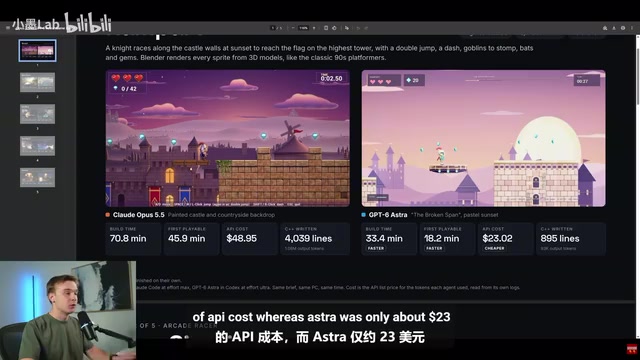
Opus 5.5's version, by contrast, was described by the creator as "night and day." It generated a complete logo featuring a sword motif; character animations, lighting, and texture quality are all noticeably superior; the UI is cleaner and more professional; and even the jump sound effects were considered better than Astra's. On cost, Opus spent roughly $48 in API costs for this round — about twice the time and money as Astra's ~$23. The creator speculates that given continuous iterative refinement, Astra might eventually reach a comparable level — but under single-prompt conditions, what it produced is what it deemed "done."
Racing and Space Combat: Better Visuals at Near-Identical Cost
The second game, Apex Circuit, moves into full 3D. Astra's lighting is actually quite decent, but tree, rock, and grass textures are off, and there's a balance issue — the player car is far faster than the AI opponents, making the race trivially easy. Opus's version delivers superior lighting, particle effects, vehicle 3D models, and boost animations, with car speeds that are far more competitive — making it a much more playable experience.
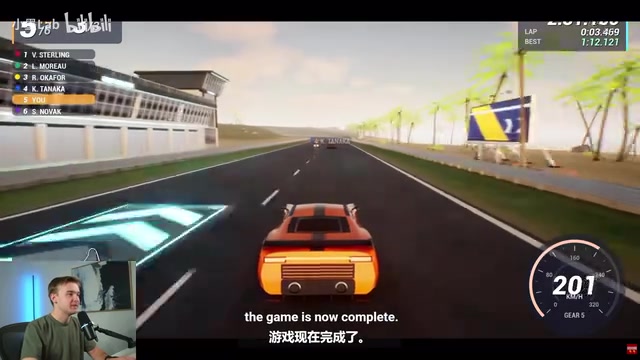
Notably, the cost comparison here is striking: Astra came in at ~$63, Opus at ~$67 — nearly identical — yet the quality difference is substantial. The creator emphasizes that these games were built using Codex and Claude monthly subscriptions rather than per-call API fees, meaning actual costs are much lower, as subscriptions provide more token allowances.
The third game, Void Wing (a space shooter), follows the same pattern. Astra's ship and asteroid models are basic, textures are average, but the mechanics work. Opus pulls ahead significantly on 3D modeling — ship assets, asteroid textures, music, and sound effects are all clearly superior. The creator notes that the single most critical gap is Opus's far superior ability to autonomously generate 3D assets. He does acknowledge, however, that Opus's UI in this round was actually closer to Astra's level — it wasn't a total sweep.
FPS and Boss Battle: Opus Approaches Commercial Game Quality
The fourth game, the first-person shooter Dead Signal, produces the most dramatic contrast. Astra's lighting is genuinely impressive, shooting feels smooth, but there's a glaring bug — most enemy drones just stand still and never attack the player, the kind of issue that requires going back and prompting the model to fix. UI remains Astra's weak spot.
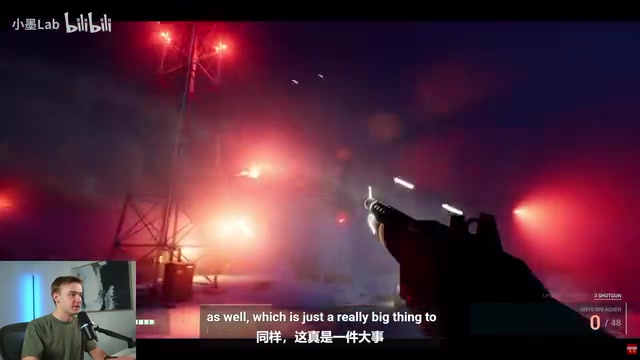
Opus's version prompted the creator to exclaim it "looks like a real game you could sell for $50." It ships with a complete loading animation and loading screen, alarm sound effects, muzzle flashlight illumination, active enemy AI behavior — the works. The UI and overall polish far exceed Astra's output. The creator even suspects Opus may have sourced some sound effects from online resources rather than generating everything from scratch. This round cost Opus ~$50 versus Astra's ~$32, but the quality is "incomparable."
The final boss battle, Colossus, tells the same story. Astra's iron golem assembly animation is decent, but the model has clipping issues (hands phase through the body), combat mechanics are flawed, and the creator couldn't figure out how to actually kill the boss — suspecting the kill condition was hardcoded incorrectly. Opus's version features a more polished assembly animation, rain effects, and a detail where the ground shatters under the boss's attacks — none of which appear in Astra's version.
Conclusion: 3D Asset Generation Is the Decisive Gap
Across all five rounds, Opus 5.5 leads comprehensively in visual quality, 3D modeling, UI design, audio, and overall completeness. The creator's core conclusion, repeated throughout: Opus's decisive advantage lies in its ability to autonomously generate 3D assets — and this is what separates it from Astra.
To be fair, Astra doesn't perform badly in absolute terms — its games mostly run, its lighting is sometimes impressive, and its mechanics are generally functional. It simply falls noticeably short on art asset quality and UI polish. This test also highlights two important caveats: first, all outputs came from a single prompt, and a week of continuous iteration and bug-fixing could yield impressive results from either model; second, using subscription plans rather than pay-per-call API pricing makes the actual costs far more accessible. For developers looking to rapidly prototype games with AI, this real-world test provides a clear directional reference.
Autonomous Blender modeling is the most critical technical hurdle in this test. Blender is an open-source 3D creation suite that supports fully procedural modeling, material assignment, and rendering via Python scripting (the bpy library). The way AI models generate 3D assets is fundamentally by producing Python code that runs inside Blender — driving geometry construction, UV unwrapping, and texture painting — rather than directly outputting 3D files. This means the model must simultaneously demonstrate spatial geometry understanding, procedural logic generation, and fluency with the Blender API. Models that generate lower-quality assets tend to produce overly simple geometry (e.g., solid-color cubes standing in for trees) or UV mapping errors that cause texture stretching — exactly the problems Astra exhibited across multiple games. Opus's advantage here reflects a deeper understanding of three-dimensional spatial relationships and procedural modeling workflows.
Related articles

Reinforcement Learning Takes On Getting Over It: Distributed Training Strategies Behind 63% Progress
A developer uses deep reinforcement learning to tackle Getting Over It. The agent climbs from the bottom to 63% progress but gets stuck at the anvil. The project is open-sourced, using divide-and-conquer training and CPU-only training, seeking community collaboration to break the bottleneck.

Sigma FP2 Released: The World's Smallest Full-Frame Camera Gets Sensor and Screen Upgrades
Sigma launches the FP2 full-frame camera, retaining its smallest-and-lightest design with three key upgrades: improved sensor, articulating LCD screen, and longer battery life—built for portable video creators.

AAAI 2027 Phase 2 Decisions Imminent: Community Debates Review Fairness and Submission Ecosystem
AAAI 2027 phase 2 review results are imminent, with the Reddit community debating reviewer consistency and process transparency. This article examines pre-decision sentiment, structural tensions in top conference review, and practical strategies for authors.