Claude Opus 5.5 vs. GPT-6: The AI Model Price War Is On

Anthropic and OpenAI slash prices on the same day, intensifying the mid-tier AI model price war.
On the same day, Anthropic released Claude Opus 5.5 and OpenAI released GPT-6 Sol and Luna, triggering an intense AI price war alongside the previous day's Grok 4.7. GPT-6 Luna drops to just $0.10/$0.50 per million tokens — half the previous generation — while Opus 5.5 cuts prices 20% and reduces cache read costs by 60%, a major win for long-running agentic workloads. Developer Simon Willison's testing also uncovered a critical flaw: Opus 5.5 in "max" mode overthinks simple SVG tasks until it hits the 128K output limit, highlighting real risks in reasoning model "thinking budget" management.
On the same day, Anthropic and OpenAI each dropped major new models — Anthropic launched Claude Opus 5.5, and just one hour later OpenAI unveiled GPT-6 Sol and GPT-6 Luna. Combined with Grok 4.7 and Xiaomi MiMo v2.6 from the day before, the large model market has entered a fierce new round of competition in an extraordinarily short span of time. And the defining theme of this round is price.
Developer Simon Willison immediately put these new models through their paces, offering detailed observations on everything from pricing structures to real-world reasoning performance. Drawing on his analysis, here's a breakdown of the key takeaways from this price war.
GPT-6 Luna and Sol: Prices Cut in Half
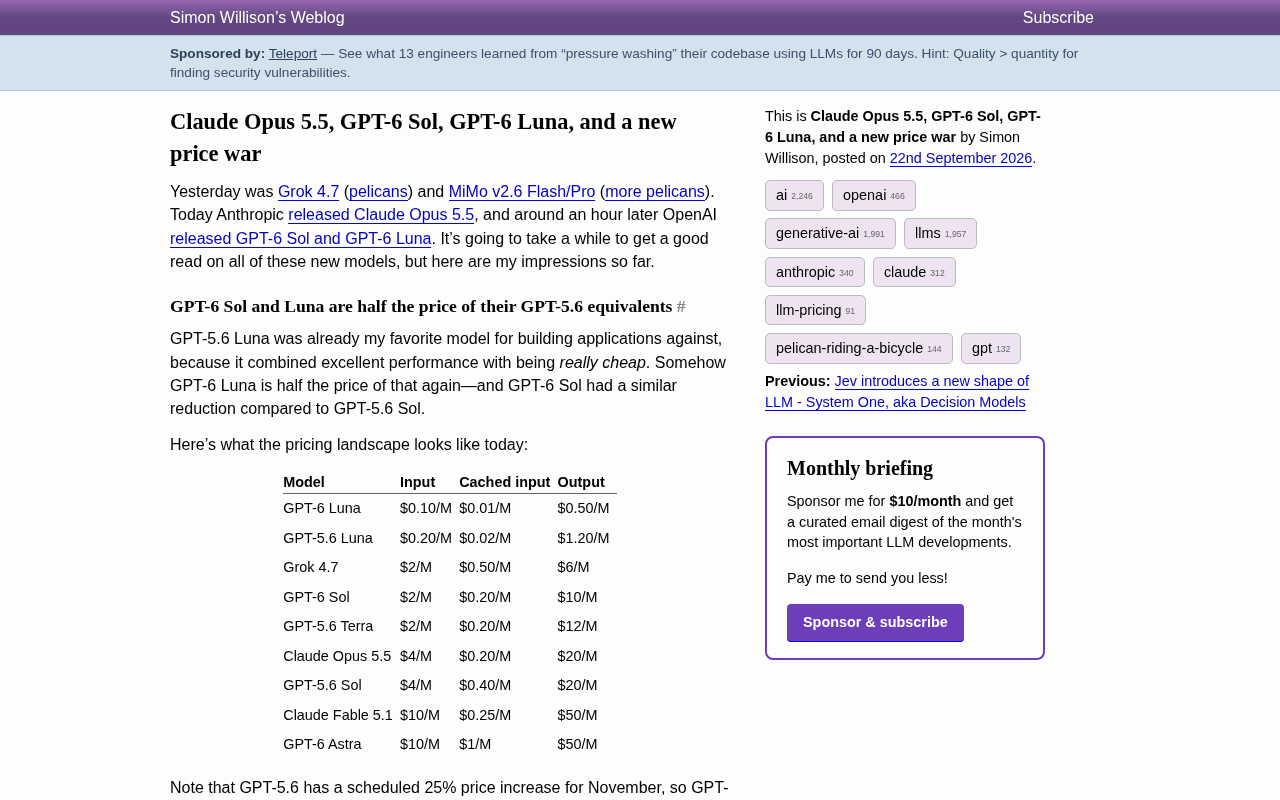
The most striking thing about the GPT-6 family isn't a leap in capability — it's the dramatic price drop. GPT-6 Luna is priced at $0.10 per million input tokens, $0.01 for cached input, and $0.50 for output — exactly half of GPT-5.6 Luna ($0.20 / $0.02 / $1.20). GPT-6 Sol saw a similar reduction compared to GPT-5.6 Sol.
What makes this even more notable is that GPT-5.6 had been scheduled for a 25% price increase in November, meaning GPT-6 is effectively hitting the market at half the promotional price of GPT-5.6. Willison notes that GPT-6 Luna at $0.10 / $0.50 is one of the cheapest models in OpenAI's history — only the far less capable GPT-4.1 Nano and GPT-5 Nano are priced lower.
This pricing reshapes the competitive landscape. The day before, Grok 4.7 launched at $2 / $6, trying to capture the mid-range market at roughly half the price of GPT-5.6 Sol. But with GPT-6 Sol following suit, the two are now neck-and-neck on input pricing, with output pricing gaps narrowing significantly. Meanwhile, GPT-5.6 Terra is now priced identically to GPT-6 Sol, removing any remaining reason to stick with Terra.
Claude Opus 5.5 Also Cuts Prices — With a Big Drop in Caching Costs
Facing OpenAI's offensive, Anthropic's Opus 5.5 also arrives with a price cut. From Opus 4.5 through Opus 5, pricing had been locked at $5 input / $25 output per million tokens; 5.5 brings that down 20% to $4 and $20.
The more meaningful change is in cache read pricing, which dropped 60%. This is especially significant for long-running agentic conversation workloads, where over 90% of input tokens are billed at cache rates. The steep drop in caching costs directly reduces the operational overhead for long-context, multi-turn tool-calling applications.
Beyond pricing, Opus 5.5 reportedly addresses long-standing user complaints about communication style. Anthropic's Thariq Shihipar states that Opus 5.5 is clearer in expression, costs less per token than Opus 5.0, approaches the intelligence level of Fable 5.1, and demonstrates high token efficiency across all reasoning intensities. The team also claims improvements on 3D tasks like Blender.
One caveat worth noting: Opus 5.5's post-reduction price happens to equal GPT-5.6 Sol's old price — and OpenAI immediately cut Sol's price in half. This price war is currently concentrated in the tier just below the high end; the top-tier GPT-6 Astra and Claude Fable 5.1 still sit at $10 / $50 and have yet to be drawn in.
Prompt Caching is an important cost-optimization mechanism in large model APIs: when the same prefix text (such as a system prompt, long document, or tool definitions) appears repeatedly across multiple requests, the provider can store its KV cache state in memory. Subsequent requests read directly from the cache without recomputation, and are billed at a significantly lower "cache read" rate. In agentic workflows, agents typically make dozens or even hundreds of tool calls within a single task, each carrying the same system prompt and accumulated conversation history — resulting in very high cache hit rates. For Opus 5.5, a 60% drop in cache read pricing means that an agent running for an hour with continuous tool calls could see actual API costs more than 80% lower than the headline price suggests — a critical factor in assessing the economic viability of agentic applications.
Opus 5.5's "max" Mode: Overthinking Until It Crashes
Beyond pricing, Willison also put the new models through his signature test: generating an SVG of a pelican riding a bicycle. The result revealed an unprecedented failure from Claude Opus 5.5 in "max" (highest thinking intensity) mode — it never returned a result at all.
The model described the request as a "classic test prompt," then began an extraordinarily verbose reasoning process: checking that the pelican's lower leg measured approximately 95.2 pixels, planning the near-leg path from hip to knee to ankle, confirming the fish peeking out of the basket, inspecting sprocket tooth counts and layer ordering... In the process, it hit the 128,000-token maximum output limit and was cut off before the SVG was even complete. Willison retried with the same result — two failures, each costing $2.56 and taking nearly 20 minutes.
This left him questioning the practical utility of "max" mode: if a model can overthink itself into failure on something as simple as an SVG prompt, it's hard to trust in more complex real-world tasks. By contrast, Fable 5.1 in "max" mode showed no signs of over-reasoning and produced what Willison called the best pelican he'd ever seen from an Anthropic model.
He also noted stylistic differences between model generations: the GPT-5.6 family tends toward bolder, more vivid colors, while the GPT-6 family is noticeably more muted and restrained. While cross-vendor comparisons via pelican drawings may not be all that meaningful, this kind of test still has reference value when comparing different reasoning intensities within the same model family.
Reasoning models typically allow users to adjust a "thinking budget" or "thinking intensity" — the maximum number of tokens the model is allowed to spend on internal chain-of-thought reasoning before producing a final answer. Higher intensity enables deeper step-by-step reasoning, which theoretically improves performance on complex tasks like mathematical proofs or code debugging. The tradeoff is longer latency, higher cost, and the risk of "overthinking" — where the model enters a lengthy self-verification loop and runs out of room to generate the actual output content. Opus 5.5 hitting the 128K output limit in "max" mode is a textbook example of this tradeoff spiraling out of control: reasoning tokens consume nearly the entire output window, leaving almost no space for the actual SVG code. This signals to developers that they should carefully match thinking intensity to task complexity in production deployments, rather than defaulting to the highest setting.
Practical Choices Amid the Price War
After his testing, Willison has set GPT-6 Sol and Claude Opus 5.5 as the default models in Codex and Claude Code respectively, and upgraded his Datasette Agent demo to GPT-6 Luna — which he found to be both fast and reliable for SQL queries and generating HTML and JavaScript.
The next move to watch is Anthropic's. The company has indicated that Sonnet 5.5 and Haiku 5.5 are coming soon. Pressure at the low end is particularly intense: the current Haiku 4.5 is priced at $1 / $5, while GPT-6 Luna is a tenth of that at $0.10 / $0.50. Whether Haiku can reclaim price competitiveness at the low end will be the next critical question in this price war.
For developers, this wave of price cuts means the marginal cost of building AI applications is falling fast. The capability gap between models is narrowing, and price, token efficiency, and caching strategy are becoming increasingly important factors in model selection.
Token efficiency refers to the total number of tokens a model consumes to complete a task of equivalent quality; combined with unit price, it determines actual cost. A model with a higher list price but significantly better token efficiency may not actually cost more in practice. Anthropic's description of Opus 5.5 specifically emphasizes "lower per-token cost than Opus 5.0," meaning 5.5 consumes fewer tokens on the same tasks — so when stacked on top of the price reduction, the real bill drops by more than the headline price difference suggests. When evaluating the cost-effectiveness of a model, developers should consider four factors together: unit price, average response token count, cache hit rate, and task completion quality. These together form the true operational cost model — not just the API list price.
Related articles

AgentCore in Practice: Connecting Custom Tools and MCP Servers to Agents
DebuggerCafe tutorial shows how to connect custom tools and MCP servers to Amazon Bedrock AgentCore agents, covering tool contract design, MCP reuse, and production concerns.

816B Parameters Scores Only 39? The Real Cost-Effectiveness of the Open-Source LLM Parameter Race
Meta's 816B Muse Spark Open scores just 39 on Artificial Analysis, while 180B Qwen3.8-Flash-Next scores 40. This article analyzes 11 open-weight models' parameters vs. scores, exploring the real impact of activated parameters, quantized size, and deployment cost.

Aerial Manipulators: The Next Step for Drones from 'Seeing' to 'Changing'
Starting from a Reddit discussion, this article analyzes the technical challenges, potential applications, and deployment bottlenecks of aerial manipulators, exploring the key challenges for drones moving from environmental perception to physical manipulation.