Claude Paid Plans Add Separate Agent SDK Quota: Developers Get Dedicated Allowance at No Extra Cost

Claude paid users get a separate monthly Agent SDK quota starting June 2025
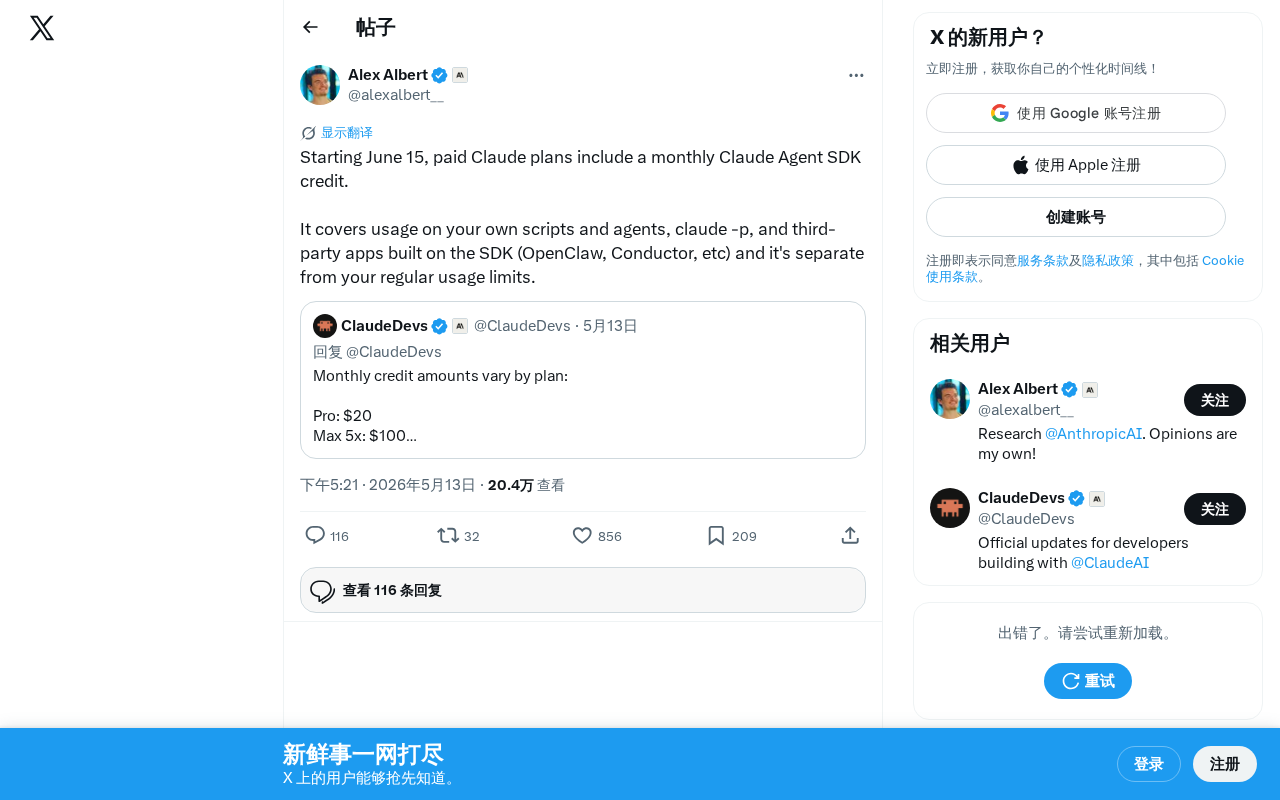
Anthropic announced that starting June 15, 2025, Claude paid users will receive a separate monthly Agent SDK usage quota, completely independent from regular conversation allowances. The quota covers personal scripts, command-line pipeline invocations, and third-party applications, resolving the resource conflict developers faced between daily usage and Agent debugging. The move aims to lower AI agent development barriers and accelerate third-party tool ecosystem growth.
SDK Usage Quota Separate from Regular Limits: Breaking Down the Core Change
Starting June 15, 2025, Anthropic announced a significant adjustment to Claude's paid plans — all paying users will receive a separate monthly Claude Agent SDK usage quota. This means developers no longer need to worry about consuming their daily conversation allowance when building and running AI agents with the SDK.
What is Claude Agent SDK? Claude Agent SDK is a developer toolkit from Anthropic that allows developers to programmatically invoke Claude's capabilities to build AI agents that can autonomously execute tasks. Unlike the standard conversation API, the Agent SDK supports multi-step reasoning, Tool Use, code execution, and other complex operations — making it core infrastructure for building automated workflows. Understanding this context helps grasp the real value of this quota adjustment.
What Use Cases Does the New Quota Cover?
Three Key Scenarios
This new monthly quota covers several typical use cases:
- Personal scripts and agents: User-written automation scripts and AI agent programs
- Command-line tools: Pipeline invocations via
claude -pcommands - Third-party applications: Third-party tools built on Claude Agent SDK, such as OpenClawAd, Conductor, etc.
About claude -p pipe mode: claude -p is the pipe mode provided by Claude's command-line interface (CLI), allowing developers to connect standard input/output directly with Claude for Shell script-level AI integration. For example, developers can pipe log files into Claude for automated analysis, or embed code review steps in CI/CD pipelines. This invocation method is extremely practical for automated operations, batch text processing, and other scenarios — serving as a critical bridge between traditional Unix toolchains and modern AI capabilities.
About OpenClaw and Conductor: These two tools are third-party automation products built on Claude Agent SDK, representing the independent software ecosystem (ISV ecosystem) forming around large model APIs. OpenClaw primarily targets code automation scenarios, while Conductor focuses on multi-step task orchestration. Their existence demonstrates that Claude's API has sufficient depth to support independent commercial products — and this quota separation will directly lower the barrier to entry for users of such tools.
Relationship Between SDK Quota and Regular Quota
This SDK quota is completely independent from users' regular usage limits. Even if you're approaching your daily conversation cap, you can still freely use your SDK quota to run agent programs, and vice versa. The two quotas don't interfere with each other — developers no longer have to choose between chatting and coding.
Practical Impact on the Developer Ecosystem
Significantly Lower Development Barriers
Previously, developers wanting to build and test AI agents on the Claude platform often had to choose between daily usage and development debugging. The introduction of a separate quota effectively solves this pain point, allowing developers to experiment and iterate more freely without worrying that a single debugging session will exhaust their daily conversation allowance.
Notably, AI Agent debugging is inherently more expensive than regular conversations — a complete Agent run often involves dozens of tool calls and intermediate reasoning steps, with token consumption potentially 5 to 20 times that of a normal conversation. This is precisely why the separate quota's practical value to developers far exceeds what the surface numbers suggest.
Accelerating Third-Party Tool Ecosystem Growth
The announcement specifically mentions third-party applications like OpenClaw and Conductor, indicating that Anthropic is actively nurturing a developer ecosystem around Claude Agent SDK. By providing users with dedicated SDK quotas, tools built by third-party developers will face lower user adoption barriers, potentially accelerating the prosperity of the entire ecosystem.
This strategy closely mirrors the ecosystem cultivation logic of platforms like Apple's App Store and Salesforce AppExchange: the platform reduces end-user costs, which indirectly incentivizes third-party developers to invest more resources in building applications, creating a positive flywheel effect.
AI Agents Moving from Concept to Practical Use: Industry Trends
This initiative reflects a clear trend in the AI industry: AI agents are transitioning from proof-of-concept to everyday practical use.
Technical Evolution of AI Agents: AI Agents refer to AI systems capable of autonomously perceiving their environment, formulating plans, and executing multi-step tasks. Unlike single-turn Q&A, Agents can invoke external tools (such as search engines, code interpreters, file systems) and dynamically adjust their action strategies based on intermediate results. Since 2023, major AI vendors including OpenAI, Google, and Anthropic have successively launched Agent frameworks (such as AutoGPT, LangChain, Google Agent Builder), but early products generally faced issues with low reliability and high invocation costs. Between 2024 and 2025, as model reasoning capabilities improved and infrastructure costs declined, AI Agents began achieving scaled deployment in vertical domains like code generation, data processing, and customer service automation. Anthropic's quota separation strategy aligns precisely with this critical industry inflection point — the transition from "experimental technology" to "production-grade tooling."
Major AI vendors are all encouraging developers to build more AI agent-based applications by lowering usage costs and providing dedicated resources. For users already on Claude's paid plans, this is a pure benefit — more usage space at no additional cost. For developers still on the fence, it adds another reason to choose a Claude paid plan.
Specific quota amounts and calculation methods have not been detailed in the announcement. Users are advised to watch for Anthropic's subsequent detailed pricing documentation.
Key Takeaways
- Starting June 15, Claude paid plans add a separate monthly Agent SDK usage quota
- Covers personal scripts,
claude -pcommand-line invocations, and third-party SDK applications - SDK quota is completely independent from regular conversation usage limits
- The high token consumption inherent to Agent debugging makes the separate quota far more valuable to developers than surface numbers suggest
- This move aims to lower AI agent development barriers and drive third-party ecosystem growth, aligning with the industry trend of AI Agent scaled deployment
Related articles
 Tech Frontiers
A Rare Quiet Day in AI: Recursive Self-Improvement Stirs Beneath the Surface
A rare quiet day in AI sees multiple sources go silent simultaneously. Behind the calm, Recursive Self-Improvement (RSI) research continues. What this means for the industry.
 Tech Frontiers
Reve 2 vs. Ideogram 4: A Deep Dive into Layout Control in AI Image Generation
A deep comparison of Reve 2 and Ideogram 4's layout control capabilities, covering technical approaches, real-world use cases, and industry trends for designers and creators.
 Tech Frontiers
In the Weights: Check Your Influence Score in the AI World
In the Weights is an AI influence search engine that quantifies your presence in the AI world with a score. Explore how it evaluates practitioners and what it means for digital identity.