Claude Platform Credit Delay Incident: Issue Resolved

Claude platform credit purchase delays caused some requests to fail; the official team completed investigation and resolution in about six hours.
Anthropic's Claude platform recently experienced delays in crediting purchased credits, causing some user requests to fail due to the system determining insufficient balance. The official status page documented the complete process: investigation confirmed at UTC 16:20, root cause fixed and monitoring entered at 18:23, and officially marked resolved at 22:36 — about six hours in total. The article points out that under a prepaid credit model, the real-time performance of the accounting system directly determines service availability; when top-ups cannot be posted immediately, pay-as-you-go API users find themselves unable to call the service right after paying, and also struggle to identify where the problem lies. The official announcement clearly stated the causal relationship, helping users quickly locate the source of the problem. The article recommends that enterprise users and heavy developers maintain a credit balance buffer and treat the platform status page as the primary channel for obtaining service anomaly information.
Anthropic's Claude platform recently experienced a delay in crediting purchased credits to user accounts, which at one point caused some user requests to fail due to insufficient balance. The official status page documented the entire process from investigation to resolution.
Incident Timeline: Investigation and Fix Completed Within Three Hours
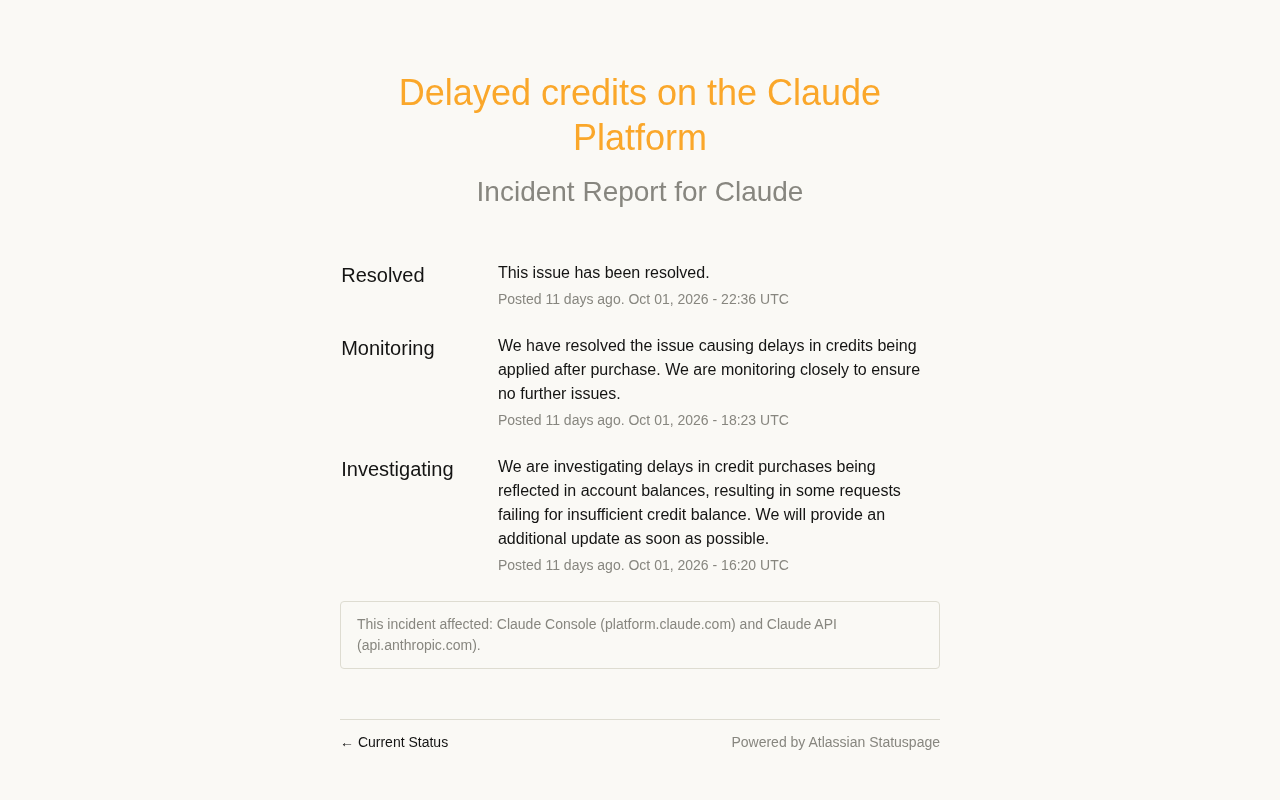
According to the announcement on the Claude platform status page, this credit delay incident went through three key phases.
Investigation phase (UTC 16:20): The official team confirmed it was investigating an issue where purchased credits were not being reflected in account balances in a timely manner. This delay directly affected user experience — some requests failed because the system determined there was "insufficient credit balance." For users relying on the Claude API for development or daily use, this meant service disruption.
Monitoring phase (UTC 18:23): After approximately two hours of investigation, the team identified and fixed the root cause of the delay, then entered a close monitoring state to confirm the issue would not recur.
Resolution phase (UTC 22:36): The incident was officially marked as resolved.
From the initial public investigation to the final confirmation of resolution, the entire process took about six hours.
A status page is a communication mechanism commonly adopted by cloud services and API platforms, typically either self-built or hosted on third-party services like Statuspage or Instatus. Its core value lies in clearly distinguishing "platform-side outages" from "user-side issues": when users encounter request failures, they can first check whether the status page has a corresponding announcement, thereby avoiding misattributing a platform failure to their own configuration, API key, or network issues. Status pages generally progress through stages of "Investigating — Identified — Monitoring — Resolved," with UTC timestamps marked at each step. Since UTC contains no timezone offset, users worldwide can convert it to their local time themselves — which is also why technical announcements commonly use UTC. Additionally, mature status pages support email, SMS, or RSS subscriptions, making it easy for developers to learn about service anomalies as soon as they occur.
Real Impact on Users
The delay in credit posting may seem like a minor issue, but its impact on users should not be overlooked.
For pay-as-you-go API users, credit balance is a direct prerequisite for service availability. When a credit purchase cannot be immediately reflected in the account, the system will directly reject service at the request level. Users may face two dilemmas: first, having just completed payment but being unable to use the service; second, being unable to determine whether the problem lies in their own account settings or on the platform side.
In this incident, the official team clearly stated the causal relationship on the status page — "credit purchases were delayed in being reflected in account balances, causing some requests to fail due to insufficient credit balance." This transparent communication approach helps users quickly identify the source of the problem and avoid unnecessary self-troubleshooting.
Reflections on Platform Stability and Payment Experience
The credit system is a core component of AI platforms' business models. The Claude platform adopts a prepaid credit model, where users purchase credits before consuming them. This model places high demands on the real-time performance of the platform's accounting system.
This incident exposed that even for leading AI platforms, delays can still occur in the payment and credit synchronization process. The speed of fixing such issues directly affects user trust — completing the entire process from investigation to resolution within six hours is a relatively timely response.
For enterprise users and heavy developers, it is recommended to maintain a certain credit balance buffer in their accounts to cope with similar unexpected situations. At the same time, paying attention to the platform status page is the most direct channel for obtaining service anomaly information.
A prepaid credit model refers to users topping up to obtain platform-internal billing units, which are then deducted based on actual usage — as opposed to a postpaid model of "use first, pay later, billed monthly." Its advantages are that the platform bears no bad debt risk and enjoys upfront cash flow, while users can control costs through balance limits; the cost is that "top-up posting" becomes a prerequisite for service availability — once data synchronization between the accounting system and the business system is delayed, users will be denied service in a link they cannot see. Such synchronization typically relies on asynchronous events or message queues, and top-up and balance updates are not in the same transaction, so there exists a brief window of inconsistency. Common mitigation measures on platforms include: setting auto-reload thresholds, allowing small overdraft limits, and returning identifiable error codes rather than generic failures when the balance is insufficient.
Incident Timeline Review
| Time (UTC) | Status | Description |
|---|---|---|
| 16:20 | Investigating | Confirmed credit purchase delays reflected in balances, some requests failing |
| 18:23 | Monitoring | Root cause fixed, continuous monitoring |
| 22:36 | Resolved | Incident officially closed |
The issue has now been fully resolved, and users can purchase and use credits normally.
One-line Summary
Claude platform credit purchase delays caused some requests to fail; the official team completed investigation and resolution in about six hours.
Paragraph Summary
Anthropic's Claude platform recently experienced delays in crediting purchased credits, causing some user requests to fail due to the system determining insufficient balance. The official status page documented the complete process: investigation confirmed at UTC 16:20, root cause fixed and monitoring entered at 18:23, and officially marked resolved at 22:36 — about six hours in total. The article points out that under a prepaid credit model, the real-time performance of the accounting system directly determines service availability; when top-ups cannot be posted immediately, pay-as-you-go API users find themselves unable to call the service right after paying, and also struggle to identify where the problem lies. The official announcement clearly stated the causal relationship, helping users quickly locate the source of the problem. The article recommends that enterprise users and heavy developers maintain a credit balance buffer and treat the platform status page as the primary channel for obtaining service anomaly information.
Related articles

Structuring Data for AI Agents: Five Approaches and a Selection Guide
There's no single best way to structure data for AI Agents. This article compares semantic models, knowledge graphs, RAG, Markdown+grep, and open formats, drawing on research from dbt, Microsoft, and Chroma to help you pick the right data architecture based on question type.

Fish Audio Drama 3 Open-Source Launch Sparks Debate: The 35B Speech Model's Selling Points and Licensing Controversy
Fish Audio Drama 3 sparks debate with 35B parameters and open weights, ranking first on pronunciation benchmarks with director-style control and word-level inpainting, but its community license restricts commercial resale, API prices are rising, and local runs need ~39GB VRAM.
LLM Gateway Selection Checklist: Evalu…
LLM Gateway Selection Checklist: Evaluate a Gateway in 10 Minutes
A 10-minute LLM gateway evaluation checklist: from protocol coverage, cache pricing, discount transparency, and credit terms to per-model SLAs and migration cost, filter out unreliable LLM gateways fast.