Claude Real-Name Policy Explained: Cloud Provider API Calls Are Not Affected

Anthropic's July 8 real-name policy only affects personal web accounts — AWS, Azure, and Snowflake API users are fully exempt.
Anthropic's new identity verification requirement, effective July 8, applies only to personal Free, Pro, and Max accounts on the Claude website. Commercial API channels through AWS Bedrock, Azure, and Snowflake are completely exempt under their existing partnership agreements. Additionally, Anthropic has lifted export controls on Fable 5, opening it to global users outside the US.
Article Content
A recent notice from Anthropic has sparked widespread concern among Claude users in mainland China: starting July 8, personal accounts on the web client may be required to complete identity verification, and mainland Chinese ID cards cannot pass the verification — meaning a large number of Claude Pro accounts face the risk of being locked or banned.
The burning question that follows: does calling Claude through cloud providers like AWS, Azure, or Snowflake also fall under this new policy? This article draws on official emails and information from major cloud vendors to give a clear breakdown of the policy's scope.
Where the Real-Name Policy Applies: Only Personal Accounts on the Official Website
Bottom line first: this real-name policy only applies to personal Free, Pro, and Max accounts on the Claude official website. According to Anthropic's official privacy documentation, all third-party distribution channels that have signed commercial partnership agreements are fully exempt from facial recognition and ID verification.
In other words, as long as you're not logging into the web chat interface directly and are instead calling Claude via a cloud provider's API, you are completely outside the scope of this rule. The policy was announced around June 10, 2026, with an effective date of July 8 — this is not old news that's been circulating.
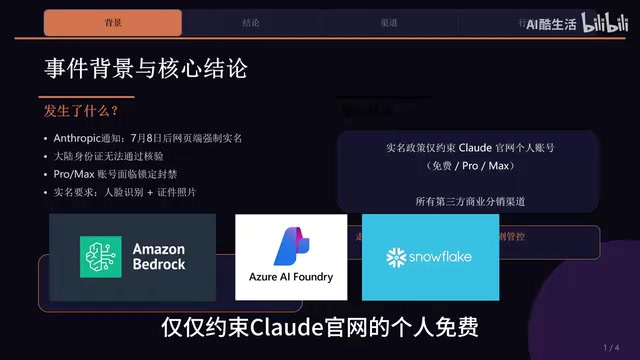
There's a key conceptual distinction to clarify here: personal web accounts and commercial API channels are two entirely separate governance systems.
AnthropicAPI's identity verification for personal web accounts is essentially a KYC (Know Your Customer) compliance mechanism — commonly seen in regulated industries like finance and telecom, and increasingly being adopted by AI services. Its purpose is to track abuse and satisfy regulatory requirements in specific jurisdictions by tying usage to real identities. Cloud providers like AWS, Azure, and Snowflake, as enterprise-level distributors, have already assumed corresponding compliance responsibilities in their commercial agreements with Anthropic — including enterprise credential verification, anti-money laundering checks, and usage monitoring at the platform level. As a result, Anthropic does not need to independently verify the end users on these channels, creating a "platform endorsement in lieu of individual identity verification" exemption model.
After July 8, personal web accounts that cannot pass identity verification face a very high risk of being banned for mainland China users. Commercial channels like AWS, Azure, and Snowflake, on the other hand, only require passing the platform's own payment and credentials review — entirely separate from Anthropic's real-name policy.
Cloud Provider API Channels: A Detailed Breakdown
AWS Bedrock: Credit Card Verification Only, No Personal ID Required
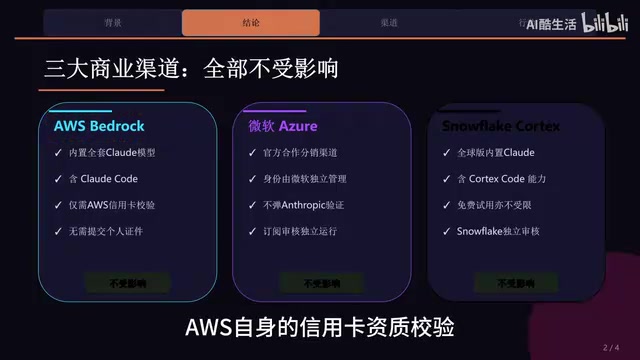
AWS's Bedrock platform includes the full suite of Claude models, including Claude Code. The entire onboarding process only requires completing AWS's own credit card verification — no personal identification documents need to be submitted to Anthropic. Users calling Claude through AWS Bedrock will therefore not trigger the July 8 identity verification process.
Background: AWS Bedrock is Amazon Web Services' fully managed foundation model service platform, officially launched in 2023. Its core value proposition is enabling enterprise developers to access models from top AI companies — including Anthropic, Meta, Mistral, and Stability AI — through a unified API, without having to deploy or maintain large model infrastructure themselves. Bedrock operates on a "model as a service" architecture with per-token billing, making it well-suited for enterprise use cases that demand stability and compliance. Because AWS has a long-term commercial distribution agreement with Anthropic, Claude calls on Bedrock run entirely through AWS's own identity and payment systems, physically isolated from Anthropic's web account system.
Azure and Snowflake: Identity Managed Independently by Each Platform
Microsoft Azure, as an official Anthropic distribution partner, manages account identities independently through Microsoft — no Anthropic identity verification prompt will appear.
When calling Claude through Snowflake's Cortex feature on the global version of Snowflake, identity verification is handled entirely by the Snowflake platform — even for free accounts — and is not subject to Anthropic's new policy.
Background: Snowflake is a technology company that started as a cloud-native data warehouse. Its Cortex feature, rolled out progressively after 2023, is an AI capability layer that allows users to call large language models — including Claude — directly within the Snowflake data platform for tasks like text summarization, semantic search, and SQL generation, without needing to export data to external services. This "data stays on platform" design is particularly attractive to industries with strict data compliance requirements, such as finance and healthcare. Snowflake's partnership agreement with Anthropic means that Claude calls within Cortex fall entirely under Snowflake's identity and permissions management system, and users do not need a separate Anthropic account.
Fable 5 Global Access: Export Controls Officially Lifted
There's also a significant update on API availability. Previous documentation restricted Fable 5 to US-based enterprises only, blocking a large number of developers in China from accessing it. On July 1, Anthropic officially updated its announcement: the US Department of Commerce has lifted the relevant export controls, and all individuals and non-US enterprises worldwide can now directly apply for access.
Background: The US export control system is administered by the Bureau of Industry and Security (BIS) within the Department of Commerce, with the Export Administration Regulations (EAR) as the core legal framework. In recent years, as large language models have been classified under "emerging and foundational technologies" controls, cross-border commercial licensing for some frontier AI models has required BIS approval. Fable 5 was previously restricted to US enterprises because it fell into the category of regulated high-performance AI systems. The Commerce Department's decision to lift export restrictions on Fable 5 signals a phase of relaxation in the US government's stance on cross-border commercialization of this model tier, with direct access implications for global developers and non-US enterprises — including those in mainland China.
Note that the newly opened access applies only to Fable 5; the top-tier Methos 5 remains restricted to US domestic institutions.
Two Hurdles to Unlock Fable 5
It's worth noting that when Fable 5 first entered limited testing on AWS Bedrock, it used an independent enterprise verification system — separate from the July 8 personal web real-name policy. To unlock Fable 5 on AWS, users must clear two distinct hurdles:
- First hurdle: The primary AWS account must complete US-based identity verification; mainland China entity accounts will be blocked outright.
- Second hurdle: Users must also pass Anthropic's manual use case review, submitting complete business usage documentation and waiting for manual approval.
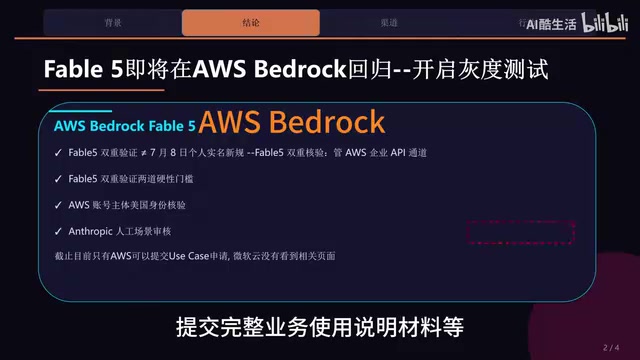
As of now, only AWS has opened the User Case application channel; no similar application portal has appeared on the Microsoft side. However, with export controls lifted, the official announcement states that AWS, Google Cloud, and Microsoft Azure will all open access soon. In practice, the Microsoft Foundry API has already been confirmed to support Fable 5 calls.
Recommendations for Mainland China Users
For mainland China users who rely on personal web accounts, the risk of account suspension after July 8 cannot be ignored. The key recommendation is:
Back up all conversation history and prompt templates in advance to avoid data loss if your web account gets suspended.
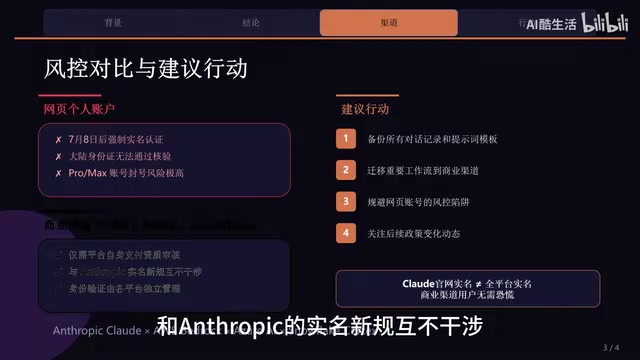
Looking further ahead, if you have ongoing, stable usage needs for Claude, migrating your workflow to commercial API channels like AWS Bedrock, Azure, or Snowflake is the safer path — these channels are not subject to the personal real-name policy and only require passing each platform's own payment and credentials review to operate normally.
Summary
The core logic behind this policy change is actually quite straightforward: Anthropic is tightening access requirements for personal web accounts on its official site, while maintaining exemptions for distribution channels that have signed commercial agreements. The two systems operate independently of each other — there's no need to conflate them or panic unnecessarily.
Meanwhile, the lifting of export controls opens Fable 5 to individuals and non-US enterprises worldwide, which is a significant win for developers in China. Making smart use of cloud provider API channels lets you both avoid the risks of the real-name crackdown and stay current with the latest model capabilities.
Key Takeaways
Related articles

Disaster and Glory of the Apollo Program: The History We Must Revisit Before Returning to the Moon
From the fatal Apollo 1 fire to Apollo 8's daring lunar orbit to Apollo 11's successful landing—revisiting the disasters, fears, and compromises of the Apollo program and their lessons for today's return to the Moon.
Netflix Trust Exercise Turns Into Firing Trap: Where Are the Boundaries of Corporate Trust?
A Netflix employee was fired after sharing private info in a trust exercise. We analyze the risks of corporate trust exercises and how employees can protect themselves.

AMD CDNA5 Architecture Deep Dive: Technical Evolution and the AI Computing Competition Landscape
Deep analysis of AMD's CDNA5 architecture covering Chiplet packaging upgrades, HBM memory evolution, and low-precision compute optimization, examining how AMD challenges NVIDIA's AI chip dominance.