Claude's Hidden Tracking Feature Sparks Controversy: Anthropic's Anti-Surveillance Stance Under Fire

Claude's hidden tracking feature clashes with Anthropic's anti-surveillance brand, sparking a user trust crisis.
Anthropic's Claude is under fire after users discovered undisclosed tracking mechanisms that appear to contradict the company's public anti-surveillance stance. The controversy highlights the inherent tension between AI model improvement (which requires user data) and genuine privacy protection, and raises broader questions about transparency standards across the AI industry.
Background: Anti-Surveillance Advocate Accused of Covert Tracking
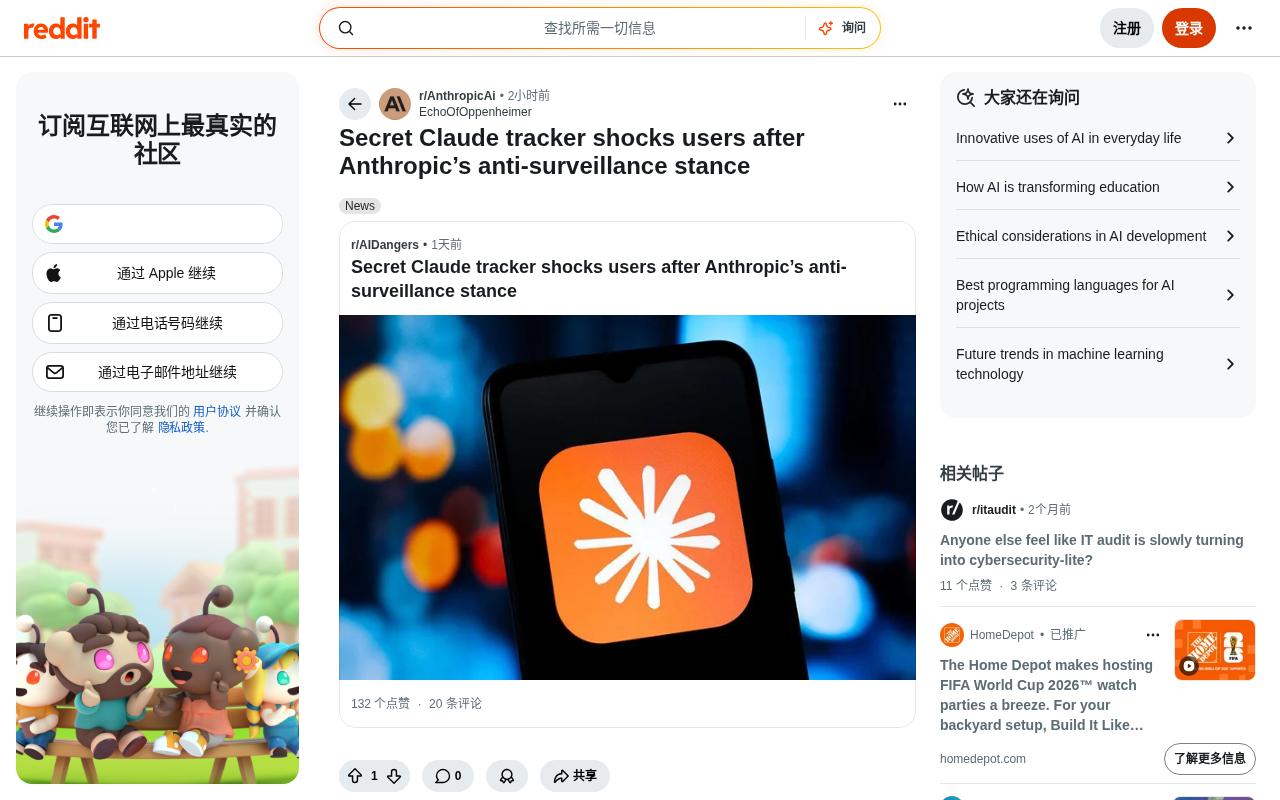
The AI community recently erupted in discussion on Reddit's r/AnthropicAi subreddit. A post titled "Secret Claude tracker shocks users after Anthropic's anti-surveillance stance" went viral, sparking widespread debate. At the heart of the controversy: Anthropic — a company that has long publicly championed AI safety and anti-surveillance principles — was accused of running an undisclosed user behavior tracking mechanism in Claude, creating a stark contrast with its carefully cultivated public image.
For a company that has built its brand around "AI safety" and "responsible AI," this kind of controversy is especially damaging. Anthropic has repeatedly emphasized privacy protection and anti-surveillance values in public forums, so when users discovered a gap between the product's actual behavior and the official narrative, the resulting trust crisis ran far deeper than a typical technical dispute.
It's worth noting that Anthropic was founded in 2021 by former core OpenAI members, with "AI safety first" as its central differentiator. The company published a technical paper called "Constitutional AI," claiming to constrain model behavior through built-in value principles rather than relying solely on human annotation.
Constitutional AI is a model alignment methodology Anthropic formally published in 2022. Its core idea is to give the model a predefined set of explicit value principles, then have it iterate on output quality through Self-Critique and Self-Revision. Architecturally, Constitutional AI uses a two-stage training pipeline: the first stage is supervised learning (SL-CAI), where the model critiques and revises its own outputs according to preset principles to produce improved versions that better align with those values; the second stage is RLAIF (Reinforcement Learning from AI Feedback), which replaces some human annotation with AI-generated preference labels to train a reward model, then uses reinforcement learning to optimize the language model's behavior. The key breakthrough of this methodology is transforming value alignment from a black-box operation into an auditable, explicit process — compared to traditional RLHF, which relies entirely on the subjective judgments of human annotators, Constitutional AI's value principles are written out explicitly and are theoretically open to external review and discussion. This approach — known as RLAIF — converts behavioral constraints from implicit human preferences into auditable explicit principles, and in narrative terms grants Anthropic a kind of moral authority as a company whose "values are quantifiable and verifiable." This narrative gave Anthropic a strong ethical identity, earning it the "responsible AI" label in both tech and policy circles. Precisely because of this, when product-level behavior appears to tension with that narrative, the contrast effect is especially pronounced — users' expectations have been actively raised by brand marketing, so any gap gets amplified into accusations of hypocrisy.
The Core Dispute: Tension Between Data Tracking and Company Values
Why Users Felt "Shocked"
Based on community reactions, users weren't shocked simply by the fact that data is being collected — the vast majority of AI products collect usage data for model improvement and service optimization. What actually triggered the backlash was the expectation gap: when a company loudly proclaims an anti-surveillance stance, users naturally hold its data practices to a higher standard.
Once users discovered what appeared to be "hidden" or insufficiently transparent tracking behavior, a sense of betrayal followed. This is fundamentally a consistency of word and deed trust issue, not merely a technical compliance question. In an increasingly competitive AI landscape, user trust is becoming a critical differentiator.
This type of controversy tends to spread rapidly through decentralized communities like Reddit. Subreddits such as r/AnthropicAi and r/OpenAI attract large numbers of technically sophisticated early adopters who have some ability to audit code and analyze network traffic — using packet capture tools like Charles Proxy and Wireshark, or browser developer tools, to identify potential tracking endpoints.
It's worth noting that the technical barrier to using packet capture tools has dropped dramatically over the past decade. Charles Proxy features a graphical interface with HTTPS decryption support, making it ideal for quickly identifying data an app sends to third parties — its "SSL Proxying" feature can decrypt encrypted traffic into plaintext, making tracking scripts impossible to hide; Wireshark provides lower-level packet capture capabilities and is commonly used for deep protocol-level analysis, supporting parsing of hundreds of network protocols. Combined with the built-in Network panel in browser developer tools, even technically-minded hobbyists without professional backgrounds can identify hidden requests an app sends to third-party servers. The democratization of this "citizen technical auditing" capability has fundamentally restructured the information asymmetry between tech companies and users, making it increasingly difficult for companies to hide their actual data practices from the technical community. Once a user posts technical screenshots or an analysis report, even if the original evidence is incomplete, it quickly triggers a community "collective verification" mechanism — other users follow up to replicate or refute the findings, generating exponential discussion spread. This information propagation model is often far faster than official corporate responses, posing serious challenges for reputation management.
Transparency Is the Real Issue
These controversies are rarely a binary question of "does data collection happen or not" — they're about transparency: how it's disclosed, and to what degree. Enterprise and individual users increasingly care about:
- What data is being collected?
- Is the data used for model training?
- Do users have clear rights to informed consent and an opt-out mechanism?
- Are the relevant terms presented in a clear, understandable way, rather than buried in lengthy privacy agreements?
Privacy disclosure practices across the AI industry vary widely. Major products including OpenAI, Google Bard/Gemini, and Anthropic Claude all include data use clauses in their terms of service, but the language is often scattered across thousands of words of legal text that most users struggle to parse. Since 2023, the EU's General Data Protection Regulation (GDPR) and US state privacy laws (such as the CCPA) have imposed stricter transparency requirements on AI products. The GDPR came into force in 2018 and is one of the strictest data protection regulations in the world, with core principles including data minimization, purpose limitation, informed user consent, and the right to be forgotten — non-compliant companies can face fines of up to 4% of global annual revenue; the CCPA took effect in 2020 and was further expanded by the CPRA amendment in 2023, giving California residents the right to know about, delete, and opt out of the sale of their personal data. These regulatory pressures have pushed some companies to introduce data training opt-out mechanisms.
However, the "opt-in by default, opt-out by choice" design itself has been criticized by privacy advocates as insufficiently respectful of user autonomy. Research in behavioral economics — especially the "default effect" systematically explored by Nobel laureate Richard Thaler and Cass Sunstein in Nudge — shows that default options have a decisive influence on user decisions. In real-world scenarios like organ donation and pension enrollment, participation rates under opt-in versus opt-out designs can differ by 40 to 80 percentage points. Setting data collection as the default in an opt-out mechanism is essentially a systematic exploitation of users' cognitive inertia: users must actively invest time and effort to protect their own privacy, while most people will simply maintain the default state. This stands in fundamental institutional contradiction with public commitments to "put users first" — the promise to respect user choice, while quietly removing the lowest-cost path to exercising that choice. When clear answers to these questions are absent, claims of a "secret tracker" can spread rapidly through online communities.
Deep Analysis: The Privacy Paradox for AI Companies
The Inherent Tension Between Model Improvement and Privacy Protection
The training and optimization of large language models (LLMs) is inherently a data-intensive process. The capability improvements of modern conversational AI like Claude depend on two key elements: learning from massive corpora during pre-training, and continuous fine-tuning plus Reinforcement Learning from Human Feedback (RLHF) after deployment.
RLHF is one of the core training paradigms for mainstream conversational AI today, systematized by OpenAI in the InstructGPT paper (2022) — its process has three steps: first, train an initial model with supervised learning; then have human annotators rank model outputs by preference to train a reward model; finally, use a reinforcement learning algorithm (such as PPO, Proximal Policy Optimization) to optimize the language model to maximize its reward score. The critical bottleneck in this paradigm is data quality: interaction data from real users reflects edge cases, long-tail needs, and the actual distribution of natural language habits far better than samples artificially constructed in a lab. Real users ask questions researchers never anticipated, using regional dialects, industry jargon, and oblique expressions — this "wild data" is critical for improving model generalization, yet can only be obtained from actual product interactions during deployment. This deeply explains, at the level of technical architecture, why AI companies find it so difficult to achieve a perfect balance between privacy protection and data collection — without collecting user data, model optimization falls into an "information cocoon," and the product will fall behind in competition over the long run.
The continuous improvement of large language models depends heavily on real user interaction data. To make Claude smarter and more attuned to user needs, Anthropic objectively needs to analyze user behavior. This creates an almost unavoidable internal contradiction: better product experiences often require more data, while stronger privacy protection means less data is available.
OpenAI, Google, Anthropic, and other mainstream AI companies all walk this tightrope without exception. The difference is that Anthropic has set a higher ethical bar for itself — so when its actual practices approach industry norms, the gap is multiplied.
The Bolder the Stance, the Stricter the Scrutiny
This incident reveals a universal pattern in marketing and product ethics: the more loudly a company proclaims a particular set of values, the more strictly the public and users will scrutinize its actual behavior. Anthropic's choice to position "safety" and "anti-surveillance" as its core differentiators is both a brand asset and a double-edged sword.
When a value system becomes the core of marketing, any product practice that contradicts it gets amplified. This is a reminder to every company selling itself on "responsible AI": value propositions must withstand scrutiny from product practice, otherwise the reputational backlash will be far more severe than what an ordinary company would face.
Implications for Users and the Industry
Users Should Maintain Critical Thinking
One additional note: the Reddit post is community-level reporting, and the specific technical details, scope of tracking, and Anthropic's official response still need further verification. Faced with this type of information, users are advised to:
- Review official privacy policies to understand the actual scope and purpose of data collection;
- Check whether opt-out options exist and actively manage your data preferences;
- Distinguish between "allegations" and "verified facts" — avoid emotionally sharing unverified content.
The Industry Needs Higher Transparency Standards
The deeper significance of this controversy is that it once again brings the issue of AI product data transparency to the forefront. As AI tools become deeply integrated into work and daily life, users' demands for informed rights over data processing will only intensify. For the entire industry, proactive, clear, and easily understandable data disclosure is upgrading from a "nice to have" to a "must have."
For Anthropic, this is both a crisis and an opportunity — responding honestly and transparently to the criticism could actually reinforce its "responsible AI" brand positioning; if it chooses to dodge or equivocate, it risks further eroding the hard-won trust of its users.
Conclusion
The core of the "secret Claude tracker" incident isn't whether Anthropic collects data — it's about whether words match actions and whether disclosure is transparent. As AI competition enters a new phase driven by trust, any company that champions high ethical standards must subject its product practices to the same rigorous scrutiny it applies to its public declarations. This is not just a lesson for Anthropic to internalize — it's a shared challenge for the entire AI industry.
Related articles

OpenAI Partners with Shield: How the Astra Agent Revolutionizes IT Troubleshooting
OpenAI and Shield launch the Astra agent, which autonomously logs into computers and legacy systems to fix IT issues in real time, 35-40% faster than traditional models, with humans involved only when judgment is needed.

iPhone Duo Battery Life Tested: One Charge a Day Is Unavoidable, and the Large Screen Is the Culprit
iPhone Duo battery test: heavy use needs at least one charge a day, and about 30% remains after 6.5 hours of screen-on time. How often the large screen is unfolded is key; a MagSafe battery pack helps, and long-term degradation is also worth watching.

Kimi K3.1 Pro Open-Sourced: 2.8 Trillion Parameters Close In on Opus
Moonshot releases the open-source MoE model Kimi K3.1 Pro, with 2.8T total parameters and 104B activated, trailing Opus 5.5 by under 1 point on Terminal Bench 4.0.