Claude's Quota Slashed by 20x — Can GLM 4.6 Be the Best Alternative?

Claude's 20x quota cut sparks exodus; GLM 4.6 emerges as a compelling 1/10th-price alternative.
Anthropic's release of Claude 4.5 Sonnet came with a ~20x reduction in Opus model quotas for $200 Max plan users, triggering widespread developer backlash and a trust crisis. Meanwhile, GLM 4.6 has rapidly emerged as a highly competitive alternative, offering nearly 1/10th the API cost, open weights, a 200K context window, and built-in MCP server. As the AI coding tool market shifts from seller's to buyer's market, developers now have more choices than ever.
Claude's Quota Plummets: $200 Plan Users Blindsided
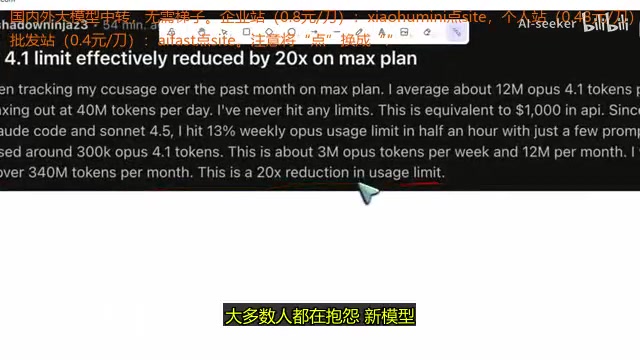
Recently, Anthropic released the Claude 4.5 Sonnet model, intending to attract more developers back to its platform. However, instead of winning applause, the release triggered widespread user dissatisfaction and exodus. The core reason: Alongside the new model launch, Anthropic drastically cut the Opus model quota for $200 Max plan users, reducing usage limits by approximately 20x.
Within Anthropic's model family, Opus, Sonnet, and Haiku form a three-tier product line from high to low. This tiered strategy is common in the large language model industry, with the underlying logic directly tied to model parameter scale — more parameters allow the model to capture more complex language patterns and logical relationships, but inference requires proportionally more GPU compute and memory. Opus is positioned as the flagship model with the largest parameter count (estimated in the hundreds of billions), offering significant advantages in complex reasoning, long-chain logical analysis, and multi-step code debugging. Sonnet is the mid-tier model, striking a balance between speed and cost. For professional developers, Opus's performance in handling large-scale code refactoring, cross-file dependency analysis, and architecture-level planning is far beyond what Sonnet can deliver — this is the fundamental reason why the quota cut triggered such intense backlash. Users paid top-tier prices but were forced into a mid-tier experience. Larger parameter counts mean higher inference costs per API call, which is Anthropic's economic motivation for limiting Opus quotas, but unilaterally shifting cost pressures onto paying users is clearly hard to justify.
For programmers who rely on Claude Code daily for development work, this is nothing short of pulling the rug out from under them. Although Claude 4.5 Sonnet looks impressive on benchmarks, real-world performance improvements are only around 10% — nowhere near matching Opus's powerful capabilities in debugging, planning, and other complex tasks.
Anthropic's Trust Crisis: From Developer Darling to Industry Pariah
User Frustration Boils Over
Anthropic was once among the most developer-beloved AI companies, but recent moves are rapidly eroding that trust. On the Claude Code Reddit board, complaint posts are everywhere, with core grievances centered on:
- Marginal new model improvements: Claude 4.5 Sonnet offers no quantum leap over its predecessor
- Stealth downgrades of premium models: $200 plan users allegedly receiving degraded or quantized model versions
- Increasingly restrictive usage limits: Strict quotas severely diminish the "paying customer" experience
The quantization suspicions deserve deeper explanation. Quantization is a model compression technique that reduces the numerical precision of model weights (e.g., from 32-bit floating point to 8-bit or 4-bit integers) to decrease computational resource consumption and inference costs. While quantization can dramatically reduce server-side GPU memory usage and inference latency, the trade-off is degraded performance in nuanced reasoning, edge case handling, and long-text coherence. In the industry, from GPTQ and AWQ to the newer GGUF format, various quantization approaches each have their trade-offs. The industry generally considers INT8 quantization to have minimal impact on model performance (typically within 1-2%), but more aggressive INT4 or even INT2 quantization can cause noticeable quality degradation, especially in precision-sensitive tasks like mathematical reasoning and code generation. In fact, multiple AI companies have been caught by user communities deploying quantized models for API services without public disclosure, making this a focal point of industry transparency debates. Users suspecting Anthropic provides quantized models to $200 plan subscribers means they may unknowingly receive performance-degraded service — raising serious trust issues on the commercial transparency front.
Many developers are already voting with their feet — some switching to GPT-5 Codex, others to GLM. Claude's user base is being steadily eroded.
Claude's API Pricing Strategy Draws Industry Scrutiny
From an API pricing perspective, Anthropic's fee structure is staggering. Claude 4.5 Sonnet charges $3/million tokens for input and $15/million tokens for output. Meanwhile, GLM 4.6, with comparable performance, charges only $0.6 for input and $2.2/million tokens for output — a price gap of nearly 10x.
To understand the real-world impact of this price gap, you need to understand how token billing works. Tokens are the basic units that large language models use to process text — an English word is typically split into 1-3 tokens, while Chinese characters usually correspond to 1-2 tokens each. Billing per million tokens is the industry standard, with input tokens (user prompts and context) and output tokens (model-generated responses) priced separately. Output tokens cost more due to the autoregressive generation mechanism of large language models — generating each new token requires recalculating attention weights across all previously generated tokens, meaning the computation for generating the Nth token scales linearly with sequence length, and the total computation for the entire output grows approximately quadratically with output length. In contrast, input tokens can be processed in parallel in a single pass, making them far more efficient than sequential generation. This is the technical reason why all major API providers charge more for output tokens. In coding scenarios, a single complex code generation request may consume thousands to tens of thousands of tokens, and with daily high-frequency usage, API costs accumulate rapidly — making a 10x price difference translate into enormous budget implications for actual development.
This means either Anthropic's models run extremely inefficiently (hard to believe for a company of this scale), or they're simply leveraging market position to set unreasonably high prices. Neither explanation is good news for budget-conscious developers.
GLM 4.6 Deep Dive: A Cost-Effective AI Coding Alternative
Model Capabilities Directly Rival Claude 4.5 Sonnet
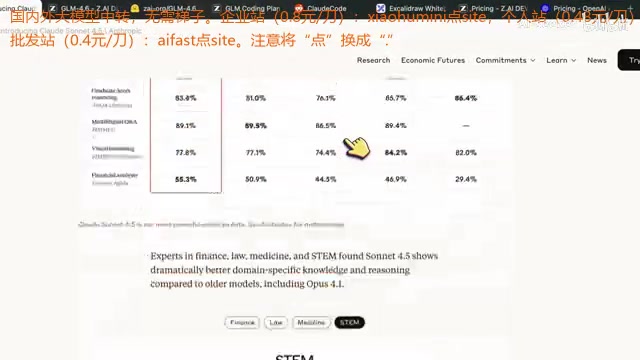
GLM 4.6 launched just one day after Claude 4.5 Sonnet. As the successor to GLM 4.5, it's an open-weight model. Based on actual usage experience, GLM 4.6 not only matches Claude 4.5 Sonnet but even surpasses it in certain tasks.
Open-weight models are those whose parameter weights are publicly released, allowing developers to download, deploy, and even fine-tune them. This differs slightly from fully open source — open weights typically publish model parameters but don't necessarily disclose training data or the complete training pipeline. For developers, the core value of open-weight models lies in: First, self-hosted deployment on local or private cloud infrastructure, keeping data within your own systems to meet compliance and privacy requirements; Second, avoiding vendor lock-in — even if the model provider changes its business strategy, downloaded models remain usable; Third, the community can fine-tune open weights for domain-specific optimization, creating customized versions better suited to business needs. Vendor lock-in is a classic enterprise IT problem that has re-emerged in new forms in the AI era — once developers build entire development pipelines around a closed-source model's specific API format, prompt engineering techniques, and workflows, migration costs escalate dramatically over time. The rise of open-weight models from Meta's LLaMA series, Mistral, and GLM is fundamentally changing this landscape, enabling enterprises to deploy models on their own infrastructure to meet strict data sovereignty requirements in regulated industries like finance and healthcare.
The model's core advantages include:
- 200K context window: Handles large codebases with ease, eliminating the need for frequent context truncation. The context window refers to the maximum number of tokens a model can process in a single interaction, determining how much information the model can "see" at once. In code development scenarios, a medium-sized code file typically contains hundreds to thousands of tokens, while a complete project may involve dozens of interconnected files. A 200K token context window is roughly equivalent to fitting an entire 500-page technical book's content simultaneously, enabling the model to handle cross-file code dependencies, understand overall project architecture, and provide more accurate modification suggestions without losing critical context.
- Excellent UI generation capabilities: Impressive performance in front-end development tasks with consistent code quality
- Built-in MCP server: Comes with web search and vision capabilities, creating a more integrated code generation experience. MCP (Model Context Protocol) is an open protocol standard designed to provide AI models with a unified interface for interacting with external tools and data sources. The protocol was first proposed and open-sourced by Anthropic in late 2024, but its ecosystem value has far transcended Anthropic's own products. MCP's design philosophy draws from the success of LSP (Language Server Protocol) — LSP greatly reduced IDE ecosystem fragmentation by standardizing communication protocols between editors and language tools. MCP aims to establish a similar standard layer for AI model-tool interactions, allowing the same tool integrations to be reused across different models and applications. MCP servers act as bridges between AI models and the external world, enabling models to invoke external capabilities like web search, file system operations, database queries, and API calls. Currently, hundreds of community-developed MCP servers cover scenarios ranging from GitHub operations to database queries. In coding scenarios, a built-in MCP server means the model can consult the latest documentation, search code repositories, and even execute code verification while generating code, forming a closed-loop development assistance experience without developers manually switching between multiple tools and copy-pasting context.
- Not tied to specific tools: No mandatory pairing with specific IDEs or coding tools, offering greater flexibility
GLM Coding Plan Pricing: Extremely Competitive
GLM's coding plan pricing strategy is aggressive:
| Plan Level | Monthly Price | Annual/Quarterly Lock-in Price |
|---|---|---|
| Basic | $3→$6 | $3 fixed |
| Pro | $15→$30 | $15 fixed |
| Premium | $30→$60 | $30 fixed |

If you choose annual or quarterly billing, prices remain fixed throughout the subscription period. In practical terms, users can get a full year of GLM Coding Pro service for a price comparable to or lower than Claude's monthly fee, with quotas far exceeding the Claude Max plan.
More critically, GLM 4.6 is an open-weight model, giving developers greater flexibility and autonomy without worrying about vendors arbitrarily changing service terms or cutting usage quotas — precisely the biggest pain point for current Claude users.
The AI Coding Tool Market Is Being Reshaped
Multiple Competitors Rising Across the Board
Anthropic's challenges don't come solely from GLM. GPT-5 Codex, Gemini, and other products are all pushing into the coding space, giving developers more choices than ever. When a company's core competitive advantage is no longer unique, premium pricing strategies become unsustainable.
Notably, the AI coding tool market is undergoing a structural transformation. The early market was dominated by a handful of companies — GitHub Copilot once held a dominant position through first-mover advantage, developers had limited choices, and vendors held strong pricing power. But between 2024-2025, emerging tools like Cursor, Windsurf, and Cline rapidly gained ground through deeper IDE integration and more flexible model selection, dramatically shifting the competitive landscape. Meanwhile, AI coding has evolved from simple code completion to agentic autonomous coding — models can not only generate code snippets but also understand project structure, execute terminal commands, run tests, and self-correct based on results. This capability leap makes the choice of underlying model even more critical, intensifying competition among model providers. As the open-source community grows, open-weight models proliferate, and more well-funded competitors enter the market, the landscape is shifting from a seller's market to a buyer's market. This competitive shift means any strategy attempting to maintain profits through user lock-in and premium pricing will face increasing market resistance.

How Should Developers Make Rational Choices?
For cost-conscious developers, now is genuinely a good time to reassess your toolchain. Here are several key dimensions worth considering:
- Cost-effectiveness: GLM 4.6's API pricing is one-tenth of Claude's, and its coding plans are extremely attractive
- Openness: Open-weight models mean lower vendor lock-in risk, with data and workflows remaining in your own hands
- Feature completeness: Built-in MCP server provides a more complete development experience, reducing tool-switching costs
- Price stability: Annual payment price-lock mechanisms eliminate pricing uncertainty, facilitating team budget planning
Of course, tool selection varies by individual. Claude Sonnet still performs excellently in certain scenarios, but "best performing" and "best value" are two entirely different questions. When the price gap reaches 10-20x, marginal performance differences become hard to justify.
Final Thoughts: Claude or GLM — How Should Developers Choose?
Anthropic is walking a dangerous path — increasingly resembling the OpenAI it once tried to differentiate itself from. Cherry-picked benchmarks, unfair model comparisons, and continuously rising prices are eroding developer community trust.
For the upcoming Claude 5, market expectations are that prices will only go higher. But with alternatives like GLM 4.6 and GPT-5 Codex maturing rapidly, whether a premium pricing strategy can continue to work is a serious open question.
The competition in AI coding tools is just beginning, and the ultimate beneficiaries will be developers with more choices. If you're frustrated by Claude's quota limits and steep costs, give GLM 4.6 a try — at least on the cost-effectiveness dimension, it offers an answer that's very hard to refuse.
Related articles
 Tech Frontiers
A Rare Quiet Day in AI: Recursive Self-Improvement Stirs Beneath the Surface
A rare quiet day in AI sees multiple sources go silent simultaneously. Behind the calm, Recursive Self-Improvement (RSI) research continues. What this means for the industry.
 Tech Frontiers
Reve 2 vs. Ideogram 4: A Deep Dive into Layout Control in AI Image Generation
A deep comparison of Reve 2 and Ideogram 4's layout control capabilities, covering technical approaches, real-world use cases, and industry trends for designers and creators.
 Tech Frontiers
In the Weights: Check Your Influence Score in the AI World
In the Weights is an AI influence search engine that quantifies your presence in the AI world with a score. Explore how it evaluates practitioners and what it means for digital identity.