Claude's Riemann Hypothesis Proof Caught in Plagiarism Dispute: US Entrepreneur Alleges Copying and Threatens Lawsuit
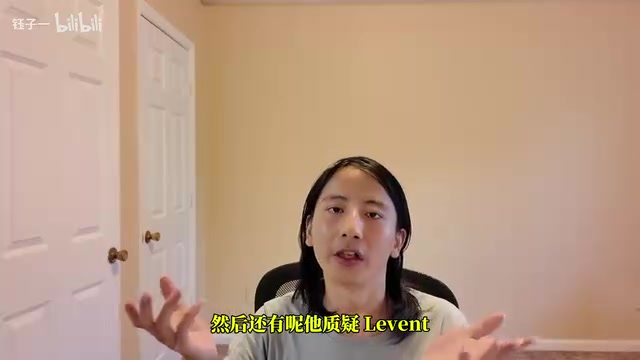
US entrepreneur accuses Anthropic's Claude of plagiarizing his Riemann Hypothesis research and threatens to sue.
US entrepreneur Robert Grant publicly accused Anthropic and its AI model Claude of plagiarizing his Riemann Hypothesis research, sending a three-page legal letter and threatening litigation. The allegations include overlapping timelines, possible data use after disabling training, and timing linked to the company's IPO. Grant copied financial institutions like Goldman Sachs and Citigroup to broaden impact. All claims are unilateral, Anthropic has not responded, and the case may lead to litigation or settlement. The incident raises concerns about AI training data privacy and user data boundaries.
Background: From Mathematical Breakthrough to Legal Threat
According to a video shared by Bilibili creator Yu Ziyi, a US entrepreneur recently publicly accused Anthropic and its AI model Claude on Twitter, alleging that their recent proof of the Riemann Hypothesis plagiarized his personal research ideas. The accuser is no ordinary internet user—he has served as an executive at several well-known pharmaceutical companies with valuations in the billions, describes himself as an "independent mathematics researcher," and has retained a lawyer, threatening to sue Anthropic.
The accusation has drawn attention not only because the Riemann Hypothesis is one of the top problems in mathematics, but also because the accuser has considerable social standing and financial resources. Yu Ziyi noted in the video that similar accusations from an ordinary person might be ignored, but this entrepreneur "really has the money to hire lawyers," so the course of events is worth watching.
The Riemann Hypothesis is one of the most famous unsolved problems in mathematics, proposed by Bernhard Riemann in 1859. It asserts that all non-trivial zeros of the Riemann zeta function lie on the line in the complex plane with real part 1/2. The conjecture is closely tied to the distribution of prime numbers, and if proven, would profoundly affect number theory, cryptography, and other fields. The Clay Mathematics Institute lists it as one of the Millennium Prize Problems, with a one-million-dollar reward. Given its extreme difficulty, any claimed proof invites rigorous scrutiny—and AI involvement in proofs is a recent phenomenon.
Five Core Challenges in the Three-Page Statement
According to the creator's summary of the statement, the entrepreneur (identified in tweets as Robert Grant) sent a formal letter to Anthropic CEO Dario Amodei, with copies to several financial institutions and executives. The statement raises five main challenges:
1. Overlapping Timeline: Key Ideas Predate Laywind's Publication
Grant claims he began research on the Riemann Hypothesis as early as June 25, 2025, and recorded his results in a mathematical manuscript. After Laywind published the proof developed with Claude, he found multiple key overlaps between the two bodies of work. He lists five specific items: fluctuations and overall balance in prime distribution (claiming he obtained results on December 31, earlier than Laywind's October publication of research progress), prime density statistics and zero detection (claiming he proposed an analytical method on August 22, 2026, 59 days earlier), reciprocal cancellation methods, precise prime estimation (claiming he proposed a construction on October 13, 2026), and Jacobian-related algebraic structures.
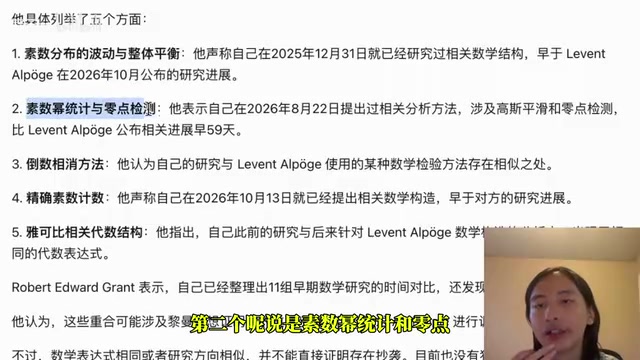
These dates all come from Grant's unilateral statement and have not been independently verified.
2. Privacy Settings Dispute: Is Data Still Used After Disabling Training?
Grant claims he submitted mathematical manuscripts to Claude multiple times to assist his research and had turned off the "allow conversations to be used for model training" option in his account. In theory, Claude should not use his data for training. But he suspects these unpublished mathematical results may still have been used for model training or entered a retrieval system. He demands that Anthropic confirm when the account privacy settings took effect and investigate whether the manuscripts were included in training data. This is the most central technical dispute in the entire accusation.
In AI model training, the use of user data is typically governed by privacy policies. Many platforms offer a toggle for "allow conversations to be used for model training," but whether data is completely excluded from training after opting out involves complex factors such as data pipelines, anonymization, and model update cycles. Even if not directly used in training, user-submitted content may be referenced by the model through retrieval-augmented generation (RAG) systems. Moreover, models may indirectly learn similar information from public or semi-public sources. Therefore, the actual effect of privacy toggles requires transparent auditing—a contentious issue in current AI governance.
3. Speculation Linking Publication Timing to the Company's IPO
Grant questions whether the timing of the Riemann Hypothesis proof's publication is related to Anthropic's IPO. He notes that Anthropic began stock trading on October 19, and the Riemann Hypothesis proof was announced on October 20. He also points out that the mathematical breakthrough was released through Laywind's personal website rather than Anthropic's official channels, arguing that this approach is linked to the company's IPO timing and demanding further investigation.
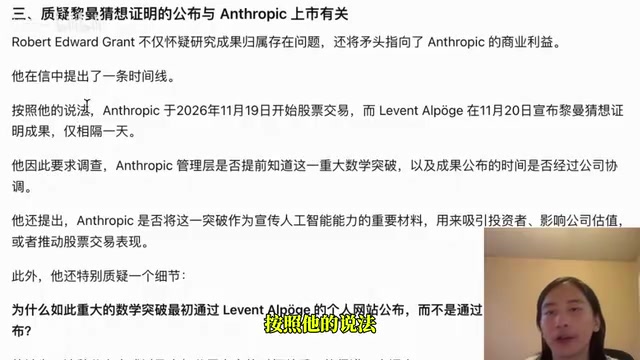
This challenge is a motive speculation, and the creator also emphasized that "this is just his personal claim without evidence."
The timing of stock trading and major announcements often attracts regulatory attention. Public companies are generally required to comply with disclosure rules and avoid releasing material news during sensitive periods that could affect share prices. However, private companies or pre-IPO firms are not subject to the same constraints. If Anthropic announced a mathematical breakthrough around its IPO, it could be intended to boost market confidence, but it could also raise conflict-of-interest concerns. Such speculation requires comprehensive judgment based on the company's listing status, the nature of the announcement, and regulatory requirements; there is currently no substantive evidence.
4. Lawyer's Letter and Evidence Preservation Demand
On the last page of the statement, Grant says he has retained a lawyer to handle the matter and demands that Anthropic preserve all relevant disputed materials, including chat records, and not destroy them. If Anthropic does not respond, he will initiate legal proceedings. Notably, he copied the letter to Anthropic's legal department, board of directors, and financial institutions including Goldman Sachs, JPMorgan Chase, and Citigroup, attempting to expand the dispute from mathematics to corporate governance and finance.
5. Attachments: 15-Page Timeline Comparison and Research Threads
The statement includes extensive materials, including a 15-page document comparing the timelines of his and Laywind's mathematical research, as well as comparisons of mathematical research beyond the Riemann Hypothesis and research experiment threads. The creator suggests interested viewers read the original statement.
Why This Matters
The core conflict in this controversy is how AI companies use private data submitted by users during model training, especially when users have explicitly disabled the training toggle. If Grant's allegations hold, they would touch on the credibility of Anthropic's privacy commitments; if not, they could involve damage to the company's reputation.
From a传播 perspective, the Riemann Hypothesis has extremely high public interest, and combined with elements like "plagiarism," "IPO," and "lawsuit," the story is prone to amplify. But the creator repeatedly emphasized in the video that he does not know whether the allegations are valid, "whether Anthropic actually called his data when training the model internally." All information currently comes from Grant's unilateral statement, and Anthropic has not publicly responded.

Another possibility is that the two parties reach a private settlement. Grant has retained a lawyer and can afford litigation costs, but legal proceedings are lengthy and outcomes uncertain. Regardless of how it unfolds, this incident provides a new case for discussion on the boundary between AI companies and user data.
The boundary between AI companies and user data is becoming increasingly prominent. Under current legal frameworks, user agreements typically grant companies broad data usage rights, but users remain concerned about where their data goes after disabling the training toggle. If the allegations enter judicial proceedings, they could drive stricter data governance standards. Meanwhile, the originality and ownership of AI-generated content have no clear legal definition, and similar disputes may increase. This incident highlights the critical role of technical transparency and user trust in AI development.
Open Questions and Follow-Up
Only one thing is certain at present: an entrepreneur with resources and a lawyer has formally accused Anthropic of plagiarism and threatened legal action. Whether Claude actually "stole" his ideas requires Anthropic's investigation and possibly judicial proceedings to answer. For readers concerned about AI ethics and data privacy, the developments are worth following closely.
Related articles

Jensen Huang Returns to Nvidia: The Power Game Behind an "Aggro Reset"
Nvidia's board reappointed Jensen Huang as CEO less than two weeks after his scandal-driven resignation. This analysis explores the board's decision-making, Trump's political intervention, media power failure, and market reaction behind the dramatic return.

Why Voice AI Can't Understand Kenyans' Everyday Conversations
Swahili speech recognition hits 3.24% error on read text, but everyday Kenyan speech mixes English, Sheng slang, and accents—leaving mainstream voice AI struggling.

Data Centers Build Their Own Natural Gas Plants: AI Compute's Breakout Around a Decade-Long Grid Wait
Grid interconnection approvals can take a decade, so xAI and others are building off-grid natural gas plants to power AI clusters. This article analyzes the drivers, costs, and impact of behind-the-meter generation on AI infrastructure.