Claude's Storage Architecture Overhaul: The Line Between Local and Cloud Is Being Redrawn

Anthropic removes local storage for Pro/Max users on Oct 6; only Claude Code and enterprise plans keep local control.
Anthropic is systematically overhauling Claude's data storage architecture. Starting October 6th, all new sessions for Pro and Max individual subscribers will be forced to cloud storage, with the local option removed — though existing locally-started tasks are unaffected. The one exception is Claude Code, which retains local runtime capability and remains the strongest option for data control. Team and Enterprise plans let admins set their own storage policies for now, with no migration timeline announced, though enterprise users should watch for future changes. This information was originally scattered across 21 official documents, highlighting a broader trend of user data sovereignty being quietly eroded as AI products consolidate around cloud-first architectures.
Claude's Storage Migration: An Architectural Shift Easy to Miss
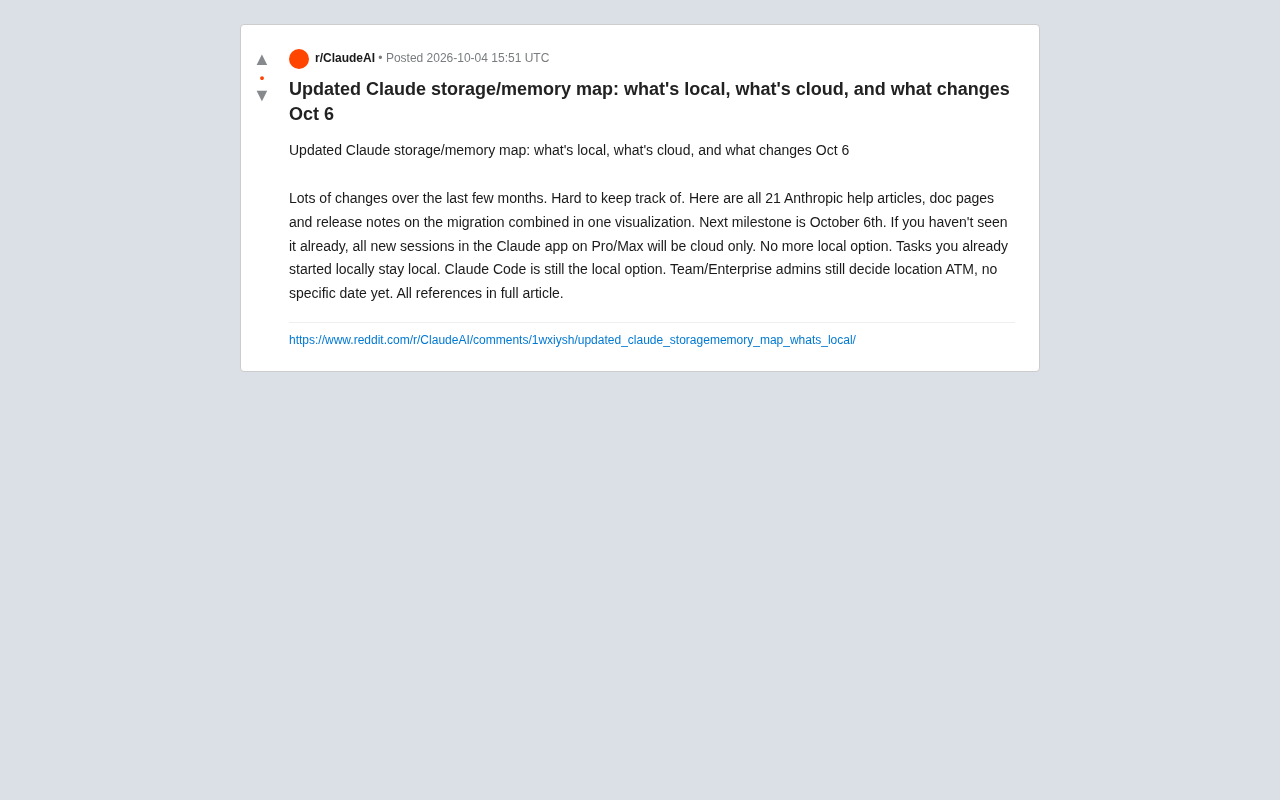
Over the past few months, Anthropic has made a series of adjustments to Claude's data storage and memory systems — at a pace that's left many users struggling to keep up. One Reddit user consolidated 21 official Anthropic help documents, explainer pages, and release notes into a visual map, attempting to answer one core question: what data lives locally, what lives in the cloud, and what changes are coming?
For users who rely on Claude for sensitive data or prefer local workflows, this isn't a trivial technical footnote. Storage location directly affects privacy boundaries, data ownership, and availability in offline or restricted network environments.
October 6th: The Local Option Disappears for Pro/Max Users
The next critical milestone in this migration is October 6th. According to the compiled information, all new sessions for Pro and Max subscribers in the Claude app will support cloud storage only — local storage will no longer be an option.
This means that starting that day, data from new conversations and tasks initiated by individual paid users on Claude's desktop or mobile app will default into Anthropic's cloud infrastructure. For users who previously relied on local storage to keep data off external servers, this is a change that warrants serious reconsideration.
There is one important buffer: tasks already started locally before the migration date will remain local. In other words, the change only applies to new sessions — existing local data won't be forcibly migrated. This gives users some transition room, but it also means that once a new session is opened, cloud storage becomes a given.
Claude Code Remains a Stronghold for Local Storage
Amid this broader shift toward the cloud, Claude Code still retains the ability to run locally. For developers, this is a notable exception worth paying attention to.
As a tool built for coding workflows, Claude Code naturally involves local codebases, file systems, and development environments. Keeping the local option intact aligns with developers' needs for code privacy and environment control, while avoiding the security and compliance concerns that would come with forcing entire local projects into the cloud.
This differentiated approach reflects Anthropic's thinking: consolidate toward the cloud on consumer-facing conversational apps to unify the experience and accelerate feature iteration, while preserving greater local control for developer tooling.
Claude Code is Anthropic's command-line AI coding tool for developers. It runs directly in the local terminal environment and integrates deeply with the user's codebase, file system, and development toolchain. Unlike conversational Claude apps, Claude Code's typical workflow involves reading and modifying local code files — which means forcing it to the cloud would send the entire codebase off the local machine, posing a real security risk for projects involving trade secrets, unreleased products, or code covered by NDAs. Keeping the local runtime also makes it better suited for air-gapped enterprise development environments without external internet access. For privacy-conscious individual users, migrating sensitive tasks to Claude Code is currently the most direct path to avoiding cloud storage.
Enterprise and Team Plans: Admins Still Hold the Keys — For Now
For Team and Enterprise plans, the situation is different. Team and enterprise administrators can still determine where data is stored, and no specific migration timeline has been announced.
This arrangement reflects the practical realities of enterprise customers. Large organizations typically have strict data residency requirements, compliance audits, and internal security policies that make passive, unannounced data migration unacceptable. Giving control to admins is Anthropic's necessary concession to the enterprise market as it pushes toward broader cloud consolidation.
That said, the word "for now" is worth noting — no announced timeline doesn't mean no change is coming. Enterprise users would be wise to monitor official release notes closely and proactively assess how potential policy shifts might affect their operations.
Data Residency is a core concept in enterprise data compliance, referring to the requirement that data must be stored within a specific geographic region or legal jurisdiction. The EU's GDPR, China's Data Security Law, and various industry regulations (in finance, healthcare, and others) all impose explicit constraints on where data is physically stored. For multinational enterprises, uploading conversation data to Anthropic's cloud infrastructure could mean cross-border data transfers, triggering data sovereignty compliance reviews. This is precisely why enterprise plans must preserve admin control over storage location — it's not just a feature preference, it's a hard legal requirement. Some highly sensitive industry users may even demand on-premises deployment, where the AI model and all data run entirely within their own internal network, completely isolated from any third-party cloud.
Why This Matters
This storage architecture shift is easy to overlook precisely because the information is scattered across 21 separate official documents, with no single, clear summary. Ordinary users have little reason to realize their data boundaries are quietly shifting.
From a broader perspective, this change is a textbook example of AI products moving toward cloud-integrated architectures. Cloud storage makes features like persistent memory, cross-device sync, and continuous iteration much easier to deliver — but the trade-off is reduced user control over where data physically lives. In an era of growing privacy awareness, this kind of trade-off will keep generating debate.
The practical takeaways for users are straightforward:
- Pro/Max individual users: New sessions after October 6th will default to cloud storage. If you have local storage requirements, plan ahead — or consider using Claude Code for sensitive tasks.
- Developers: Claude Code can still run locally and currently offers the strongest control over data location.
- Enterprise/Team users: Storage location remains admin-controlled for now, but stay on top of official updates to avoid being caught off guard.
Understanding "what's local and what's in the cloud" is no longer just technical curiosity — it's a practical decision about data sovereignty.
Related articles

Gemini 4 Argon Hands-On: AI Builds Board Games, Constructs Temples, and Trains Robots Autonomously
Gemini 4 Argon hands-on roundup: AI autonomously builds a desk racetrack and temple in Blender, writes a ray tracing engine, trains a humanoid robot to sink 7 shots, plus API pricing and developer access.

The Magic Octagonal Coin: Why Only 9% of People Can Predict Its Flip?
Only 9% of people can correctly predict the Magic Octagon coin flip. This article explains its spatial rotation mechanism, common cognitive pitfalls, and a new hypothesis based on Relevance Theory, exploring the limits of human spatial reasoning.

Sam Altman: AI Is Entering the Era of Scientific Discovery — Math Breakthroughs Will Replicate in Biology and Energy
Sam Altman says AI is entering the era of scientific discovery — math breakthroughs will replicate in biology, materials science, and energy to help develop new drugs and energy sources.