Claude's Terms Confuse European Users: Pro/Max Prohibited for Commercial Use, Even Support Can't Clarify

European Pro/Max terms contain a hidden non-commercial restriction; support is vague, and developers' commercialization is blocked.
Anthropic's Free, Pro, and Max consumer terms for the European Economic Area (EEA) and Switzerland include a "non-commercial use only" provision, while US terms do not. A developer built a project intended for commercialization with Max and Claude Code and asked official support whether they could sell the output and whether upgrading to a commercial plan would cover code written earlier. Both support replies failed to give a clear answer, pushing the judgment responsibility back to the user. Another community claim says upgrading to a commercial plan before selling "would likely be sufficient," but the rules remain vague. More ironically, the Team plan lacks a seat equivalent to Max 20x, so heavy users who comply must accept reduced usage, objectively pushing some European users to cancel or switch to cheaper plans. The poster calls on European users to speak up and share clear answers, and advises developers to confirm terms in writing, keep records, and plan migration before commercialization.
An Overlooked Clause Blocks European Developers' Path to Commercialization
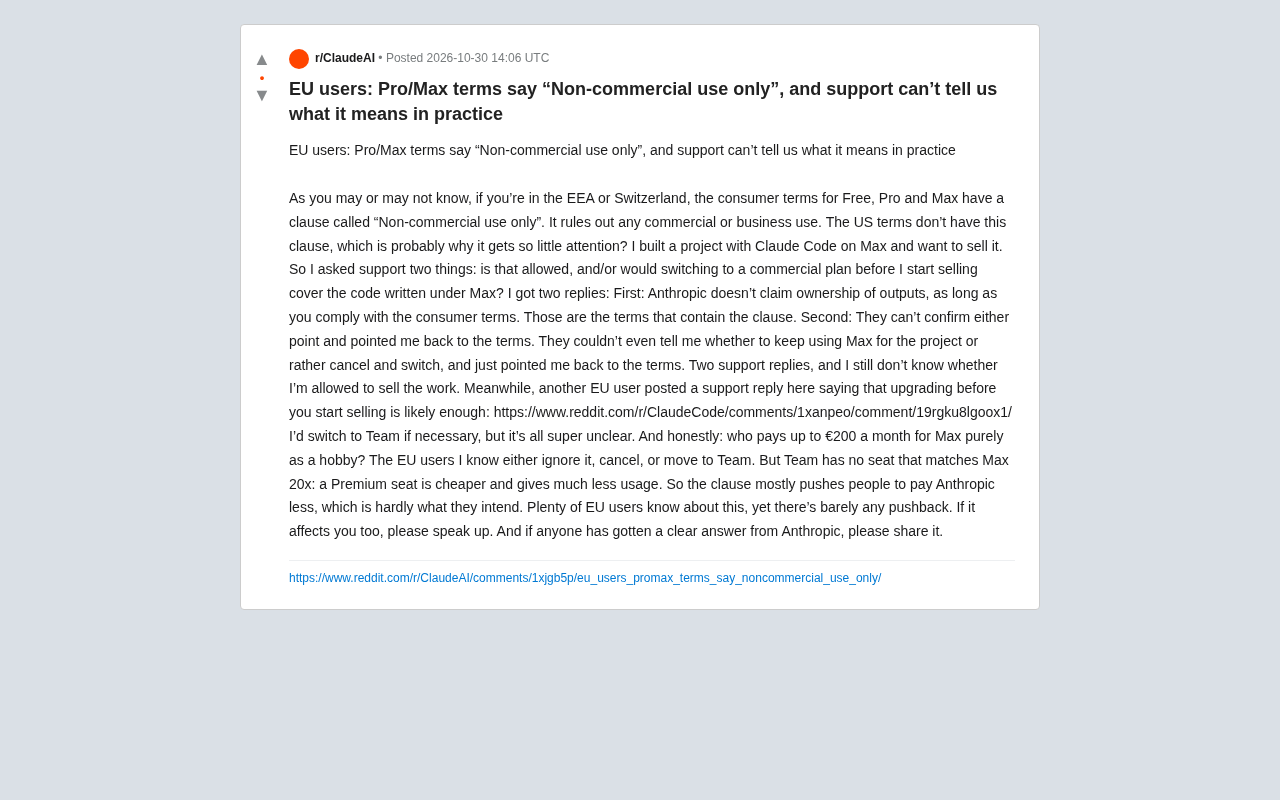
If you're in the European Economic Area (EEA) or Switzerland and using Claude's Pro or Max subscription to build something that makes money, you may want to pause and take a close look at the user terms. A developer in the Reddit r/ClaudeCode community pointed out that Anthropic's Terms of Service for Free, Pro, and Max consumers in Europe include a "Non-commercial use only" provision that explicitly excludes any commercial or business use. The US terms do not contain this clause, which may explain why the issue has long lacked discussion.
This user built a project using a Max subscription with Claude Code and planned to commercialize and sell it, so they raised two specific questions with official support: Is this allowed? If they switch to a commercial plan before starting sales, would that cover the code written under Max?
The European Economic Area (EEA) and Switzerland are the regions where Anthropic applies a separate set of consumer terms. The EEA includes the 27 EU member states plus Iceland, Liechtenstein, and Norway. Although Switzerland is not an EU member, it has long aligned with the EU on data protection and consumer rights rules. AI service providers often bundle these two regions together because local consumer protection laws (such as the EU's Unfair Contract Terms Directive) impose stricter requirements on distinguishing "commercial use" from "consumer use," and vendors tend to explicitly exclude commercial use in consumer terms to limit liability. This also explains why the same product has inconsistent terms wording in the US and Europe—it is more a product of compliance strategy than a difference in product capability.
Two Support Replies That Said Essentially Nothing
According to the post, the support team provided two replies, but neither resolved the issue. The first reply stated that as long as the consumer terms are followed, Anthropic does not claim ownership of the output—and those consumer terms are precisely the document containing the "non-commercial use" restriction. The second reply was more direct: they could not confirm any of the above and could only refer the user back to the original terms.
The user said support could not even tell them whether to continue using Max to advance the project or simply cancel the subscription and switch to another plan, repeatedly pointing only to the terms link. After two rounds of communication, they still did not know whether they had the right to sell the work product.
This detail is worth noting: the first half of the support response (no claim to output ownership) sounds friendly, but the second half pushes the judgment responsibility entirely back to the user. For developers who need to make business decisions, this kind of "compliance at your own risk" answer provides no actionable information.
"Anthropic does not claim ownership of the output" is a common statement in generative AI terms of service, meaning the vendor waives copyright claims over model-generated text, code, and other outputs, and users may use them freely. But this commitment is usually conditioned on "compliance with the terms of service." In other words, ownership attribution and usage-scenario restrictions are two independent dimensions: even if the vendor does not claim copyright, a user who violates the "non-commercial use only" agreement may still be in breach of contract. Support treated the former as reassurance and pushed the latter back to the user—essentially using an unrelated commitment to sidestep the real compliance question.
Another Voice in the Community: Upgrading Before Selling May Be Enough
The post also cited a support reply previously shared by another European user, which suggested that upgrading to a commercial plan before starting sales "would likely be sufficient." Under this interpretation, code produced while using Max could be used for commercial purposes after upgrading to a commercial plan such as Team.
But the poster was not reassured by this. They said they were willing to switch to Team if necessary, but the rules were too vague. The more practical question is: who would spend nearly 200 euros a month on a Max subscription purely for a hobby? The European users they know either ignore this clause, cancel their subscriptions, or switch to Team.
A Pricing Structure Mismatch That Pushes Users Toward Cheaper Plans
The poster pointed out a rather ironic business logic: the Team plan has no seat equivalent to Max 20x usage. Premium seats are cheaper but offer much less usage. This means that a heavy user with usage close to Max 20x who wants to commercialize compliantly must either accept reduced usage or leave the platform.
In other words, this vague "non-commercial use" clause objectively pushes some European users to pay Anthropic less money—clearly not the intent of the clause's designers. When the cost of compliance exceeds the benefit, users often do not dutifully upgrade; they simply churn.
Max 20x is Anthropic's subscription tier for heavy users, priced at roughly 5 times Pro, offering significantly higher usage quotas and mainly serving scenarios such as long-running Claude Code sessions and handling large codebases. The Team plan is billed per seat and divided into Standard and Premium tiers. The Premium seat unit price is lower than Max 20x, but the per-seat usage cap is also noticeably lower. The two are not products on the same dimension: Max is for individual heavy usage, while Team is for multi-person collaboration plus management features. Therefore, for a solo heavy developer, there is no option to "pay more and transfer usage"—this is the structural root of the trade-off dilemma described in the article.
Why More European Users Should Speak Up
The poster mentioned that many European users are actually aware of this clause, but there has been almost no vocal opposition. Their call is direct: if you are also affected, speak up; if anyone has received a clear answer from Anthropic, share it.
The issue reflects a problem that goes beyond any single product. When AI subscription services operate globally, regional differences in terms translate directly into differences in product capability. For developers, whether code output can be used commercially is a core concern, and a vague "non-commercial only" definition is enough to undermine the entire tool selection process. For vendors, outsourcing compliance judgments entirely to users and support scripts saves legal costs in the short term but erodes user trust in the long term.
For developers in Europe currently using Pro or Max for projects, the current practical advice is: before a project enters the commercialization stage, proactively confirm the scope of the terms with official channels in writing and keep records of the communication; if no clear answer can be obtained, plan the migration path to a commercial plan in advance and assess whether the usage gap is acceptable.
Does your region have similar restrictions in its terms? Feel free to share your experience in the comments.
Related articles

Claude Code v2.1.316 Update Analysis: Enterprise Gateway and Multiple Stability Fixes
Claude Code v2.1.316 released: new enterprise gateway pooled group budgets, layered policy mode, subagent effort control, dozens of Shell, network, and session recovery fixes, and Opus 4.8 fast mode deprecated.

17th-Century British Floods and Doomsday Panic: A New Perspective on Weather History
Based on a Hacker News discussion of '17th-Century British Floods and Foreboding,' this piece explores how extreme weather was given divine and political significance, and what weather history teaches us about contemporary climate communication.

Salesforce Acquires Rune for $375M: AI Logistics Tech Bolsters Defense Business
Salesforce reportedly acquires defense tech startup Rune for $375M. Rune's AI logistics tech will strengthen Salesforce's Missionforce defense platform, continuing its M&A spree.