Claude Shared Links Indexed by Google: Privacy Risks and Protection Guide

Claude's shared links and Artifacts risk being indexed by Google, potentially exposing private conversations publicly.
Claude's share feature generates public URLs for conversations and Artifacts that can be discovered and indexed by Google's crawlers, potentially exposing sensitive user data to public search. The article analyzes the technical root causes, including the lack of noindex protections and how Googlebot discovers URLs, discusses privacy and compliance risks under GDPR and HIPAA, and provides practical protection tips for users alongside product design recommendations for AI vendors.
Claude Shared Links Indexed by Google: Event Overview
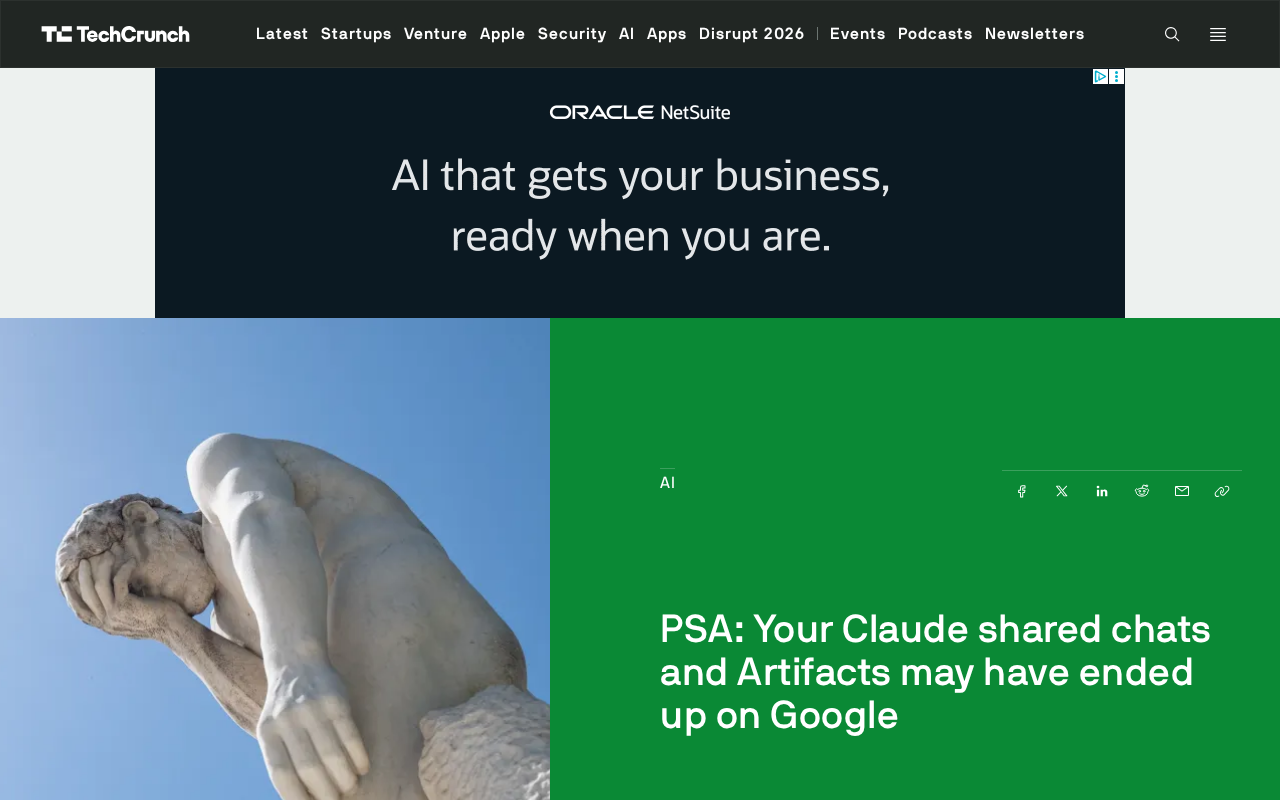
Recently, a privacy concern involving Anthropic's AI assistant Claude has attracted widespread attention in the tech community. According to discussions on Hacker News, conversation links (shared chats) generated through Claude's "Share" feature, as well as Artifacts (interactive outputs such as code and documents generated by Claude), may be crawled and indexed by Google's search engine.
This means that conversation content users believed was only shared privately with specific recipients could unknowingly become publicly searchable web pages. For conversations involving sensitive information, trade secrets, or personal privacy, this is undeniably a risk that cannot be ignored.
Technical Root Cause Analysis
The Inherently Public Nature of Shared Links
When a user clicks the "Share" button in Claude, the system generates an accessible public URL. While this link typically isn't actively distributed, it is essentially a public page accessible to anyone who holds the link.
The crux of the issue is this: if these shared pages don't explicitly instruct search engine crawlers to "do not index" through robots.txt or page-level noindex meta tags, then whenever the link is exposed on the internet in any form (e.g., shared on public forums, social media, or referenced by other indexed pages), Google's crawler may crawl and include it in search results.
It's worth explaining the difference and hierarchy between these two technical measures. robots.txt is a protocol file placed in a website's root directory, following the Robots Exclusion Protocol proposed by Martijn Koster in 1994, which tells search engine crawlers which pages are allowed to be crawled and which should be skipped. However, robots.txt is essentially a "gentleman's agreement" — it relies on crawlers voluntarily complying, and malicious crawlers can completely ignore it. In contrast, page-level noindex meta tags (<meta name="robots" content="noindex">) are directives embedded directly in the HTML header. Even if a crawler fetches the page content, the search engine will honor this directive and not include it in the index. Additionally, there's the X-Robots-Tag HTTP header approach, suitable for index control of non-HTML resources. In actual engineering practice, the safest approach is to use multiple layers of protection together.
How Google's Crawler Discovers These Links
Google's web crawler (Googlebot) operates through a complex URL discovery and crawling mechanism. Its URL sources include: hyperlinks from already-indexed pages, XML Sitemaps, browser activity data (via Chrome Usage Statistics), and URLs submitted by third-party tools. A key detail is that even if a page has never been actively submitted to Google, as long as its URL appears on any indexed public page — such as a tweet, a forum post, or even a public bookmarking service — Googlebot may discover and crawl it. Furthermore, modern Googlebot has JavaScript rendering capabilities and can execute JS code on pages, meaning even single-page applications (SPAs) that generate content dynamically can be fully crawled and indexed.
This Isn't a Problem Unique to Claude
You may not have noticed, but similar privacy incidents have occurred with other AI products before. For example, there were previous reports of ChatGPT shared conversations being indexed by search engines under certain circumstances. This reflects an industry-wide systemic issue: AI vendors often underestimate the cascading risk of public URLs being indexed by search engines when designing "share" features.
This is especially true for Artifacts — these interactive outputs are essentially complete web applications that inherently meet the conditions for being crawled and rendered by bots. Specifically, Claude's Artifacts feature allows the AI to generate independent interactive outputs during conversations, including complete HTML/CSS/JavaScript applications, SVG graphics, Markdown documents, React components, and more. These Artifacts are technically similar to online code sandboxes like CodePen or JSFiddle — they render and execute within independent iframe environments and are essentially complete web pages. When a user shares a conversation containing an Artifact, the rendered page of that Artifact also receives an accessible URL. Since these pages contain complete DOM structures and renderable content, they are indistinguishable from regular web pages to search engine crawlers, and may even be more easily indexed at high quality due to their clear structure and complete content.
Potential Privacy and Security Implications
Risk of Sensitive Information Leakage
Users may inadvertently input large amounts of sensitive information in their conversations with Claude: internal code snippets, unpublished product documentation, personally identifiable information, financial data, and even business strategies. Once this content is indexed by search engines through shared links, anyone could retrieve this supposedly confidential information through keyword searches.
Indexed Content Is Difficult to Completely Remove
Even if users realize the risk after the fact and delete the shared link, search engine caching mechanisms may still retain page snapshots for a period of time. Google's caching mechanism saves snapshot copies of web pages on its servers, and users can view historical versions of pages through the "Cached" option in search results. Even after the original page has been deleted or access-restricted, cached copies may remain accessible for days to weeks.
To completely remove this content from Google's index often requires proactively submitting removal requests through Google Search Console, which presents a high operational barrier for ordinary users. Specifically, website owners can submit emergency removal requests through Google Search Console's "Removals" tool, which typically takes effect within 24-48 hours. However, ordinary users who are not website owners can only submit requests through Google's "Remove Outdated Content" tool, and only if the original page is no longer accessible or the content has changed. Even more noteworthy is that even if Google removes the index, third-party archiving services like the Wayback Machine (Internet Archive) may still retain copies of the page — truly "disappearing from the internet" is virtually impossible to achieve.
Enterprise Trust and Compliance Risks
For enterprise users, such incidents also involve data compliance issues. If employees use Claude's sharing feature while processing data subject to regulatory frameworks like GDPR or HIPAA, and the content becomes publicly indexed, this could constitute a substantive compliance violation, bringing legal and reputational risks.
It's important to understand the strictness of these two major regulations. GDPR (General Data Protection Regulation) is a data protection regulation implemented by the EU in 2018, requiring data controllers to ensure that personal data processing has a lawful basis, and granting data subjects the right to request deletion of their personal data (the "right to be forgotten"). Violating companies can face fines of up to 4% of global annual turnover or €20 million (whichever is higher). HIPAA (Health Insurance Portability and Accountability Act) is a U.S. regulation for protecting medical health information, with strict restrictions on the storage, transmission, and disclosure of Protected Health Information (PHI). If AI conversations containing personal data or PHI are publicly indexed, data controllers may be deemed to have failed to fulfill their legal obligation to "implement appropriate technical and organizational measures to protect data," thereby facing investigation and penalties from regulatory authorities.
Practical Self-Protection Recommendations for Users
Use Claude's Sharing Feature with Caution
The most straightforward advice is: do not use Claude's share link feature unless you are certain the content can be made fully public. For collaboration scenarios, prioritize conveying information through controlled channels such as screenshots or copied text, rather than generating public URLs.
Regularly Check and Clean Up Shared Links
Users can periodically check the shared links they've created in their Claude account and delete those no longer needed. Additionally, try searching site:claude.ai plus relevant keywords in Google to check whether any content has been inadvertently indexed.
Exercise Extra Caution with Claude Artifacts
Since Artifacts themselves are renderable web outputs, they carry a higher risk of being crawled by search engines. Artifacts involving sensitive logic or data should not be distributed via the sharing feature.
Product Design Implications for AI Vendors
This incident once again reminds AI product vendors that privacy protection must be treated as a default priority (Privacy by Default) in feature design:
The Privacy by Default design principle originates from the Privacy by Design framework, proposed by Dr. Ann Cavoukian, former Information and Privacy Commissioner of Ontario, Canada, in the 1990s, and later formally incorporated into legal requirements under Article 25 of GDPR. The core tenet of this principle is that systems should provide the maximum degree of privacy protection in their default state — users should not need to take additional steps to enjoy privacy safeguards. In product design, this means sharing features should default to a "minimum disclosure" state — links should come with access restrictions or anti-indexing tags by default, and users should need to actively opt in to expand the scope of public access. This creates a natural tension with the "viral spread" design philosophy pursued by many internet products, but in an era of increasingly strict regulation, privacy-first has become an irreversible trend.
Specific product improvement directions include:
- Disable indexing by default: All user-generated shared pages should have
noindextags added at the server level by default, technically blocking search engine crawling. - Clear risk warnings: When users click share, they should be clearly informed that "this link will generate a publicly accessible page," rather than obscuring its public nature with vague wording.
- Convenient revocation mechanisms: Provide one-click functionality to delete shared links and request search engine cache removal, reducing the cost of user remediation.
- Link expiration mechanisms: Consider setting default expiration periods for shared links (e.g., automatic expiration after 7 or 30 days) to reduce long-term exposure risk.
- Access control options: Provide granular access controls such as password protection and email verification, allowing users to find a balance between "fully public" and "fully private."
Conclusion
As AI conversation tools become deeply integrated into daily workflows, the density and sensitivity of information users leave on these platforms is also increasing dramatically. While the current discussion around Claude's shared links potentially being indexed by Google remains limited in scale, it touches on a fundamental issue of the AI era: the tension between convenient sharing features and user privacy.
For users, cultivating the security awareness that "any public link may be discovered by search engines" is crucial. For vendors, building privacy protection into every aspect of product design is the fundamental path to earning long-term user trust. In an era where AI tools are increasingly becoming our "second brain," the value of information we entrust to these systems far exceeds that of any previous internet product — this demands that vendors apply higher security standards to every design decision that could potentially expose user data.
Related articles

Disaster and Glory of the Apollo Program: The History We Must Revisit Before Returning to the Moon
From the fatal Apollo 1 fire to Apollo 8's daring lunar orbit to Apollo 11's successful landing—revisiting the disasters, fears, and compromises of the Apollo program and their lessons for today's return to the Moon.
Netflix Trust Exercise Turns Into Firing Trap: Where Are the Boundaries of Corporate Trust?
A Netflix employee was fired after sharing private info in a trust exercise. We analyze the risks of corporate trust exercises and how employees can protect themselves.

AMD CDNA5 Architecture Deep Dive: Technical Evolution and the AI Computing Competition Landscape
Deep analysis of AMD's CDNA5 architecture covering Chiplet packaging upgrades, HBM memory evolution, and low-precision compute optimization, examining how AMD challenges NVIDIA's AI chip dominance.