Claude Sonnet 5.5 Comes to Devin: A Major Leap in Coding Performance

Claude Sonnet 5.5 joins Devin, hitting 64.4% on FrontierCode 1.1 and outperforming rivals at their highest reasoning settings.
Devin has integrated Anthropic's Claude Sonnet 5.5, marking a meaningful upgrade to its underlying reasoning engine. Scoring 64.4% on the FrontierCode 1.1 benchmark, Sonnet 5.5 not only improves significantly over its predecessor but also surpasses Fable 5.1's performance under extra-high reasoning effort — at standard configuration. This is especially relevant for high-frequency coding agent use cases, where lower reasoning overhead means reduced latency and API costs. Devin users can expect fewer code errors and higher task completion rates, though real-world results should still be validated in actual workflows.
Sonnet 5.5 Now Integrated with Devin
AI coding agent platform Devin has announced the integration of Anthropic's latest Claude Sonnet 5.5 model. For developers who rely on Devin for automated software engineering tasks, this represents a meaningful upgrade to the underlying reasoning engine.
The core highlight of this update is a significant improvement in coding capability. As a product positioning itself as an "autonomous software engineer," Devin's performance is heavily dependent on the underlying model's ability to understand, generate, and debug code — meaning every model iteration directly impacts real-world task success rates.
Devin is developed by Cognition AI and entered the public spotlight in early 2024 as "the first fully autonomous AI software engineer." Its core design philosophy goes beyond generating code snippets — it operates within a persistent sandbox environment, autonomously executing terminal commands, browsing documentation, running tests, and iteratively fixing issues to complete the full engineering loop from requirements to merged code. The capabilities of the underlying model directly determine Devin's upper limits in task planning, error attribution, and context management, which is why each model upgrade carries real significance for Devin users.
FrontierCode 1.1 Benchmark Performance
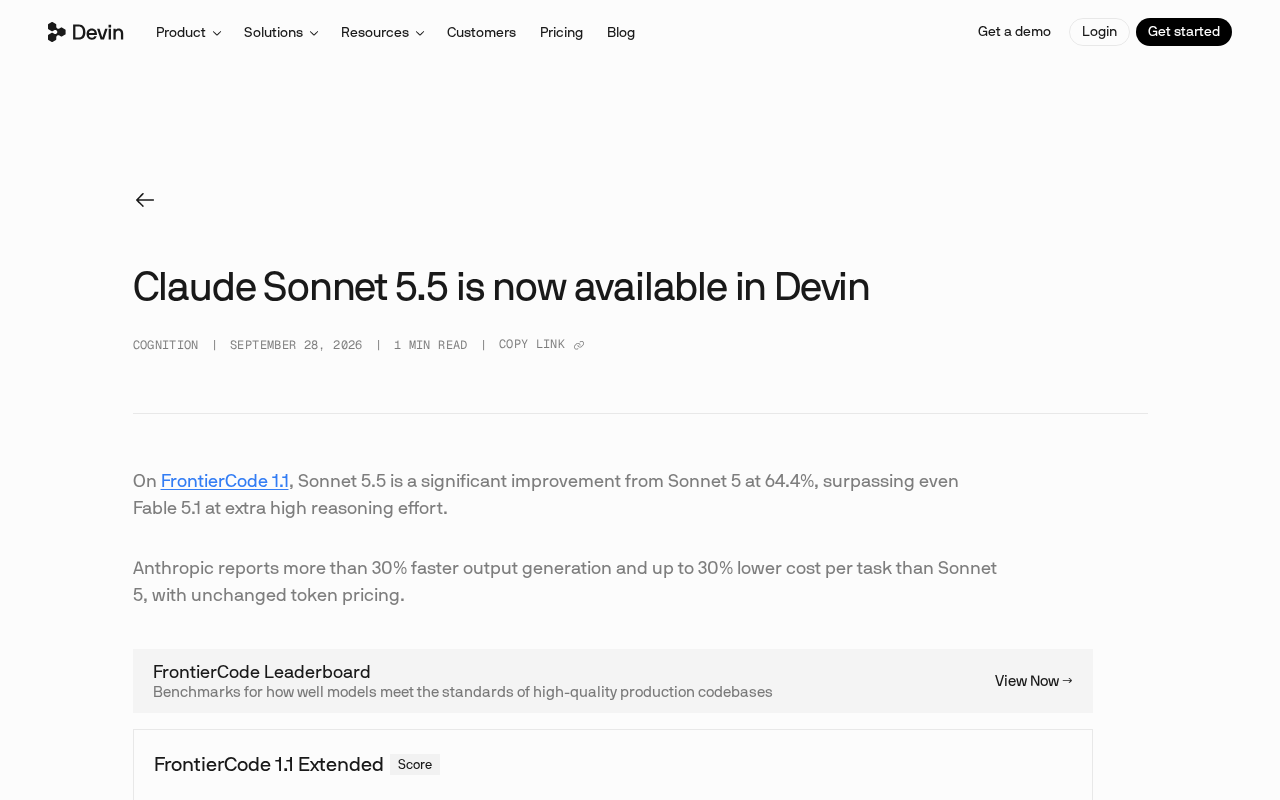
According to official data, Sonnet 5.5 achieves a score of 64.4% on the FrontierCode 1.1 coding benchmark — a notable improvement over the previous Sonnet 5.
Even more noteworthy: this score surpasses Fable 5.1's performance under "extra high reasoning effort" configuration. That comparison is telling — it means Sonnet 5.5 at default or standard reasoning settings can match what competing models only reach when running at maximum compute and reasoning depth.
Why This Comparison Matters
In real deployments, "reasoning effort" is directly tied to latency and cost. A model that requires extra-high reasoning effort to hit a certain accuracy level typically means longer response times and higher token consumption. If Sonnet 5.5 can match or exceed a competitor's high-effort performance with lower reasoning overhead, the cost-efficiency advantage is substantial — especially for coding agent scenarios that involve large-scale, high-frequency model calls.
FrontierCode is a benchmark designed to evaluate LLM coding ability in realistic software engineering scenarios, covering code generation, debugging, refactoring, and cross-file comprehension. Compared to earlier benchmarks like HumanEval or MBPP that focused on single-function completion, it more closely reflects the complexity of production environments. Version 1.1 adjusts the difficulty distribution and evaluation process from the original to reduce "question-guessing" effects, making scores better reflect a model's generalization ability. A score of 64.4% places it in the top tier among current mainstream models — though direct cross-institution comparisons should be treated with some caution, as testing conditions (temperature parameters, pass@k settings, etc.) vary.
"Reasoning effort" is an adjustable parameter offered by some LLM providers that essentially controls the depth and number of iterations of internal chain-of-thought or multi-step verification before generating an answer. Increasing reasoning effort generally improves answer quality, but at the cost of significantly higher first-response latency and greater total input/output token volume, raising the cost per call. In coding agent scenarios, a complex task may involve dozens to hundreds of model calls — differences in reasoning effort get multiplied, directly impacting team API bills and user wait times. Therefore, the claim that "default configuration outperforms competitors at high-effort configuration" — if the data holds up — suggests that Sonnet 5.5 has moved the throughput-vs-accuracy tradeoff curve forward as a whole, rather than just winning at a single endpoint.
What This Means for Devin Users
For teams currently using Devin, model upgrades typically require no additional action to enjoy performance improvements. Stronger coding benchmark results should theoretically translate into fewer code errors, more accurate task decomposition, and higher first-attempt completion rates on complex engineering tasks.
That said, benchmark scores should be interpreted with appropriate perspective. Evaluations like FrontierCode reflect performance on standardized tasks, while real projects introduce factors — codebase scale, context complexity, dependency chains — that continue to influence the actual experience. A benchmark improvement is a positive signal, but real-world impact still needs to be validated within specific workflows.
Summary
Claude Sonnet 5.5's integration into Devin is another example of model providers and AI coding platforms co-evolving. A score of 64.4% on FrontierCode 1.1 — along with outperforming competitors at their highest reasoning effort settings — demonstrates the new generation of coding models' dual progress in efficiency and accuracy. For developers following AI-assisted programming, this is an update worth tracking.
Since publicly available information is currently centered on benchmark data, further details about Sonnet 5.5's specific capabilities in areas like long-context handling and multi-file refactoring await additional evaluation from official sources or the broader community.
Related articles

Why Does the Tesla Roadster Need to Fly? A Deep Dive into Musk's Wild Demo
Tesla's Roadster launch showed wall-climbing, upside-down driving, and flying stunts—but The Vergecast notes the demo car may lack a battery, the Rocket version is invite-only and not street-legal, and the website terms don't guarantee delivery. After nine years of delays, why does this car still need to exist?

AI Is Not a Replacement: Human-AI Collaboration Through the Lens of Factory Root Cause Analysis
Starting from factory root cause analysis, this article explains how AI accelerates evidence chain construction rather than replacing human experts, exploring the pragmatic implementation logic and business value of 'AI supporting people rather than replacing them.'

AI Agent Decision Auditing: Building an Evidence Chain in Regulated Workflows
Starting from a Reddit discussion, this article analyzes three core issues in AI agent decision auditing within regulated workflows: what fields audit records should contain, how to handle feedback latency for erroneous decisions, and how to continuously calibrate LLM judge consistency with human judgment.