Claude Sonnet 5.5 Coming Soon: Near Opus-Level Performance, OpenAI Teases Mysterious Agent "O"

Sonnet 5.5 leaks as a GPT-6 rival, while OpenAI and MiniMax both make moves in the agent and coding AI race.
Anthropic's Claude Sonnet 5.5 has been spotted in gray-scale testing within Claude Code, with leaks suggesting it can match GPT-6 while being priced below Opus 5.5 — continuing the Sonnet series' high-value positioning, with a likely Tuesday ET release. Simultaneously, OpenAI is teasing a persistent AI assistant codenamed "O" set to debut at its developer conference on the 29th, signaling a shift from conversational to task-execution agents. Domestically, MiniMax has released the lightweight M3.1 Flash Preview for rapid bug fixing. The flurry of activity across all three fronts signals that the AI industry's competitive focus is rapidly converging on coding assistance and intelligent agents.
Claude Sonnet 5.5 Spotted in Gray-Scale Testing
According to a leak by Bilibili creator EverAI, Anthropic's new model Claude Sonnet 5.5 is currently being gray-scale tested inside Claude Code, sparking widespread discussion after users spotted it in the wild. Sources suggest the model will most likely be officially released on Tuesday afternoon at 2 PM ET.
From the leaked test information, Sonnet 5.5 appears to be positioned quite aggressively: beta testers report that its performance can go head-to-head with flagship models like GPT-6, while being significantly cheaper than Opus 5.5. This strategy of "matching top-tier performance at a lower price point" is consistent with Anthropic's long-standing approach to the Sonnet series — delivering near-flagship capabilities at lower cost to cover high-frequency everyday development and production use cases.

It's worth noting that this information is still at the leak and gray-scale testing stage. The model's official name, release date, and actual performance should all be treated as unconfirmed until Anthropic makes an official announcement.
Performance Comparison: Closing In on Opus, Targeting GPT-6
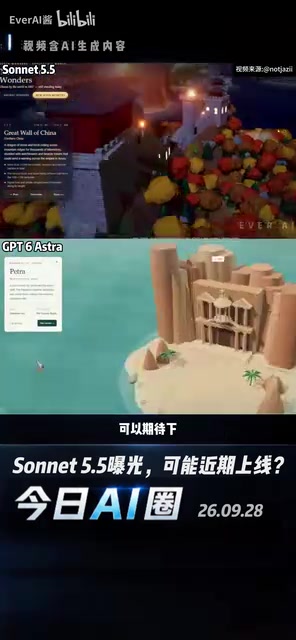
The most talked-about claim in the leak is a direct head-to-head comparison between Sonnet 5.5 and competing models using identical prompts. Testers demonstrated its ability to generate 3D interactive applications and compared the results against models like GPT-6, with the output quality and interaction completeness generating considerable excitement.
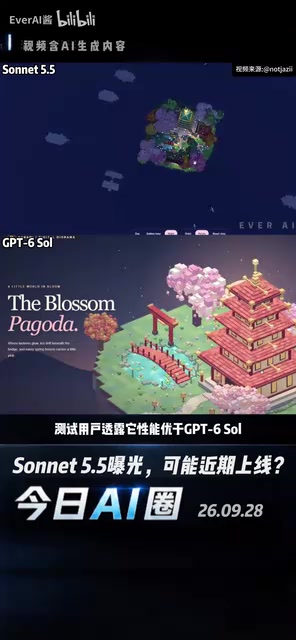
If the leaks are accurate, Sonnet 5.5 could push capabilities close to Opus 5.5 levels while maintaining a much lower price tag. For developers focused on code generation and Agent workflows, this kind of cost-performance ratio is highly compelling — in real-world projects, API call costs are often the deciding factor in whether large-scale deployment is feasible.
That said, single-source benchmark comparisons are easily influenced by prompt selection and task type. Whether it can truly "beat GPT-6" requires further independent evaluation for cross-validation. Until official benchmark data is published, it's wise to approach these early comparison claims with measured skepticism.
OpenAI Teases Mysterious Agent "O" Ahead of Developer Conference
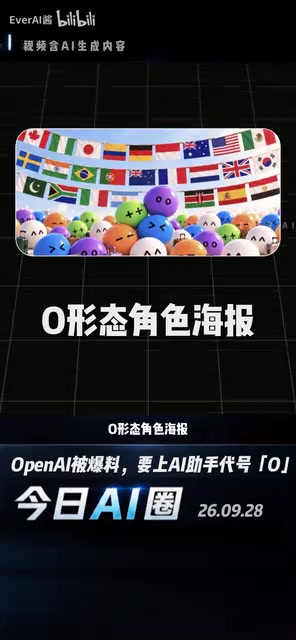
Meanwhile, OpenAI has also been busy. According to insiders, OpenAI is developing a persistent AI assistant codenamed "O." OpenAI's official account has already dropped a character poster in the shape of an "O" to build hype for its developer conference on the 29th.
Based on the "persistent AI assistant" positioning, "O" is likely not a simple conversational model, but rather an Agent-form product capable of long-term residency and proactive task execution. This aligns with the broader industry trend of evolving from "Q&A-style AI" toward "task-execution-style AI."
If OpenAI formally launches this agent at the developer conference — coinciding with Anthropic's near-simultaneous release of Sonnet 5.5 — the head-to-head competition between the two companies on Agent capabilities and coding performance will intensify significantly.
The core distinction between a persistent AI assistant and a traditional chatbot lies in persistence and autonomy. Traditional conversational models reset their state at the end of each session, requiring users to manually initiate the next interaction. A Persistent Agent, by contrast, can maintain cross-session memory and context, continuously monitor in the background, or trigger tasks on a schedule — without needing the user to manually invoke it each time. Typical capabilities include automatically monitoring emails and replying based on rules, periodically summarizing and pushing information, and automatically triggering code review workflows when repository changes occur. This form factor depends far more on OS-level permissions (file read/write, network access, application calls) than ordinary chat models, which also introduces significantly more complex security and privacy challenges. Microsoft Copilot and parts of Google Gemini have already been exploring similar paths. If OpenAI's "O" lands at the developer conference, it will represent a major product validation of the industry's push toward "proactive AI."
MiniMax Releases M3.1 Flash Preview
On the domestic front, MiniMax has released a new text model, M3.1 Flash Preview, targeting everyday development scenarios.
The "Flash" in the product name makes its positioning clear: speed is the priority. The company highlights its use in code development for rapid bug fixes, emphasizing response speed and reliability. Lightweight, high-frequency, low-latency models like this are an indispensable part of today's developer toolchain — not aimed at solving the most complex problems, but at handling common tasks quickly and reliably.
Taking together the flurry of activity around Sonnet 5.5, OpenAI's "O," and MiniMax's M3.1, it's clear that both domestic and international AI vendors are rapidly converging on two key competitive battlegrounds: coding assistance and intelligent agents. For developers, this means an ever-growing selection of tools — along with an ever-greater need to make precise trade-offs based on cost and use case.
The "Flash" naming convention originates from Google's tiered naming system first popularized with the Gemini series: Ultra/Pro for flagship capabilities, Flash for high-speed, low-latency lightweight versions. This naming logic has been widely adopted across the industry, signaling that the model has been specifically optimized for inference speed and cost — typically through smaller parameter counts or more aggressive quantization strategies to achieve lower time-to-first-token (TTFT). For IDE plugins or CI/CD pipelines that require real-time code completion or rapid lint fixes, the difference between a 50ms and 500ms response time directly impacts the development experience. Flash-tier models don't aim to outperform flagship models on difficult reasoning or long-context tasks; instead, they maximize cost-effectiveness in high-frequency "good enough" scenarios, forming a complementary product matrix alongside flagship models.
Related articles

iPhone Duo Hands-On: Is the $2,000 Small-Screen Foldable Worth It?
YouTube's Allison shares her iPhone Duo hands-on: dual-screen multitasking doubles efficiency, great video viewing, nice matte finish—but thick body, small outer screen, and a $2,000 luxury price.

Sentry's Ad Cracks Up Developers: Can On-call Actually Be Fun?
Sentry's ad short film taps into developers' on-call anxiety, using humorous dialogue to showcase its observability platform—errors, logs, traces, metrics, replays, and releases in one place.

LLM App Getting Worse With Every Change? Build an Effective Evaluation System in Three Steps
How do you know if your LLM app is getting better or worse? A Reddit-based guide to test sets, automated regression evaluation, LLM-as-judge scoring, and structured agent tracing.