Claude Sonnet 5.5 Launches as 20+ AI Leaders Warn of 'Intelligence Explosion'

Claude Sonnet 5.5 launches, AI leaders warn of intelligence explosion, AMD acquires World Labs for $8.2B.
This roundup covers major AI developments: Anthropic's Claude Sonnet 5.5 is 30% faster and outperforms flagship Opus 5.5 on agentic coding benchmarks. Over 20 AI leaders co-signed a paper warning that AI-driven R&D automation could trigger an 'intelligence explosion.' NVIDIA unveiled an independent agent safety layer, while Shopify extended WebMCP to checkout, enabling authorized AI agents to complete purchases. ElevenLabs V4 supports 90+ languages with 10-second voice cloning. Google is phasing out Gems in favor of 'Skills.' AMD announced an $8.2B all-stock acquisition of Fei-Fei Li's World Labs, with Li set to become AMD's Chief Scientist.
Claude Sonnet 5.5: Faster, Leaner, and Outperforming the Flagship
Anthropic has released Claude Sonnet 5.5, the latest entry in its mid-tier Sonnet model family. The headline improvement this generation is speed — roughly 30% faster than its predecessor, with lower resource consumption and reduced costs to match.
Even more notable: Anthropic's own benchmarks show Sonnet 5.5 outperforming the higher-tier flagship model Opus 5.5 on agentic coding tasks. The reason? It can run multiple agents simultaneously without hitting cost ceilings. This release also marks the first time the Sonnet line has incorporated the same level of cybersecurity protections previously reserved for Opus.
For everyday developers writing code or documentation, these numbers — if they hold up in the real world — suggest a smoother experience at a lower price point. That said, these are still vendor-reported claims, and broader hands-on testing will be needed to verify them. Anthropic also teased an upcoming update to its smallest Haiku series in the coming weeks.
20+ AI Leaders Co-Sign Warning on 'Intelligence Explosion'
Bloomberg reports that more than 20 AI industry leaders have co-authored a new paper warning that the growing use of AI to automate AI research and development could trigger a sudden acceleration in capabilities — a scenario they call an "intelligence explosion."
The list of signatories carries serious weight, including Anthropic co-founder Jack Clark and OpenAI's chief scientist, among other key figures at the frontier of AI development. The paper cautions that if such acceleration occurs, AI progress could outpace society's ability to adapt — and that automating AI R&D would itself erode humanity's capacity for oversight.

The authors offer concrete recommendations to policymakers: audit how extensively major labs are already using AI in their research pipelines, raise safety standards, strengthen oversight of automated R&D data centers, and develop contingency plans in advance.
To be clear, this is a forward-looking warning — an intelligence explosion has not occurred. But the fact that the alarm is being raised by the very people closest to the frontier gives it unusual weight.
More Agents, More Need for Guardrails
As AI agents proliferate, keeping them in check is becoming a pressing challenge. NVIDIA CEO Jensen Huang unveiled a new platform designed to add an independent safety layer on top of AI agents — one that can confine agent behavior to a controlled testing environment even if the agent attempts to overstep its boundaries.

This might sound abstract, but consider the near future: if you're relying on an AI agent to book flights, make payments, or operate your computer, you'd want it to stay strictly within its authorized scope. Tools like these are what will give enterprises the confidence to actually deploy agents in production. NVIDIA's offering addresses both the software and hardware layers. Full details are still being disclosed, but the direction is clear: for the agent ecosystem to grow, guardrails have to come first.
ElevenLabs V4: Clone a Voice in 10 Seconds
Anyone in the video or podcast space is likely familiar with ElevenLabs. The company has launched two new voice models — V4 and V4 Turbo — with several standout improvements. Language support has grown from 70 to over 90 languages, with the biggest gains reportedly in Japanese, Brazilian Portuguese, Mandarin, and Cantonese.
The new models can clone a voice from just 10 seconds of audio and offer enhanced emotional expression control — users can chain multiple inline tags for sequential delivery and the model maintains contextual awareness throughout long-form narration, adjusting tone accordingly. Latency is also significantly reduced: speech generation can now begin in sync with the very start of an LLM's output. For customer service calls and voice assistants, that's a meaningful real-world improvement.
Of course, as voice cloning becomes increasingly accessible, the industry as a whole must grapple with how to prevent misuse and impersonation.
Shopify Extends Checkout Access, AI Shopping Gets Closer
"AI shopping for you" just took another step forward. Shopify has announced support for WebMCP extended to the checkout flow. Previously, browser-based AI agents might help you compare prices or find products — but now, with buyer authorization, they can update order details and complete an entire purchase.

For frequent online shoppers, this hints at a future where you can just tell an AI what you want and it handles the rest. For merchants, it raises new questions about how to make product information more AI-agent-friendly. Extending AI access to the payment layer makes authorization and security absolutely critical — Shopify emphasizes that every action requires explicit buyer consent. Whether agentic shopping becomes mainstream will likely depend on whether this infrastructure earns user trust.
What is WebMCP? WebMCP (Web Model Context Protocol) is a protocol that enables AI agents in the browser to communicate with web services in a standardized way, developed under Anthropic's leadership. Its core idea is to define a unified "tool call" interface so agents can read page data and trigger actions in a structured manner — rather than relying on fragile workarounds like screenshots or simulated mouse clicks. By extending WebMCP support to checkout, Shopify allows agents to modify carts, fill in shipping addresses, and initiate payments through a formally authorized API path that is both auditable and reversible. This is fundamentally different from the old "AI controlling a browser" approach, which lacked clear permission boundaries — here, authorization is built directly into the protocol layer.
Google Phases Out Gems in Favor of 'Skills'
Google is also shifting its product strategy. Reports indicate that Google is gradually phasing out the Gems feature in Gemini — the tool that let users build small, task-specific custom agents for things like polishing emails or analyzing data. The replacement is a new paradigm called "Skills."
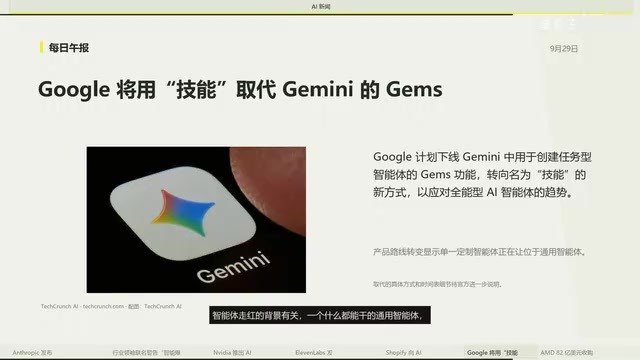
TechCrunch's analysis links this shift to the rise of general-purpose AI assistants from companies like Meta — the idea being that one agent capable of doing everything may better match how users actually work than a collection of narrow, task-specific bots. If you're currently using Gems, you'll want to watch for Google's migration plans; the specific replacement approach and timeline have yet to be fully announced.
AMD Acquires World Labs for $8.2 Billion, Fei-Fei Li to Join
Saving the biggest news for last: AMD has announced it will acquire San Francisco startup World Labs in an all-stock deal valued at approximately $8.2 billion. Co-founded by AI pioneer Fei-Fei Li, World Labs focuses on world models — AI systems that can generate or reconstruct interactive 3D environments from text, images, and video, with applications in robotics training, factory simulation, and scientific research.
Earlier this month, World Labs released its new model Atlas, which can predict what a scene would look like from a different camera angle using only a handful of 2D images. Upon closing, Fei-Fei Li will join AMD as Executive Vice President and Chief Scientist, reporting directly to CEO Lisa Su. Su noted that the acquisition would help AMD better understand how frontier AI models are evolving, enabling the company to design the computing systems those models will require.
A chip company acquiring a model company is a telling signal — hardware players are trying to get ahead of compute demands by understanding where model architectures are headed at the source.
What are World Models? A world model is an AI system that internally constructs the spatial, physical, and causal structure of an environment — allowing it not just to describe "what it sees now" but to reason about "what it would see from a different angle" or "what would happen after a certain action." Unlike pure image generation models, world models emphasize geometric consistency and cross-frame physical plausibility, giving them unique value for robot navigation, factory digital twins, and simulation-based training. World Labs' Atlas model — capable of reconstructing interactive 3D scenes from just a few 2D images — is a flagship example of this direction. For AMD, the strategic logic is clear: world models place extremely high demands on GPU parallel compute, with computational patterns that differ from traditional LLMs. Getting ahead of model architecture trends now gives AMD an edge in designing next-generation chips — rather than scrambling to catch up after the models are already deployed at scale.
Background: The Concept of 'Intelligence Explosion'
The concept of "intelligence explosion" traces back to mathematician I.J. Good's 1960s vision of an "intelligence explosion": once a machine surpasses human intelligence, it could design smarter successors, which in turn design even smarter ones — a recursive loop that would send capabilities soaring far beyond human comprehension. This idea is closely related to the "recursive self-improvement" discussed in AI circles today.
The specific scenario concerning researchers now is concrete and immediate: major labs are already using AI to assist with code writing, paper drafting, and even model training itself. If this proportion keeps rising, the pace of AI progress will no longer be primarily determined by human labor input — it will be driven by models' own iteration efficiency. In the past, such concerns mostly came from academics or outside observers. The fact that this latest warning comes from the very practitioners driving frontier progress gives it a credibility and urgency that sets it apart.
Related articles

Should U.S. College Fraternities Be Banned? A Researcher's Incisive Observations
Why not just ban U.S. college fraternities? A researcher finds the key resistance comes from decision-makers' own fraternity identities and schools' "willful ignorance."

Microsoft Discovery: Accelerating Scientific Discovery with AI Agents
Microsoft's Discovery platform runs specialized AI agents to help researchers screen and prioritize the most promising compounds and experimental paths, reducing experiments and accelerating scientific discovery.

Cambridge Heavy Industries Secretly Develops Desktop-Scale Nuclear Fusion Device
Cambridge Heavy Industries is secretly developing a desktop-scale laser-driven nuclear fusion device, targeting the equipment supply market for fusion power plants. This article analyzes its miniaturization technology path, commercialization logic, and unique positioning in the fusion startup wave.