Claude Sonnet 5.5 Officially Launched: Faster, Half the Price, Performance Approaching Flagship

Claude Sonnet 5.5 launches with near-flagship performance, half the price, and top coding benchmark results.
Anthropic has officially released Claude Sonnet 5.5, positioning it as the ideal model for everyday tasks. It outperforms the previous Sonnet 2.5 across benchmarks, surpasses flagship Opus 5.5 on Terminal Bench 4.0, and ranks second globally on Artificial Analysis with a score of 56. At $2/million input tokens and $10/million output tokens — roughly half the cost of Opus 5.5 — it poses a direct challenge to OpenAI's recently launched GPT-6 series. It is also the first Sonnet model to match flagship-level cybersecurity protections. Available now on all Claude platforms and major cloud providers, with a lightweight Haiku model expected soon.
Anthropic Introduces a New Sonnet Three Months Later
According to a Bilibili AI news report, Anthropic officially released the Claude Sonnet 5.5 model in the early hours of the morning. This is the second model in the Sonnet 5.5 series, and the company positions it as "the ideal model for everyday tasks."
Notably, this mid-tier model inherits the strong capabilities of the flagship Opus 5.5 while delivering significant improvements in speed and inference cost. For developers who have long been balancing cost against performance, this combination is quite compelling.
From a product strategy perspective, this is also the first time Anthropic has elevated the Sonnet series to such close proximity to the flagship — Sonnet has historically been regarded as the "value-tier" option, but its overall capabilities now approach those of Opus 5.5, which to some extent blurs the line between the two product lines.
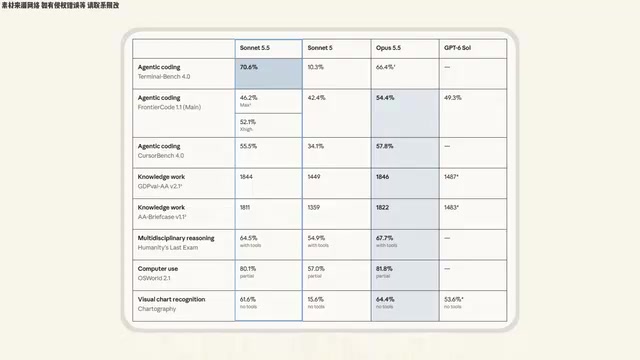
Benchmarks: Outperforms Previous Generation Across the Board, Surpasses Flagship in Coding
Across multiple benchmarks, Claude Sonnet 5.5 comprehensively outperforms the previous-generation Sonnet 2.5 and matches the overall capability level of Opus 5.5. Even more noteworthy: in Terminal Bench 4.0, a benchmark focused on terminal-based coding tasks, Sonnet 5.5 actually surpasses its own flagship Opus 5.5.
This result demonstrates that mid-tier models, when targeted optimizations are applied, can now compete head-to-head with — and even outperform — much larger models on specific coding and terminal operation tasks. For teams whose core workflow revolves around coding, this is a very practical signal.
In the latest Artificial Analysis overall rankings, the model scored 56 points, trailing its flagship Opus 5.5 by only about 2 points, while surpassing GPT-6 Astra to rank second globally.

Terminal Bench 4.0 is a benchmark suite specifically designed to evaluate AI models' ability to perform programming tasks in terminal environments. It focuses on assessing model performance in real-world development scenarios such as command-line operations, script writing, code debugging, and automated workflows. Unlike traditional coding benchmarks such as HumanEval, which emphasize code generation, Terminal Bench places greater weight on whether models can make accurate judgments and take correct actions in semi-structured, multi-step terminal interactions. This is why the test carries higher reference value for "real-world coding workflows" — it more closely reflects the actual environment in which developers use AI assistants, rather than pure code completion scenarios. Artificial Analysis is a third-party AI model evaluation organization whose comprehensive leaderboard aggregates scores from multiple benchmarks and real-world performance metrics to provide cross-vendor, cross-model comparisons, and is widely cited by the industry as a neutral reference for model capability.
Pricing Halved: A Direct Challenge to OpenAI's Latest Models
Pricing is one of the core competitive advantages of this release. Claude Sonnet 5.5's official API pricing is approximately half that of Opus 5.5: $2 per million input tokens and $10 per million output tokens. Cutting the price in half while maintaining near-flagship performance makes for an exceptionally strong value proposition.
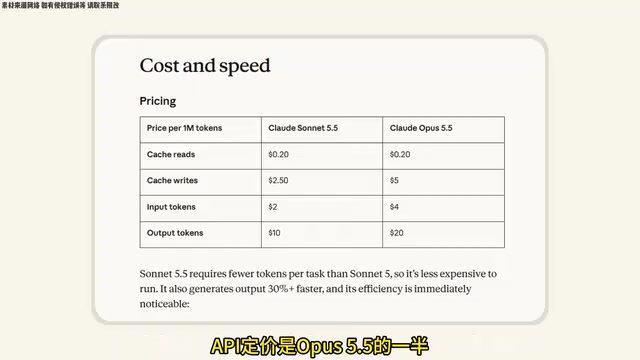
Reports suggest that the model most affected by this release is actually OpenAI's newly launched GPT-6 series — less than a month after its debut, it has already lost ground on both cost and performance. This reflects the blistering pace of iteration in today's large model market: the window of advantage for a new flagship may last only a few short weeks.
In terms of availability, Sonnet 5.5 is now live across all Claude platforms, and has also launched on major third-party cloud platforms including Amazon AWS, Google Cloud, and Microsoft Azure, making it easy for enterprises to integrate directly within their existing cloud environments.
Safety: First Sonnet Model to Match Flagship-Level Protections
Alongside the capability improvements, Anthropic has also strengthened safety measures accordingly. According to the company, Sonnet 5.5 is now on par with Opus 5.5 in terms of offensive cybersecurity capabilities, making it the first model in the Sonnet series to employ equivalent cybersecurity protection mechanisms.
In addition, the model features enhanced safeguards around biology-related content and anti-distillation protections. This means that for certain sensitive tasks, Sonnet 5.5 will — just like Opus — fall back to older models to handle requests, in order to mitigate risk.

Simultaneously advancing capability improvements and safety hardening is a common practice among leading AI providers. For developers, it's worth noting that model fallback behavior may occur on certain tasks, and its impact on business workflows should be assessed in advance.
Anti-distillation refers to the technical and strategic measures that model providers take to prevent third parties from making large volumes of API calls to collect output data and then use that data to train low-cost models that approximate the original model's capabilities. As model distillation techniques have matured, the practice of directly using a flagship model's outputs as training data to "clone" its capabilities has become increasingly common — posing a direct threat to providers' commercial interests and intellectual property. Anthropic strengthening this protection in Sonnet 5.5 also reflects the growing attention that leading providers are paying to the risk of capability leakage. Model fallback behavior refers to the system automatically switching to an older, more limited but safer model when a high-risk request is detected, in order to mitigate potential misuse. Developers need to account for this mechanism's impact on response consistency when designing business workflows.
What's Next: A Smaller Haiku Model May Be on the Way
The release also hints that Anthropic is planning to launch a smaller-scale Haiku model in the near future. This means Anthropic is working toward completing its full product matrix — from Haiku (lightweight) to Sonnet (balanced) to Opus (flagship) — covering different deployment needs from lightweight edge applications to high-performance inference.
Taken together, the message from the Sonnet 5.5 launch is clear: mid-tier models are rapidly closing the gap with flagships, while being cheaper and faster. For developers and enterprises focused on balancing cost and performance, the practical value of such models may well exceed that of a pure flagship. Whether it's worth migrating will still depend on your own benchmark results in practice.
Related articles

A Single Prompt Triggers a Global PHP Security Storm: Is AI a Savior or a Hidden Risk?
A single AI prompt triggered a global PHP security crisis affecting Wikipedia and the Internet Archive. This article reviews the incident, analyzes the OpenAI-Amazon controversy, and explores the security paradox of lowered vulnerability discovery barriers in the AI era and developer response strategies.

When AI Is Taken Away: How Reliance on Shortcuts Undermines Your Problem-Solving Resilience
A study of 1,222 people found that after using AI to answer questions, once AI was removed, people gave up on more problems than a control group that never used AI. The article analyzes the impact of AI reliance on learning resilience and metacognition, and explores design implications for AI learning tools.

Carta and NewView Partner to Let Startup Employees Cash Out Equity Early
Carta and NewView Capital partner to simplify startup tender offers, helping employees sell equity early. Analysis of the mechanism, liquidity pain points, and impact.