Claude Sonnet 5.5 Released: Ranks #2 on Benchmarks, 30% Faster and 30% Cheaper

Claude Sonnet 5.5 ranks #2 globally with 30% speed gains, but high token usage narrows real-world cost advantages.
Anthropic's Claude Sonnet 5.5 scores 56 on the Artificial Analysis Intelligence Index, ranking #2 globally just behind Opus 5.5 Max, with over 30% speed improvement and pricing identical to Sonnet 5 ($2/$10 per million tokens input/output). However, real-world data reveals a catch: its token consumption runs 60% higher than Opus 5.5 and seven times higher than Astra, pushing per-task costs close to Fable 5.1 and undermining the "30% cost reduction" claim. On the soft-skills front, Sonnet 5.5 shows improved design and writing performance, making it well-suited for prototyping and presentations. Developers should calculate total costs using real task token volumes rather than relying on unit pricing alone.
Sonnet 5.5: The Second Model in the 5.5 Family
Anthropic has officially released Claude Sonnet 5.5, the second model in the Sonnet 5.5 family following Opus 5.5. Compared to the previous Sonnet 5, the new model delivers a substantial performance leap — official data shows a speed improvement of over 30%, along with cost reductions of up to 30% on most tasks.
For a model positioned in the "mid-weight" tier, these gains are significant enough to shift how many developers make their model selection decisions. The Sonnet series has always been Anthropic's flagship product line for balancing cost-efficiency with capability, and version 5.5 maintains that positioning while pushing the upper limit considerably higher.
Benchmark Performance: Ranked #2 Overall, Just Behind Opus 5.5
On the Artificial Analysis Intelligence Index, Sonnet 5.5 scored 56 points — only 2 points below the top-tier Opus 5.5 Max — securing a strong #2 overall ranking. This is a striking result: it means a Sonnet-class model can now surpass competitors like Fable and Astra in overall capability.
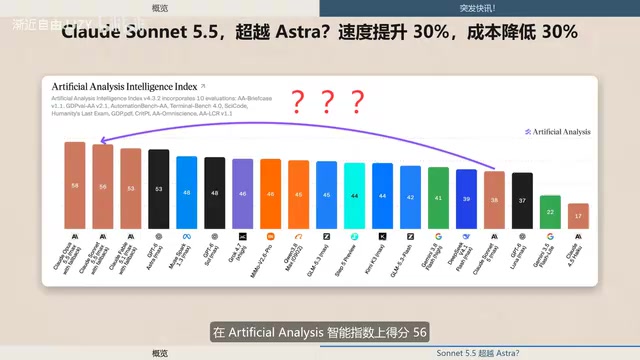
The video author reviewing the benchmark charts remarked, "So all it takes is a Sonnet to beat Fable and Astra?" — reflecting just how much this score distribution has disrupted the competitive landscape. Across multiple benchmarks, Sonnet 5.5 — even at low or medium reasoning intensity — outperforms Sonnet 5's best results at roughly one-tenth of the cost.
The Artificial Analysis Intelligence Index is a third-party comprehensive AI model evaluation platform that ranks major large language models across multiple benchmarks, including reasoning, coding, mathematics, and language understanding. Rather than a single benchmark score, it provides a weighted composite assessment of a model's "overall intelligence level," making it harder to game with targeted optimization. Fable and Astra are both mid-to-high scoring competitors on this leaderboard — the fact that Sonnet 5.5, a non-flagship product, surpasses them suggests Anthropic has achieved a structural breakthrough in model efficiency, not merely thrown more compute at the problem.
Pricing and Costs: The Gap Between Marketing and Real-World Testing
Sonnet 5.5 is priced identically to Sonnet 5 — $2 per million input tokens and $10 per million output tokens. Anthropic emphasizes that the model typically requires far fewer tokens to complete the same work, and with output generation speed improved by over 30%, it's being called "the fastest Sonnet model to date."
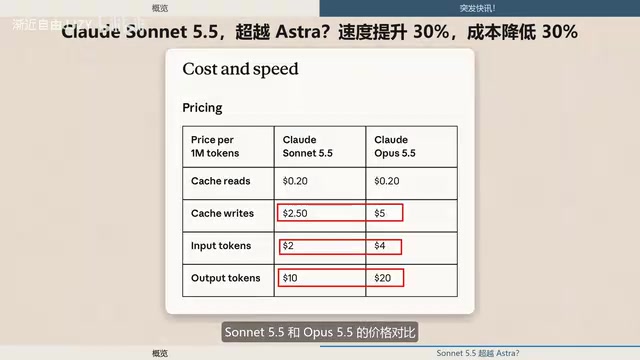
Compared to Opus 5.5, the two models share the same cache read pricing, while Sonnet 5.5 is roughly half the price on all other tiers. On paper, the cost-efficiency advantage looks compelling.
However, the actual cost story deserves scrutiny. The video points out that Sonnet 5.5's real-world costs may not be as low as advertised — its token consumption is very high, running 60% above Opus 5.5 and seven times higher than Astra. This directly inflates per-task costs, bringing them nearly on par with Fable 5.1.
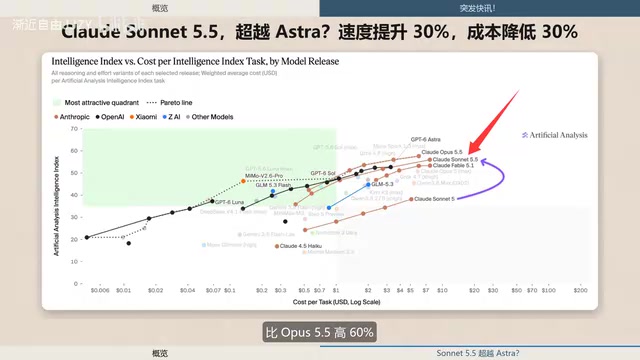
This raises a sharp question: if per-task costs are comparable, why not just use the more capable Opus 5.5 at a lower unit price? For production environments sensitive to token consumption, this warrants real-world testing before deployment — don't rely solely on listed rates.
Tokens are the fundamental billing and computation unit for large language models, roughly corresponding to words or sub-word fragments in text (approximately 1 token ≈ 0.75 English words; 1 Chinese character ≈ 1–2 tokens). The number of tokens a model consumes to complete a given task is influenced by multiple factors: the more complex the chain-of-thought reasoning and the longer the internal "drafts," the higher the token consumption. Some models generate more intermediate steps before delivering a final answer — these models may appear cheaper per token but end up costing more overall. Sonnet 5.5's 60% higher token consumption compared to Opus 5.5 is a direct manifestation of this dynamic — it likely generates longer internal reasoning chains, which inflates the actual per-task cost and offsets the unit price advantage.
Design and Writing Capabilities
Beyond benchmarks and costs, Sonnet 5.5 shows meaningful progress in "soft skills." It demonstrates a strong aptitude for design, enhancing the polish of user interfaces and generating slides from templates that require almost no editing — a practical advantage for users building presentations or prototypes.
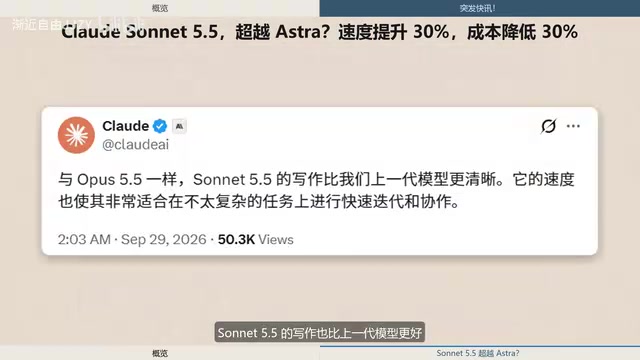
Like Opus 5.5, Sonnet 5.5's writing quality is also noticeably better than the previous generation. Overall, it pushes the "near-flagship capability at a friendlier price" positioning another meaningful step forward.
Availability and the Classic Comparison Round
Sonnet 5.5 is now live across all platforms, while Haiku 5.5 from the same family is set to release in the coming weeks. Based on benchmark projections, Haiku 5.5 is expected to land around the same level as Astra (approximately 53 points).
The video closes with the classic "pelican riding a bicycle" model comparison — a fan-favorite benchmark featuring GPT-6, Sonnet 5.5, Astra, and others — offering a fun and visual way to compare generative performance across models.
Summary
Claude Sonnet 5.5 is an impressive iteration: faster, ranked #2 on benchmarks, with improved design and writing capabilities, and strong on-paper cost efficiency. But its elevated token consumption is a reminder that developers should calculate total costs based on real task token usage — not just unit pricing. For users chasing peak cost-efficiency or handling high-intensity workloads, Opus 5.5 remains a serious option worth comparing carefully.
Related articles

Claude Code v2.1.316 Update Analysis: Enterprise Gateway and Multiple Stability Fixes
Claude Code v2.1.316 released: new enterprise gateway pooled group budgets, layered policy mode, subagent effort control, dozens of Shell, network, and session recovery fixes, and Opus 4.8 fast mode deprecated.

17th-Century British Floods and Doomsday Panic: A New Perspective on Weather History
Based on a Hacker News discussion of '17th-Century British Floods and Foreboding,' this piece explores how extreme weather was given divine and political significance, and what weather history teaches us about contemporary climate communication.

Salesforce Acquires Rune for $375M: AI Logistics Tech Bolsters Defense Business
Salesforce reportedly acquires defense tech startup Rune for $375M. Rune's AI logistics tech will strengthen Salesforce's Missionforce defense platform, continuing its M&A spree.