Claude Sonnet 5 Deep Dive: Near-Opus Performance but Higher Costs — Is It Worth the Upgrade?

Claude Sonnet 5 rivals Opus 4.8 in some benchmarks but costs more in practice due to poor token efficiency.
Anthropic's Claude Sonnet 5 delivers genuine capability improvements over Sonnet 4.6 and approaches Opus 4.8 on several benchmarks, but real-world testing reveals a pricing paradox: poor token efficiency means agentic tasks can cost more than using Opus 4.8. The model also has deliberately reduced cybersecurity training to avoid regulatory scrutiny, with cyber safeguards enabled by default.
Claude Sonnet 5 Is Now Live
Anthropic quietly launched Claude Sonnet 5, claiming it delivers near-Opus 4.8 performance at a lower price. But according to in-depth analysis from technical reviewers, the reality is far more nuanced than the official pitch — this may be the first Sonnet model that Anthropic has intentionally under-trained.
"Intentionally under-trained" in LLM development refers to a model that hasn't been fully optimized along certain capability dimensions through supervised fine-tuning (SFT) or reinforcement learning from human feedback (RLHF). The accusation of "intentionality" here means this isn't a resource constraint — it's a deliberate product strategy. Possible motivations include accelerating time-to-market, sidestepping regulatory review windows, or deliberately preserving capability moats for the upcoming flagship Opus 5. This kind of capability tiering isn't unusual in the competitive LLM market — OpenAI employs similar gradient design between GPT-4o mini and GPT-4o.
Sonnet 5 is currently available on claude.ai and Claude Code. You may not have noticed that the accompanying Fable 5 and Mythos 5 still have no confirmed release dates. Based on the versioning, the next flagship model will likely jump straight to Opus 5 — a reflection of Anthropic's internal product iteration cadence.
In terms of positioning, Sonnet 5 is a major version leap over its predecessor Sonnet 4.6. But the real controversy is this: its actual usage cost may exceed even the flagship Opus 4.8.
Benchmarks: Across-the-Board Gains, With a Catch
A direct comparison between Sonnet 5 and Sonnet 4.6 shows near-dominant improvements across almost every dimension. On tasks like computer use and world knowledge, Sonnet 5 approaches Opus 4.8 levels. However, in the critical area of agentic coding, it still falls noticeably short of Opus 4.8.
"Agentic coding" is fundamentally different from simple code completion or single-turn code generation — it requires the model to autonomously plan, execute, debug, and iterate across multi-step tasks. In tools like Claude Code, the model needs to read the filesystem, invoke terminal commands, self-correct based on error messages, and complete full engineering-level task flows. This demands extremely high context tracking, tool use stability, and error recovery capabilities.
Interestingly, on Cognition's third-party benchmark Frontier Code, Sonnet 5 actually outperforms Opus 4.8 — a genuinely impressive result. Frontier Code is maintained by Cognition (the developer behind Devin AI) and specifically measures long-horizon coding agent capabilities. It's widely considered more representative of real production scenarios than traditional HumanEval. In cross-model comparisons, Sonnet 5 is roughly equivalent to GLM 5.2 high in capability, but costs approximately three times as much — though Sonnet 5 offers revision capabilities that GLM 5.2 lacks, giving it a meaningful differentiator.
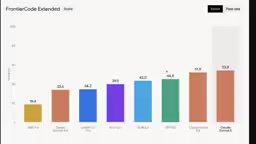
In tiered agentic search tests, Sonnet 5 significantly outperforms Sonnet 4.6 across all effort levels, but overall performance still falls short of Opus 4.8 — placing it at roughly an "Opus 4.7" level.
The Pricing Paradox: Why Sonnet 5 May Actually Cost More Than Opus
This is perhaps the most puzzling aspect of Sonnet 5. The Sonnet line is theoretically the "value-for-money" option, but real-world testing suggests it is not a token-efficient model.
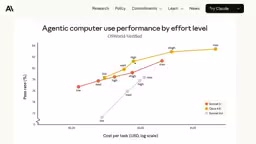
Understanding this issue requires separating two dimensions of API cost: unit price (dollars per million tokens) and consumption (actual tokens used to complete a given task). A token-inefficient model can end up costing more in practice even with a lower unit price, if it requires far more tokens than competing models to complete the same task. That's exactly Sonnet 5's problem — in agentic tasks, it may generate redundant intermediate reasoning steps or unnecessary formatted output, causing output token counts to balloon significantly.
In agentic computer use benchmarks, Opus 4.8 on the high setting performs comparably to Sonnet 5 on the max setting — but Sonnet 5 consumes substantially more tokens, resulting in a higher actual API bill. In other words, if you want equivalent performance, choosing Opus 4.8 on high is actually the more cost-effective option.
This may be precisely why Anthropic introduced introductory discount pricing for the first time with a new model:
- Promotional price (through August 31): $2/million input tokens, $10/million output tokens
- Standard price: $3/million input tokens, $15/million output tokens
The standard pricing is nearly on par with the existing Sonnet 4.6. Anthropic is typically known for pricing stability, making this "introductory discount" somewhat telling — it arguably confirms the model's poor token efficiency, with per-unit price cuts used to compensate for higher consumption.
Deliberately Trimmed Cybersecurity Capabilities
Another noteworthy detail in the technical report: Sonnet 5 has deliberately not been reinforcement-trained on cybersecurity tasks.
The regulatory logic here is clear. Since the U.S. AI Executive Order in 2023, AI models with high-risk cyberattack capabilities have been subject to additional safety evaluation processes before release. Anthropic's Responsible Scaling Policy (RSP) specifies that under the ASL-3 standard, models assessed as providing "meaningful uplift" to attacks on critical infrastructure require stricter access controls and review procedures. By actively reducing training intensity on cybersecurity-related capabilities, Anthropic can keep Sonnet 5 within ASL-2 rating boundaries, bypassing time-consuming compliance review windows and enabling a faster commercial release.
When assessed for "potentially dangerous cyber skills" (such as developing software exploits), Sonnet 5 performs noticeably worse than both Opus 4.8 and Mythos 5. This is believed to be intentional — designed to let the model bypass government regulatory review processes and ship directly.
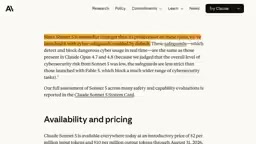
Even so, Anthropic notes that since Sonnet 5 is slightly stronger than its predecessor on such tasks, cyber safeguards are enabled by default. This protection mechanism is essentially a content classifier safety filter layer deployed on the model's output side. When the filter threshold is set too conservatively, it can misidentify large numbers of legitimate requests as harmful and refuse to respond — the "over-refusal" problem that previously drew significant developer criticism around Fable 5. Developers building legitimate applications in areas like security research or penetration testing assistance may need to proactively design prompt engineering strategies to handle false refusals, or apply for API access whitelisting.
Real-World Highlights: Impressive Design and Coding Capabilities
Setting aside the pricing debate, Sonnet 5's performance on real-world generation tasks is genuinely impressive — particularly for web design and one-shot application scenarios.
Web design: Out-of-the-box webpage output has moved past the "cheap AI-generated feel" of the past, delivering visually professional and natural results that most models have historically struggled to achieve.
Real-time 3D tracker: Asked to create a location tracker calling a live API, Sonnet 5 completed all functionality within a single HTML file — accurate globe rendering, real-time data fetching, and precise current location annotation, with coordinates verified during testing. The "single-file architecture" paradigm here is worth noting: no build toolchain, no dependency management — just one file that runs a full interactive application in the browser. This "one-shot generation" capability requires the model to produce complete, immediately runnable code in a single pass without multiple rounds of iteration or human correction. It demands high instruction comprehension precision, code structure planning, and edge case handling — and is central to the competitive value proposition of products like Claude Artifacts.

Voxel art scene: Generated a "voxel art scene of a pagoda in a garden" with solid results, supporting interactive options including regeneration, day/night switching, petal visibility toggle, and auto-rotation. The only weakness was slight color fading when zooming out, with the overall palette leaning somewhat dark.
Verdict: Capability Is There, Value Proposition Remains Questionable
Overall, Sonnet 5 represents a genuine major upgrade over its predecessor, particularly excelling in visual generation and UI component building. But viewed rationally:
"Considering the overall trade-offs between price, token efficiency, and performance, Opus 4.8 remains the more robust choice for most workflows — Sonnet 5 has not delivered greater efficiency at a lower cost."
This reveals an intriguing industry signal: when the real-world usage cost of a "value mid-tier model" approaches or even exceeds that of the flagship, its market positioning needs to be reassessed. LLM vendors' capability tiering strategies are commercially reasonable, but once a mid-tier product's token efficiency can no longer support its pricing narrative, developers' calculus shifts. Sonnet 5's strong one-shot generation capabilities deserve recognition, but in truly cost-sensitive agentic workflows, it has yet to prove itself the superior choice. As more real-world data accumulates, that judgment may be further refined.
Related articles

AgentCore in Practice: Connecting Custom Tools and MCP Servers to Agents
DebuggerCafe tutorial shows how to connect custom tools and MCP servers to Amazon Bedrock AgentCore agents, covering tool contract design, MCP reuse, and production concerns.

816B Parameters Scores Only 39? The Real Cost-Effectiveness of the Open-Source LLM Parameter Race
Meta's 816B Muse Spark Open scores just 39 on Artificial Analysis, while 180B Qwen3.8-Flash-Next scores 40. This article analyzes 11 open-weight models' parameters vs. scores, exploring the real impact of activated parameters, quantized size, and deployment cost.

Aerial Manipulators: The Next Step for Drones from 'Seeing' to 'Changing'
Starting from a Reddit discussion, this article analyzes the technical challenges, potential applications, and deployment bottlenecks of aerial manipulators, exploring the key challenges for drones moving from environmental perception to physical manipulation.