Claude Sonnet vs Cursor Composer 2.5: Which Should You Choose for Large Projects?

Comparing Claude Sonnet and Cursor Composer 2.5 for large-scale backend development workflows.
This article provides a deep comparison between Claude Sonnet and Cursor Composer 2.5 for large backend projects, examining contextual understanding, multi-file collaboration, cost-effectiveness, and privacy concerns. It explores how Cursor's semantic indexing and native editor integration offer advantages for codebase comprehension, while Claude remains strong for complex reasoning. The piece advocates a pragmatic toolbox approach rather than an either/or replacement strategy.
A Real Developer's Dilemma
On Reddit, an engineer working on large backend projects posed a question that many AI-assisted programming users are currently pondering: should they switch from Claude Sonnet to Cursor's Composer 2.5?
This developer's core needs are highly representative. Their work focus isn't simple code generation, but rather understanding the overall project structure and existing documentation. In their words: "Understanding the entire project and existing documentation is far more important than simply generating code." Claude Sonnet excels in this regard, but the $20 subscription plan frequently hitting usage limits has become a real pain point.
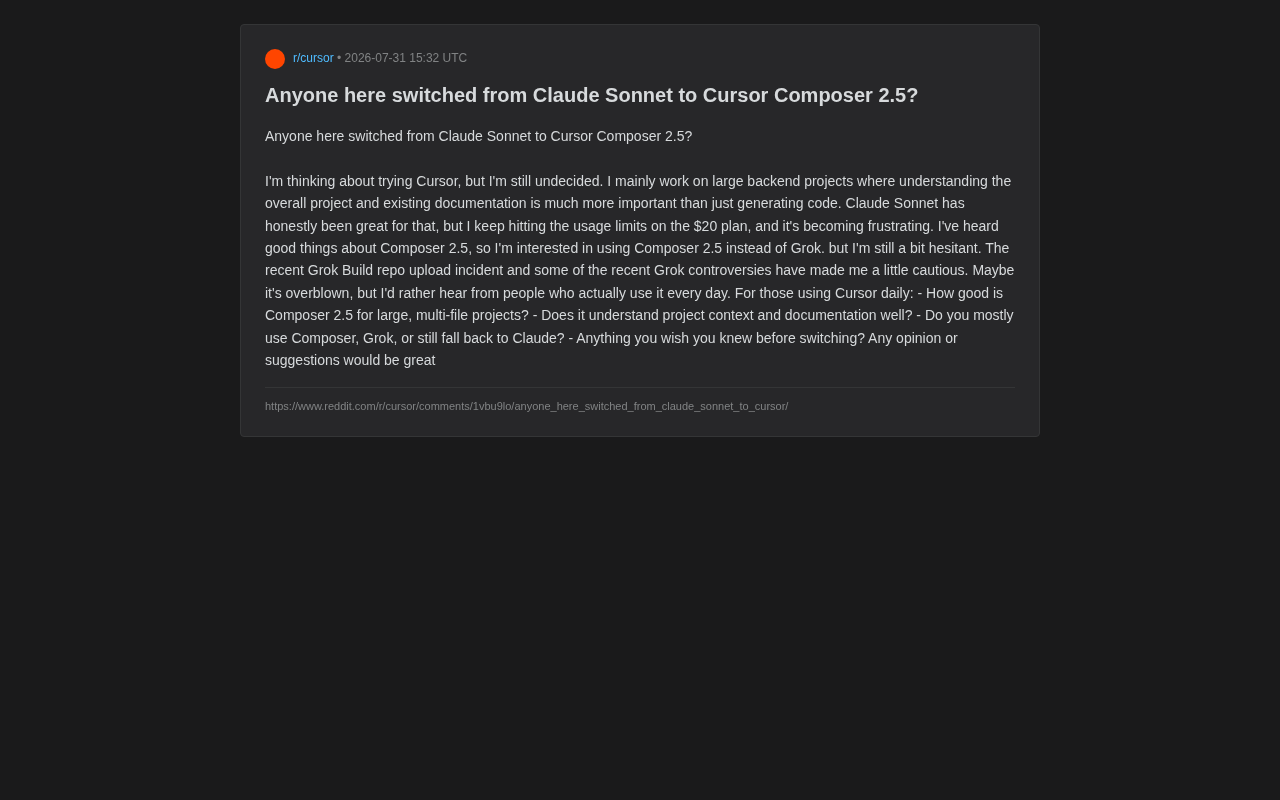
Behind this question lies a key watershed moment in the current AI programming tool competitive landscape: the balance between a model's contextual understanding capability and cost control in large codebase scenarios.
Cursor Composer 2.5's Positioning and Core Advantages
Deeply Integrated Editor Experience
Cursor Composer is an AI programming feature deeply integrated within the Cursor editor, and its greatest advantage lies in its native integration with the codebase. Compared to conversing with Claude in a standalone chat window, Composer can directly read project files, index the entire codebase, and coordinate modifications across multiple files.
For "multi-file large project" scenarios, this level of integration offers clear advantages. Composer 2.5 can quickly locate relevant code through semantic indexing and understand dependency relationships between modules — something that purely conversational AI (like using Claude directly) struggles to accomplish efficiently. Semantic indexing is a technology that converts code files into vector embeddings and stores them in a vector database. Unlike traditional keyword search, semantic indexing can understand the meaning and functional intent of code. For example, when a developer asks "where is the module that handles user authentication," semantic indexing can locate the relevant files even if the filenames or variable names don't directly contain the word "authentication." By indexing the project locally, Cursor builds a code knowledge graph that enables AI to quickly locate cross-file dependencies, function call chains, and data flows — which is especially critical for understanding large monolithic applications or microservice architectures.
Usage Quotas and Cost-Effectiveness Comparison
A pain point repeatedly mentioned in the original post is "the $20 plan frequently hitting usage limits." This is a common complaint among Claude Sonnet subscribers — in high-intensity coding scenarios, token consumption is extremely rapid.
To understand the technical root cause of this pain point, you need to understand the token mechanism. Tokens are the basic unit by which large language models process text — a Chinese character typically consumes 1.5-2 tokens, while an English word consumes approximately 1-1.5 tokens. When developers pass large codebase context to the AI, tens of thousands of lines of code can consume hundreds of thousands of tokens. Claude Pro's $20 subscription plan has caps on token consumption per day or per time period, and high-intensity usage (such as repeatedly passing in entire project structures or maintaining long conversation contexts) will quickly exhaust the quota. This is also why specialized tools for code scenarios use indexing and retrieval mechanisms to reduce the number of tokens directly passed to the model, thereby controlling costs without sacrificing understanding capability.
Cursor's pricing model may offer better value in certain usage patterns, especially since Composer is optimized for code tasks — it uses intelligent retrieval to pass only the most relevant code snippets into the model's context, reducing unnecessary context transmission.
The Controversy Around Grok and Developer Caution
Why Developers Hesitate
A notable detail: this developer specifically mentioned concerns about Grok. They referenced the "recent Grok Build repository upload incident" and "some Grok-related controversies," candidly admitting these made them cautious — "maybe it's been exaggerated, but I'd rather hear from people who actually use it every day."
Grok is a large language model developed by xAI (founded by Elon Musk), and its programming capabilities are rapidly iterating. The so-called "repository upload incident" refers to users needing to upload code repositories when using Grok's code features to gain contextual understanding, which raised concerns among some developers about code privacy and data security. In enterprise development scenarios, source code often contains trade secrets, proprietary algorithms, and security-sensitive information — any insufficiently vetted third-party data processing could pose compliance risks. This is why an increasing number of enterprise developers prioritize whether tools support local processing, whether data is used for model training, and whether they've passed security certifications like SOC 2 when selecting AI tools.
This attitude reflects a dimension that developers increasingly value when choosing AI tools today: looking not just at capability, but also at trust and security. Code is a company's core asset, and any rumors involving code leaks or improper privacy handling will directly influence tool selection decisions.
Model Selection Isn't a Binary Choice
In fact, one important feature of Cursor is its support for multi-model switching. Users can freely choose between Composer, Grok, and Claude. This means adopting Cursor doesn't mean abandoning Claude — the actual strategy of many power users is:
- Use Composer for codebase-wide multi-file refactoring and routine coding
- Fall back to Claude when deep reasoning or complex architectural analysis is needed
- Dynamically switch based on the nature of the specific task
From a technical implementation perspective, Cursor's multi-model switching is built on an API routing mechanism. The editor acts as a middleware layer, packaging the user's code context and instructions into standardized requests, then routing them to different model API endpoints (such as Anthropic's Claude API, OpenAI's GPT API, xAI's Grok API, etc.) based on user selection. Each model has significantly different reasoning styles: Claude tends toward cautious, structured output and excels at complex logical reasoning; the GPT series stands out in creative code generation; while Grok has demonstrated competitiveness in certain coding benchmarks. This architecture lets developers choose the most appropriate "brain" based on task characteristics.
This "toolbox" approach to usage is perhaps closer to real development workflows than an "either/or" replacement mindset.
Practical Considerations for Large Backend Projects
Contextual Understanding Is the Core Evaluation Criterion
For large backend projects, several technical dimensions deserve focused evaluation:
- Codebase indexing quality: Can Composer accurately index hundreds of thousands of lines of code and precisely retrieve relevant snippets when needed?
- Documentation understanding: Can READMEs, architecture documents, API specifications, and other project documentation be effectively incorporated into the model's context?
- Multi-file consistency: When modifying logic in one place, can it simultaneously identify and update all affected files?
These are precisely what separates "toy-grade" from "production-grade" AI programming tools.
What You Should Know Before Migrating from Claude to Cursor
For developers considering migration, community experience typically offers the following advice:
- Don't expect a drop-in replacement: Different tools have differences in reasoning style and code style — there will be an adaptation period
- Make good use of rules files: Cursor supports defining project specifications through configuration files, and upfront configuration investment can significantly improve output quality. Specifically, Cursor supports defining project-level AI behavior specifications through .cursorrules files (similar to .editorconfig or .eslintrc). Developers can specify coding styles (such as naming conventions, design pattern preferences), tech stack constraints (such as "this project uses TypeScript strict mode"), and architectural principles (such as "all database operations must go through the Repository layer"). These rules are injected into the context of every AI interaction, essentially setting a "project-specific persona" for the AI. For large team projects, well-configured rules files can improve AI output consistency by over 50%, significantly reducing manual review and correction workload.
- Keep a fallback: Since multiple models are supported, there's no need to abandon your familiar Claude workflow from the start
- Pay attention to privacy settings: For enterprise-grade code, make sure to verify the tool's data handling policies and privacy modes (such as Privacy Mode)
Conclusion: No Silver Bullet, Only the Right Trade-offs for You
The choice between Claude Sonnet and Cursor Composer 2.5 is fundamentally a workflow paradigm trade-off. The former provides powerful general reasoning capabilities; the latter provides deeply integrated codebase understanding and a more flexible cost structure.
For backend developers whose core need is "understanding the full picture of a project," perhaps the most pragmatic approach is: try Cursor on non-critical projects first, experience Composer's codebase understanding capabilities, while retaining Claude as a supplement for complex tasks. As for the Grok controversies, seeking multiple sources and proceeding with caution before making trust decisions is always the wise choice.
The value of a tool ultimately depends on whether it fits your specific workflow — which is exactly why the original poster chose to listen to "real feedback from people who actually use it every day" rather than making decisions based solely on marketing claims.
Related articles

Poison-Resistant Concept Anchoring: A New Approach to Defending Against AI Data Poisoning
Deep dive into Poison-Resistant Concept Anchoring, defending against data poisoning via signed anchors and bounded updates. Experiments show 62% poison isolation with 0% false rejection rate.

Hungarian Algorithm Explained: Principles, Complexity, and Engineering Implementation Guide
In-depth explanation of the Hungarian Algorithm: core principles, O(N³) time complexity advantages, and engineering implementation. Covers assignment problem definition, step-by-step algorithm walkthrough, Python/C++ libraries, and applications in multi-object tracking and resource scheduling.
OpenAI's First Enterprise AI Report: H…
OpenAI's First Enterprise AI Report: How ChatGPT Is Changing the Way Organizations Work
OpenAI's first enterprise AI report reveals three key traits of ChatGPT Enterprise adoption: the shift from novelty to necessity, writing and coding as top use cases, and data governance as a core prerequisite.