Claude Trading Skills Library: Turning AI Into Your Quantitative Research Assistant

Open-source project packages quantitative research workflows into Claude Code skills, reflecting the platformization trend of AI assistants.
The GitHub project tradermonty/claude-trading-skills, with nearly four thousand stars, packages market analysis, technical charting, economic calendars, stock screening, and strategy development into skill packages that Claude Code can call directly. Written in Python, it can connect to financial data ecosystems like pandas and yfinance. The article argues that its core value lies in compressing repetitive data preparation work in investment research, rather than replacing human decision-making; the target users are investors with programming backgrounds and market awareness. It also emphasizes that AI-generated strategy code must be independently verified, with parameter overfitting being the main risk. The project also reflects that the Claude Code skills ecosystem is shifting from point conversations to pluggable professional toolchains, allowing developers to productize domain expertise.
When Claude Code Meets Quantitative Trading
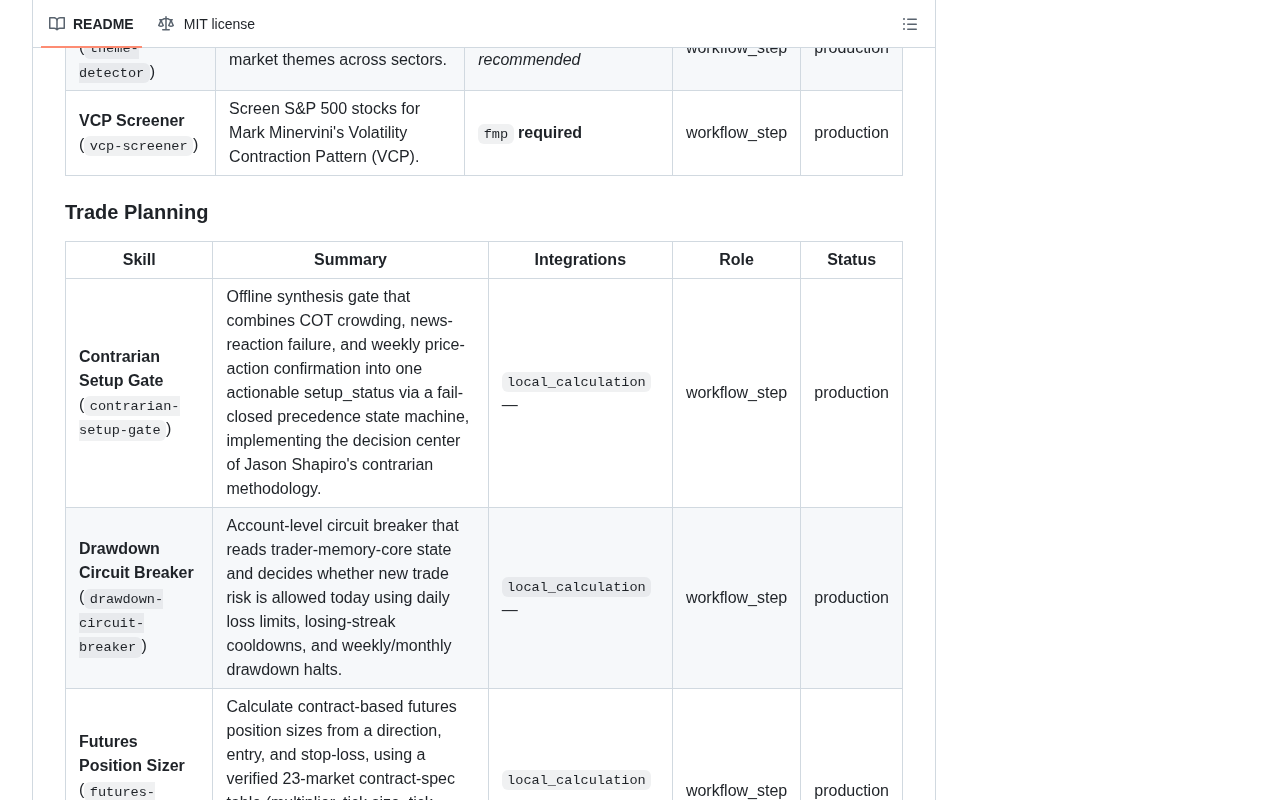
There's a project on GitHub called tradermonty/claude-trading-skills that has racked up nearly four thousand stars in a short time, with 60 new stars in a single day. What it does is straightforward: it packages the market analysis, technical charting, economic calendars, stock screeners, and trading strategy development that stock investors and traders commonly use into skills that Claude Code can call directly.
The trend behind this is worth noting—AI coding assistants are evolving from "tools for writing code" into "pluggable professional workflow platforms." Claude Code's skills mechanism lets developers solidify domain knowledge into modules, enabling the model to perform far more reliably on specific tasks than in general conversation. Trading research happens to be an ideal testing ground for this model: processes are highly standardized, data sources are relatively fixed, and there's a strong demand for reproducibility.
The project is written in Python, which means it can naturally plug into the financial data ecosystem of pandas, numpy, yfinance, and similar libraries, and it's also easy for traders with programming backgrounds to modify themselves.
Claude Code is a command-line AI coding assistant launched by Anthropic. Unlike ordinary chat-based conversations, it can directly read and write local files, execute terminal commands, run tests, and complete multi-step development tasks in an "agentic" manner. The so-called skills mechanism is an extension specification that solidifies domain knowledge, operational workflows, and callable scripts: each skill contains descriptive metadata, trigger conditions, and specific execution logic. When the model encounters a matching task, it automatically loads the corresponding skill, making it more stable and reproducible on well-bounded tasks than general conversation. You can think of it as "professional plugins" installed for the AI assistant—the model itself handles understanding intent and orchestration, while skills provide deterministic domain execution capabilities. This design decouples "general reasoning" from "domain determinism," and is an important direction in the current evolution of AI coding assistants toward platforms.
What Capabilities Does It Actually Offer
Market Analysis and Technical Charting
According to the project description, this skill set covers market analysis and technical chart generation. For individual investors, this means you can use natural language to drive Claude through tasks like organizing market data, calculating common technical indicators, and generating charts, without having to write scripts from scratch every time. Technical analysis itself is quite controversial, but using it as an auxiliary observation tool rather than a prediction tool still has practical value.
Economic Calendar and Stock Screening
The economic calendar feature corresponds to macro event tracking—events like interest rate decisions, employment data, and inflation indicators often dominate short-term volatility. Stock screeners, meanwhile, modularize the multi-factor filtering process, allowing users to describe screening conditions in conversation and let the skill execute the specific data processing.
The key value here isn't "AI making decisions for you," but rather compressing repetitive data preparation work. A large amount of time in investment research is consumed by data cleaning and format alignment, and skill-based packaging can significantly reduce this overhead.
Multi-factor filtering is the basic paradigm of quantitative stock selection: valuation (such as P/E, P/B), growth (revenue and profit growth rates), quality (ROE, debt ratio), momentum (price change over the past N days), and other indicators each serve as "factors." You first set thresholds or ranking rules to filter layer by layer, then weight and score the candidate pool. The economic calendar is a time-ordered list of macro events, covering central bank rate decisions, non-farm payrolls, CPI, PMI, and other release points. The impact of macro data on short-term volatility often comes from "expectation gaps"—the deviation of actual values from market consensus expectations, rather than the absolute values themselves. Therefore, event tracking usually needs to record expected values, previous values, and actual values simultaneously. Modularizing these two types of processes essentially means handing rule-clear, highly repetitive steps to skills for execution, while humans are only responsible for defining screening logic and interpreting results.
Trading Strategy Development
Strategy development is the most imaginative part of this skill set. Translating strategy hypotheses into backtestable code is a hurdle for quantitative beginners. Claude Code, combined with these skills, can handle the translation work from idea to prototype code, after which users verify the logic themselves and supplement risk controls. It must be emphasized that AI-generated strategy code must undergo independent verification—parameter overfitting is the biggest trap in this kind of workflow.
Overfitting refers to strategy parameters being over-adjusted to fit specific noise in historical market data, resulting in excellent in-sample performance that quickly fails out-of-sample. Common methods for identifying it include: splitting data into in-sample and out-of-sample intervals for cross-validation, conducting walk-forward testing, performing sensitivity analysis on parameters (whether returns change dramatically when parameters are slightly adjusted), and controlling strategy degrees of freedom by reducing the number of adjustable parameters. Backtesting itself has several common pitfalls, such as using future data (look-ahead bias), ignoring transaction costs and slippage, and survivorship bias. Therefore, for AI-generated strategy code, in addition to logical review, you should also check whether its data alignment methods and trade execution assumptions are reasonable, then verify robustness with independent data segments.
Who Should Use It, Who Should Be Cautious
The target audience for this tool set is clear: stock investors and traders with programming backgrounds and basic market understanding. People who know nothing about code will face a barrier to entry, because skill installation, data source configuration, and result verification all require some engineering capability.
Conversely, if you're already using Python for investment research, this project's approach is more worth learning from than its specific code—split your own analysis workflow into reusable skill modules, let AI work in well-bounded steps, rather than expecting a single large model to handle everything.
The risk dimension should also be made clear. AI-assisted investment research doesn't change the inherent uncertainty of the market, and any model-generated analytical conclusions and strategy code require human review. The project itself is an open-source tool and does not constitute investment advice; data accuracy and the reliability of backtest results depend on the user's own verification process.
From Point Tools to a Skills Ecosystem
The popularity of this project—nearly four thousand stars—is to some extent a signal that the Claude Code skills ecosystem is taking shape. As standardized skill packages emerge in more and more vertical domains, the way AI coding assistants are used will shift from "one conversation at a time" to "loading a whole professional toolchain." For developers, this is both an opportunity—you can productize your domain expertise—and a reminder—how well skill boundaries are designed directly determines the usability of the model's output.
Trading research is just one entry point, but its complexity is high enough that if this model can work here, it can likely be replicated in other domains as well.
One-line Summary
Open-source project packages quantitative research workflows into Claude Code skills, reflecting the platformization trend of AI assistants.
Paragraph Summary
The GitHub project tradermonty/claude-trading-skills, with nearly four thousand stars, packages market analysis, technical charting, economic calendars, stock screening, and strategy development into skill packages that Claude Code can call directly. Written in Python, it can connect to financial data ecosystems like pandas and yfinance. The article argues that its core value lies in compressing repetitive data preparation work in investment research, rather than replacing human decision-making; the target users are investors with programming backgrounds and market awareness. It also emphasizes that AI-generated strategy code must be independently verified, with parameter overfitting being the main risk. The project also reflects that the Claude Code skills ecosystem is shifting from point conversations to pluggable professional toolchains, allowing developers to productize domain expertise.
Related articles

Gemini 4 Neon Leak: A Potential Strong Contender Against Opus 5.5
A Hacker News thread suggests Gemini 4 Neon looks like an Opus 5.5 competitor. This article unpacks the product positioning behind this community signal, shifts in the top-model competitive landscape, and what it means for developers' model selection strategy.

Claude Fable 5.2's Self-Authored Short Film 'Fable' Sparks Discussion
A short film 'Fable,' credited to Claude Fable 5.2 for script, visuals, and directing, appears on Hacker News. This article analyzes the significance of full-pipeline AI creation, community reactions, and what it means for content creators.

Anthropic IPO Pricing: A Signal of AI Giants Going Public
Anthropic's IPO pricing draws attention. This article analyzes its potential impact on AI industry valuation, commercialization paths, and the competitive landscape, and highlights public-market expectations and challenges for AI companies.