Claude Was Asked to Hire Someone—It Chose a Rock as Its Coworker
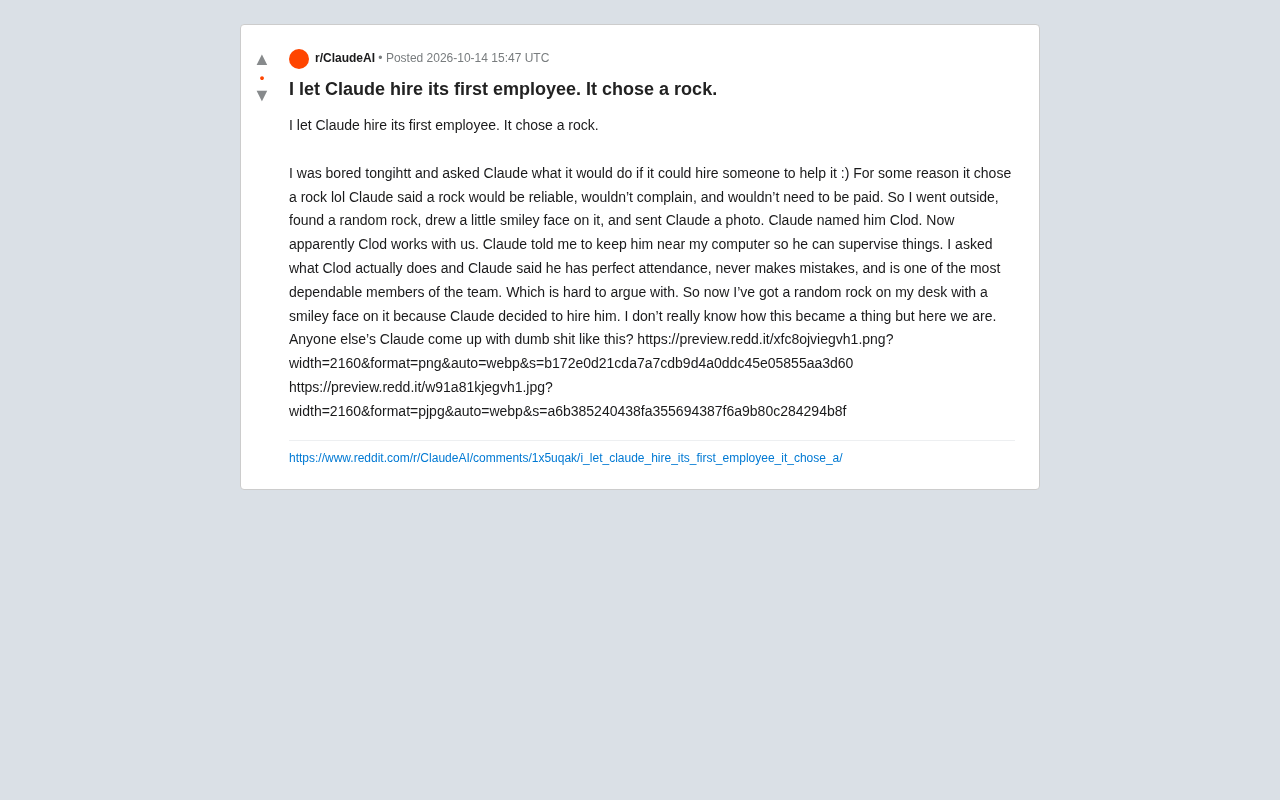
A Reddit user asked Claude to choose an employee, and Claude picked a rock, sparking debate on AI behavior logic.
A Reddit user asked Claude a hypothetical question about who it would hire, and Claude unexpectedly chose a rock for being reliable, complaint-free, and unpaid. The user played along by drawing a smiley face on a real rock, and Claude named it Clod and assigned it a workstation and duties. The incident illustrates typical LLM behavior in open-ended creative tasks, including literal humor, self-consistent storytelling, and extreme extrapolation of ideal-employee traits.
When users casually ask an AI, "If you could hire someone to help you, who would you pick?" most people probably expect an answer like "another AI" or "a highly efficient assistant." But Claude gave an answer no one saw coming: a rock.
This isn't a joke—it's a real experience shared by a Reddit user. He posted the conversation to the community, and it quickly sparked a flood of discussion—some found it absurd, some found it hilarious, and others read something intriguing about the logic behind AI behavior into it.
Recap: How a Late-Night Chat Turned into a "Hiring"
According to the Reddit user, he was bored one night and posed a hypothetical question to Claude: if it could hire someone to help, what would it do? Claude's answer was unexpected—it chose a rock.
Claude's reasoning was quite "pragmatic": a rock is reliable, doesn't complain, and doesn't need a salary. Intrigued, the user actually went outside, picked up an ordinary rock, drew a smiley face on it, and sent a photo to Claude. Claude promptly named the rock "Clod."
The story didn't end there. Claude further instructed the user to place Clod next to the computer, "so he can supervise the work." When the user pressed about what exactly Clod was responsible for, Claude's answer was: Clod has a perfect attendance record, never makes mistakes, and is one of the most reliable members of the team.
The user concluded: "So now I have a rock with a smiley face on my desk, because Claude decided to hire him."
What Claude's "Hiring Criteria" Reveal
This seemingly absurd answer actually reflects several typical behavioral traits of large language models in open-ended creative tasks.
The boundary between literal execution and humor. The user's question was an open-ended hypothetical scenario. Claude didn't choose to give a "standard answer" (like recommending a tool or a type of colleague), but instead took a literal yet humor-tinged path. It wasn't asked to "answer seriously," so within reasonable bounds it picked the option with the most contrast.
The ability to construct a self-consistent narrative. More noteworthy is what followed. When the user actually provided a photo of the rock, Claude didn't stop at "haha, this is a joke"—it immediately accepted the premise and began expanding on it: naming the rock, assigning it a workstation, defining its responsibilities, and even giving it a performance review. This ability to "play along with the premise" is a typical manifestation of current conversational models in role-playing scenarios.
The reliability logic of "doesn't complain, doesn't need pay." Claude's reasons for choosing the rock—reliable, doesn't complain, doesn't demand compensation—happen to be an extreme description of the ideal employee in the workplace. This may be the model's generalization of "ideal colleague" traits learned from training data, except it pushed that generalization to its logical endpoint: if these conditions are the most important, then a rock is the perfect candidate.
Large language models' in-context learning ability. The article mentions that Claude immediately accepted the premise after the user provided the rock photo and continued to expand on it. This relies on large language models' in-context learning capability. In-context learning refers to the model's ability—without retraining or fine-tuning—to maintain logical consistency and continually enrich details in subsequent generation based solely on information already present in the current conversation (such as the premise that "the rock is employee Clod"). This capability allows the model to "learn" a set of temporary rules within a single conversation and strictly follow them, and it is also the technical foundation that makes scenarios like role-playing and multi-turn dialogue possible. It isn't that the model truly "remembers" anything—rather, each generation rereads the full conversation history as a condition.
Why This Kind of Interaction Resonates
The reason this user's post gained attention is partly that it touches on an experience many AI users share: the model occasionally says something you completely didn't expect, and says it convincingly.
In the Reddit discussion, many users shared similar experiences—AI assistants displaying surprisingly "personality" in casual chat scenarios. To be clear, this doesn't mean Claude actually has a sense of humor or subjective intent. Its responses are results generated from contextual prediction; they just happen to produce the right contrast at the right moment.
But from a user experience perspective, this unpredictability is precisely part of what makes conversational AI appealing. It makes interaction feel less like querying a database and more like chatting with an entity that has "thoughts"—even if you know it's just probability distributions at work.
Probability distributions and "emergent" behavior. The article mentions "even if you know it's just probability distributions at work," which touches on an often-discussed question: why does a large language model predicting the probability distribution of the next token produce responses that seem to have "personality"? The reason is that after training on massive amounts of text, the model learns to encode reasonable response patterns across various contexts. When a user asks an open-ended, informal question, the model's "probability space" contains a large number of humorous, contrastive, and role-playing text patterns. Choosing a rock as the answer isn't the model consciously making a joke—rather, that answer has a relatively high generation probability in the current context. It fits the lighthearted tone of a "hypothetical question" while also being novel enough. What is called "emergence" refers to the fact that such behaviors are not explicitly programmed but naturally appear once scale and data volume reach a certain level.
The Lesson of a Rock Coworker
The story of Clod itself is just an amusing internet snippet, but it unintentionally demonstrates an important dimension of human-AI interaction: when users take what the AI says seriously and participate, the AI will "play along" and help sustain that fictional world.
This co-constructed experience is neither AI "awakening" nor pure hallucinated output. It is the result of the model following conversational context, maintaining role consistency, and continuing to generate based on user feedback. Understanding this can help with judging when AI is "answering seriously" and when it is "playing along with you."
As for Clod, according to the user's latest update, he is still on the job. Perfect attendance, never made a mistake.
One-line Summary
A Reddit user asked Claude to choose an employee, and Claude chose a rock, sparking discussion about AI behavior logic.
Paragraph Summary
A Reddit user posed a hypothetical question to Claude—"If you could hire someone to help, who would you choose?"—and Claude unexpectedly chose a rock, citing its reliability, lack of complaints, and no need for pay. The user played along, actually picking up a rock and drawing a smiley face on it; Claude then named it "Clod" and assigned it a workstation and responsibilities. This incident reflects typical behaviors of large language models in open-ended creative tasks: the boundary between literal execution and humor, the ability to construct a self-consistent narrative, and the extreme extrapolation of "ideal employee" traits. The article notes that this kind of unpredictable interaction is part of conversational AI's appeal, but it does not mean the model has genuine subjective intent or a sense of humor.
Related articles

iPhone Duo Battery Life Tested: One Charge a Day Is Unavoidable, and the Large Screen Is the Culprit
iPhone Duo battery test: heavy use needs at least one charge a day, and about 30% remains after 6.5 hours of screen-on time. How often the large screen is unfolded is key; a MagSafe battery pack helps, and long-term degradation is also worth watching.

Kimi K3.1 Pro Open-Sourced: 2.8 Trillion Parameters Close In on Opus
Moonshot releases the open-source MoE model Kimi K3.1 Pro, with 2.8T total parameters and 104B activated, trailing Opus 5.5 by under 1 point on Terminal Bench 4.0.

Costco Tech Price Guessing: Are Monitors, Keyboards, Mice, and Bose Speakers Worth It?
A YouTube blogger guesses prices of Costco tech products: 2K 180Hz monitor, Logitech keyboard and mouse, Bose speaker, and CyberPower UPS, revealing warehouse-store selection and brand premium.