claudemon: A Terminal Pokémon Game to Play While Waiting for Claude Code

A terminal game that lets you battle Pokémon while waiting for Claude Code to finish tasks.
claudemon is a developer tool that transforms Claude Code's idle waiting time into classic Pokémon encounters. Each prompt counts as a step through tall grass, and every 20 seconds of AI work triggers potential wild Pokémon battles in a second terminal tab. Featuring all 151 original Pokémon, it runs fully locally with no account required, addressing the fragmented waiting problem of AI-assisted programming with nostalgia-driven fun.
When AI Programming Meets Waiting Anxiety
When using AI programming assistants like Claude Code, developers often find themselves in a peculiar situation: half the time is spent writing prompts and reviewing code, while the other half is spent waiting for the AI to complete its tasks. These waiting periods are awkwardly timed—too short to switch to social media without losing focus, but too long to just sit idle.
To understand this, you need to know how Claude Code works: it's Anthropic's command-line AI programming assistant that lets developers chat directly with Claude in the terminal, asking it to read codebases, write features, and fix bugs. Unlike IDE-embedded completion tools like GitHub Copilot, Claude Code functions more like an autonomous coding agent that can browse files, execute commands, and perform multi-step reasoning on its own. This means a single task can take anywhere from a few seconds to several minutes, creating noticeable waiting gaps—and that's exactly the problem.
Targeting this "fragmented waiting" pain point, developer Sergio Zamarro launched a cleverly designed developer tool called claudemon, with a tagline that's both straightforward and fun: "A wild Pokémon appeared... while waiting for Claude Code!" The product earned 98 upvotes on Product Hunt, ranking 9th that day, and was categorized across Developer Tools, Artificial Intelligence, and Games.
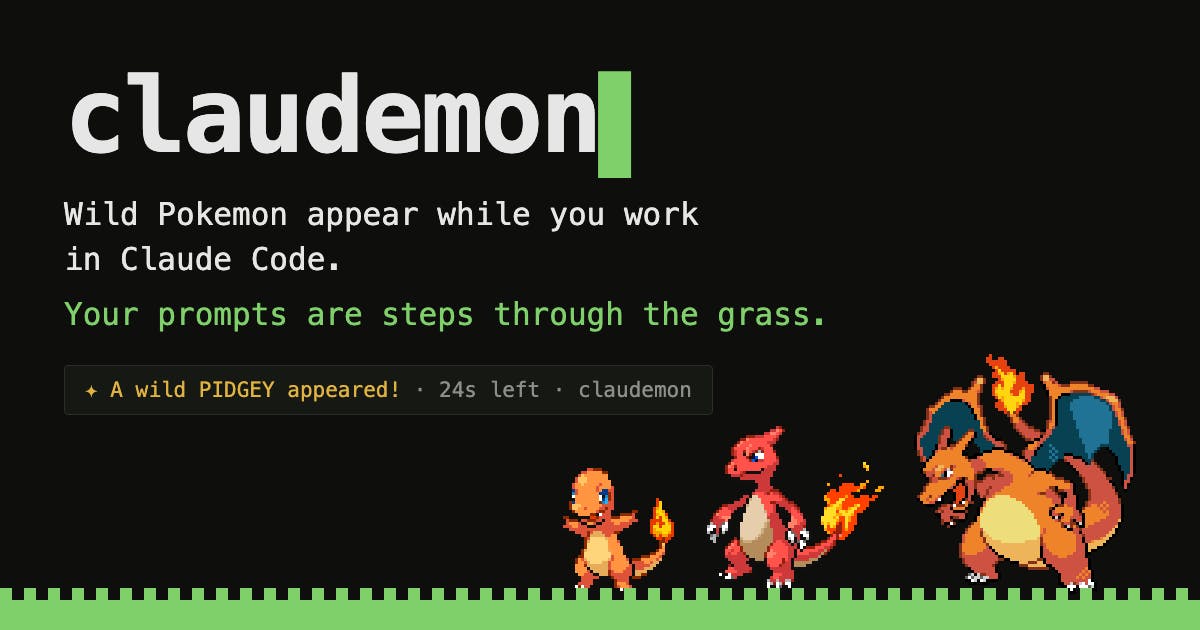
Core Gameplay: Prompts as Steps
claudemon's design logic is quite clever—it maps Claude Code's workflow onto classic Pokémon game mechanics:
- Each prompt you send counts as walking through tall grass
- Every 20 seconds Claude works equals one step forward
- As you walk, a wild Pokémon will eventually "jump out"
- The status line notifies you of a Pokémon encounter
- You can battle it in a second terminal tab
The elegance of this design lies in not interrupting the developer's main workflow. Instead, it leverages the already-existing "idle window." While waiting for AI-generated code in one terminal, you can complete a quick Pokémon battle in another—and by the time you're done, Claude's task might be nearly finished too.
From a cognitive science perspective, this design may be more beneficial than doing nothing or scrolling social media. Research shows that the "intermittent collaboration" pattern introduced by AI programming tends to cause what's known as "attention residue"—the brain struggles to quickly return to a deep thinking state after brief idle periods. Lightweight activities like claudemon, which have clear objectives but don't require deep cognitive investment, can serve as cognitive transition buffers, helping developers switch back to work mode more quickly once the wait is over.
Full Recreation of the Original 151 Pokémon
Notably, claudemon includes all 151 original Pokémon—an Easter egg brimming with nostalgia for developers familiar with the franchise. Collecting, battling, and the Pokédex—these classic elements are condensed into the terminal environment.
The original 151 Pokémon come from Pokémon Red/Green, released on Game Boy in 1996, spanning from Bulbasaur (#001) to Mew (#151). This generation's Pokédex has become an iconic symbol in global pop culture. For programmers born in the 80s and 90s—who happen to be the core user base of current AI programming tools—the original Pokémon are deeply tied to childhood memories. Choosing the first-generation Pokédex over the 800+ Pokémon from later generations both reduces development complexity and maximizes the nostalgic marketing effect.
Fully Local, No Account Required
In terms of privacy and convenience, claudemon makes a clear choice: fully local operation, no account registration needed.
This is particularly important for the developer community. As a small tool that lives in the terminal environment, local operation means:
- No additional network requests or data uploads
- No privacy concerns from account systems
- Install and play—minimal friction
From a technical architecture standpoint, fully local operation means claudemon's game logic, Pokémon data, battle system, and everything else is bundled client-side with no dependency on remote servers. This architecture is increasingly popular among developer tools, since many programmers work in environments involving corporate intranets, VPNs, or offline development scenarios. Local operation also avoids the latency issues and service shutdown risks common to online games—even if a developer goes offline or the project is no longer maintained years later, the game still works.
For programmers who value a clean working environment, this "zero-burden" approach is far more acceptable than tools requiring login, internet connectivity, or background processes. It also aligns with the developer community's growing appreciation for "local-first" software philosophy—where data sovereignty belongs to the user and functionality doesn't depend on the cloud.
The Product Philosophy of Gamified Developer Tools
Precisely Addressing the Emotional Needs of the AI Programming Era
At its core, claudemon is a "useless but fun" tool—it won't make your code faster or improve AI reasoning capabilities. But it precisely captures a real emotional need in the AI programming era: how to gracefully spend waiting time.
As AI programming assistants become widespread, the rhythm of human-machine collaboration is undergoing fundamental change. Traditional software development is a highly continuous mental activity requiring sustained focus on code logic. With AI assistants in the picture, developers no longer code at high intensity continuously—instead, they enter a "prompt—wait—review" loop. The developer's role shifts from "executor" to "intent articulator" and "quality gatekeeper," with fragmented idle time from AI execution interspersed throughout. Tools like claudemon are products born from this new workflow—they fill not a functional gap, but an experiential one.
From Efficiency-Oriented to Experience-Oriented
From a broader perspective, claudemon represents a trend: developer tools are extending from purely "efficiency-oriented" to "experience-oriented." When basic functionality becomes homogenized, the ability to provide developers with joy and reduce fatigue is becoming a new dimension of differentiation.
We can see similar thinking in other terminal tools—flashy terminal themes (Starship, Oh My Zsh), command-line mini-games (terminal Snake, ASCII 2048), progress bar animations (like npm's random loading messages), and even VS Code pet plugins (vscode-pets). The shared logic of these tools is: developers' daily work is already tedious and high-pressure enough—injecting a bit of fun without impacting efficiency is a reasonable humanistic design choice. claudemon simply combines this philosophy with today's hottest AI programming scenario, leveraging the appeal of Pokémon—a global IP with cumulative revenue exceeding $100 billion.
Final Thoughts
claudemon isn't a product that will reshape the industry landscape, but it responds to a specific, real-world pain point of the AI programming era in a lighthearted and humorous way. For developers who work with Claude Code daily and hold nostalgic feelings for the original Pokémon, this might be a "productivity slacker's dream tool" worth trying.
It also reminds us: on the path to maximizing productivity, occasionally stopping to encounter a Pikachu in the tall grass might just be a healthy work rhythm. As AI takes on more and more execution work, human developers actually need to learn to coexist peacefully with "waiting"—and claudemon offers an entertaining answer.
Related articles

Switching Back from Claude to ChatGPT: AI Tool Choice Isn't Just About Performance
A user switched from ChatGPT to Claude and back within a week, revealing that interaction style, habits, and emotional connection matter more than benchmarks in AI tool choice.

Hoplite: A Deep Dive into the Cloud-Based Coding Agent Deployment Platform
Deep analysis of YC S26 project Hoplite, a platform for cloud coding agent deployment and orchestration. Learn how it addresses execution isolation, scalable orchestration, and the AI programming infrastructure market.

AACL Commitment Guide: Tips and Templates for Writing Your Response to Metareview
A detailed guide to writing the Response to Metareview for ACL Rolling Review Commitments, with structure, tips, and templates to maximize persuasiveness within the 2000-character limit.