Clef Flash Plays Snake in Real Time: A Real-Time Inference Experiment with a 9B Model on RTX 5080

Clef Flash 9B plays Snake in real time on RTX 5080 with zero training, validating zero-shot real-time decision-making.
A developer ran Clef Flash (9B parameters, Q4 quantization) on a single RTX 5080 to play Google Snake in real time — no training, no game-state hacking, just natural language descriptions of the snake's perception driving model decisions within a ~135ms window. The experiment validates whether a general-purpose LLM can handle continuous real-time decision-making without task-specific fine-tuning, demonstrating zero-shot generalization, consumer hardware viability, and low-latency inference. It's best treated as a proof of concept rather than a rigorous benchmark.
A Real-Time Gaming AI Experiment with Zero Training
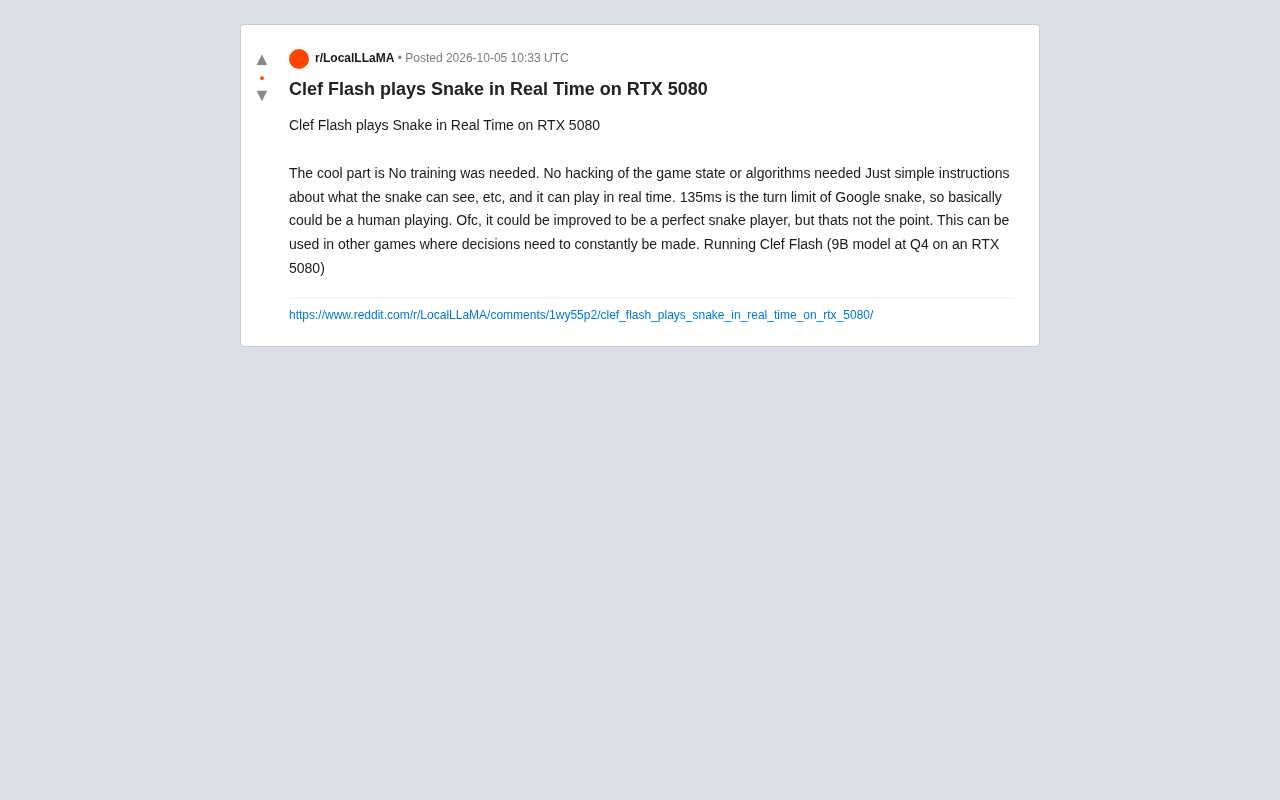
An interesting demo surfaced on Reddit: a developer got the Clef Flash model to play Google's Snake game in real time on an RTX 5080 GPU. The most striking aspect of the whole setup is this — no training was involved, and there was no reverse-engineering of game state or algorithms.
All the developer gave the model was a set of simple instructions describing what the snake could "see" at any given moment — things like the snake head's position, the direction of food, boundaries, and other basic information — and the model made decisions in real time based on that input. This approach stands in sharp contrast to traditional reinforcement learning-based game AIs, which typically require extensive training iterations and carefully designed reward functions.
What a 135-Millisecond Decision Window Actually Means
The demo highlights a key figure: Google Snake's maximum turn time is approximately 135 milliseconds. The model needs to complete the full perception–decision–output loop within that window to keep pace with the game. In other words, the model's response speed is close to that of a human player — "basically the same as a person playing."
This time constraint matters a great deal. It means the model doesn't just need to play — it needs to play fast. Running a language model through continuous decision-making at sub-200ms latency on consumer-grade hardware is a genuine stress test of inference speed.
Hardware and Model Configuration
Based on information shared in the original post, this demo ran on:
- Model: Clef Flash, a 9B-parameter model
- Quantization: Q4 (4-bit quantization)
- Hardware: A single RTX 5080 GPU
Q4 quantization dramatically reduces VRAM usage and inference latency while still allowing the model to run smoothly on consumer GPUs — a prerequisite for meeting that 135ms decision window.
Q4 quantization (4-bit quantization) is a technique that compresses model weights from their original 16-bit or 32-bit floating-point representation down to 4-bit integers. For a 9B-parameter model, FP16 precision requires roughly 18GB of VRAM, while Q4 quantization brings that down to around 5–6GB — making it viable on consumer GPUs like the RTX 5080 with its 16GB of VRAM. The trade-off is a slight loss in precision, but for instruction-following and simple decision-making tasks, this is generally acceptable. Quantized inference also significantly reduces single-pass forward computation time, which is the key technical enabler for meeting the real-time 135ms window. Mainstream quantization toolchains — including llama.cpp (GGUF format) and bitsandbytes — have made this kind of deployment largely standardized.
The Goal Isn't "Perfect Play" — It's Validating General-Purpose Decision-Making
The developer was explicit: "Of course, it could be improved into a perfect Snake player, but that's not the point."
This remark gets at the core value of the experiment. Snake is a relatively simple game — building an unbeatable algorithmic solver is trivial. What's genuinely interesting is something else: a general-purpose large language model, with no task-specific training, can understand game rules and make reasonable, continuous decisions based purely on natural language instructions.
The potential applications of this capability extend far beyond Snake. As the original post noted, this approach "could be used in other games that require continuous decision-making." Any scenario that involves repeatedly judging the next action based on real-time environmental state could theoretically adopt the same "perception description + model decision" paradigm.
This "perception description + model decision" paradigm is fundamentally about converting structured game state into a natural language prompt, then having the language model output an action command. The core assumption is that large language models accumulate enough knowledge about spatial reasoning, rule comprehension, and sequential decision-making during pretraining to transfer to new tasks in a zero-shot setting. This contrasts with the traditional reinforcement learning (RL) path, which requires designing a reward function, iterating through trial and error in the environment, and updating a policy network — often requiring millions to billions of interactions before converging. The language model approach eliminates training costs, but in doing so, it depends on the task complexity remaining within the model's existing knowledge boundaries.
The Significance and Limitations of This Kind of Experiment
On the positive side, this demo illustrates several noteworthy trends:
- Zero-shot generalization: The model handles a novel interactive task without any fine-tuning, demonstrating the adaptability of general-purpose models.
- Consumer hardware viability: A 9B model with Q4 quantization brings this kind of real-time inference out of the data center and onto a desktop GPU.
- Low-latency inference: A sub-200ms decision loop provides a useful reference point for real-time AI-driven interactive applications.
That said, the limitations are worth acknowledging. Snake's state space and decision complexity are far lower than those of genuinely complex games or real-world tasks. Good performance here doesn't directly translate to competence at higher-dimensional decision problems. Additionally, as a single-source personal demo, the post lacks systematic performance data — average scores, decision accuracy, long-run stability, and so on. It's better viewed as a proof of concept than as a rigorous benchmark.
Closing Thoughts
This small experiment of Clef Flash playing Snake in real time answers a concrete question in an intuitive way: can a large language model participate in real-time, continuous decision-making tasks on a consumer GPU without any training? The answer appears to be yes. Snake itself may be inconsequential, but the underlying idea it validates — using natural language instructions to drive real-time decision-making — is arguably what makes this demo genuinely interesting.
Related articles

Why Does the Tesla Roadster Need to Fly? A Deep Dive into Musk's Wild Demo
Tesla's Roadster launch showed wall-climbing, upside-down driving, and flying stunts—but The Vergecast notes the demo car may lack a battery, the Rocket version is invite-only and not street-legal, and the website terms don't guarantee delivery. After nine years of delays, why does this car still need to exist?

AI Is Not a Replacement: Human-AI Collaboration Through the Lens of Factory Root Cause Analysis
Starting from factory root cause analysis, this article explains how AI accelerates evidence chain construction rather than replacing human experts, exploring the pragmatic implementation logic and business value of 'AI supporting people rather than replacing them.'

AI Agent Decision Auditing: Building an Evidence Chain in Regulated Workflows
Starting from a Reddit discussion, this article analyzes three core issues in AI agent decision auditing within regulated workflows: what fields audit records should contain, how to handle feedback latency for erroneous decisions, and how to continuously calibrate LLM judge consistency with human judgment.