Clicks.page: A Revenue-First Analytics Tool Built for Indie Developers

Clicks.page is an open-source, revenue-first analytics tool that shows indie developers exactly which channels drive paid conversions.
Clicks.page is a lightweight analytics tool for founders and indie developers centered on a "revenue-first" philosophy — it doesn't just report traffic, it directly links visitor sources to payment events so you can see which channels actually generate revenue. The product uses cookieless tracking to sidestep GDPR and CCPA consent requirements, supports AI Agent setup via a single natural language prompt, and as an open-source project offers self-hosting options for developers who prioritize data sovereignty. Still in its early stages, Clicks.page tackles a genuine pain point by making revenue attribution — not pageviews — the core unit of analysis.
For indie developers and founders, website analytics tools have never been in short supply — from Google Analytics to a growing list of privacy-friendly alternatives, the options are endless. But the vast majority of these tools stop at telling you "how many people showed up," rarely answering the more critical question: Of all those visitors, which ones actually paid? That's exactly the gap Clicks.page is trying to fill.
Launched on Product Hunt under the tagline "Beautiful revenue-first analytics for founders & makers," this product puts revenue — not traffic — at the center of the analytics experience.
The Mindset Shift: From Traffic Analytics to Revenue Analytics
Traditional analytics tools are built around traffic: pageviews, bounce rates, session duration, referral sources. These metrics matter, but for an indie developer trying to monetize a product, they're process metrics — not outcome metrics. You might have a high-traffic page and still have no idea whether it's actually driving paid conversions.
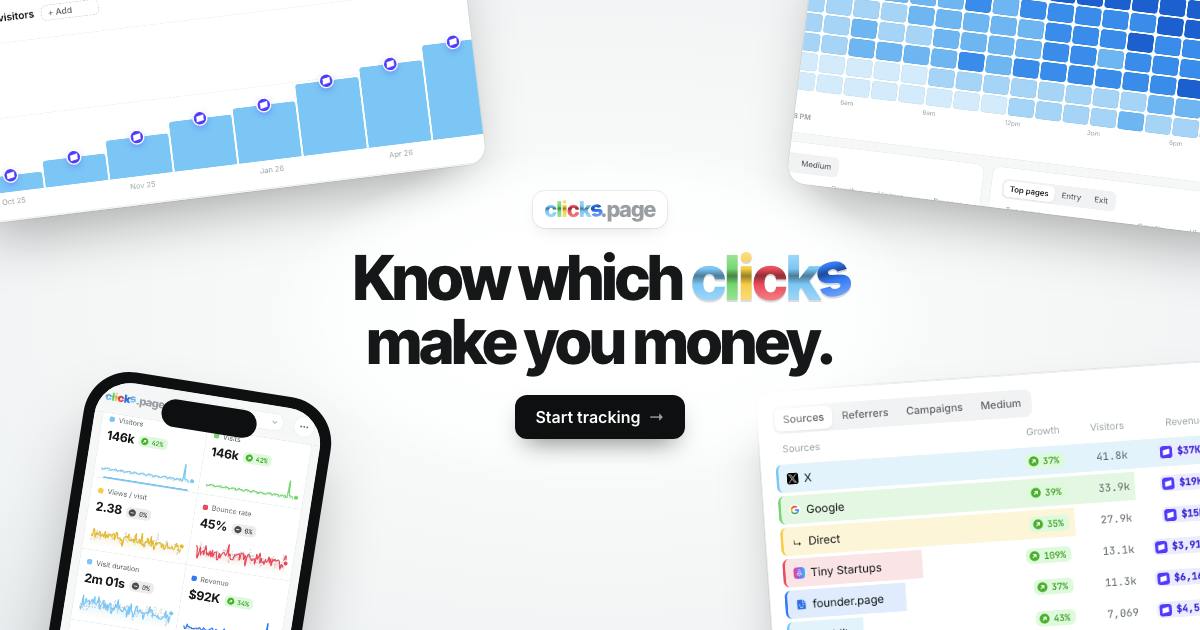
Clicks.page is positioned as "revenue-first," meaning revenue attribution takes center stage. According to the product description, it lets you "see every visitor, where they came from, and which ones paid." The endpoint of analysis is no longer an abstract conversion rate — it's a direct link between specific traffic sources and specific payment events.
For solo founders or small teams, this kind of attribution capability has real practical value: it tells you directly which channel is worth doubling down on and which piece of content actually generated revenue, instead of leaving you guessing amid a pile of pretty but inconclusive charts.
Revenue Attribution refers to the practice of tracing a completed payment back to a specific traffic source, marketing channel, or user behavior path. Traditional attribution models include Last-click (crediting the final touchpoint before purchase), First-click, and Multi-touch (distributing credit across all touchpoints by weight). For indie developers, the core challenge lies in connecting website visit data to payment records from systems like Stripe, Paddle, or Lemon Squeezy — typically by passing tracking parameters through the checkout flow or sending payment events back to the analytics platform via Webhook. Clicks.page focuses precisely on closing this "visit source → payment action" loop, helping developers skip the ambiguity in between and see a direct mapping between channels and revenue.
Cookieless Design: Privacy-Friendly and Compliant
Clicks.page uses a cookieless tracking approach — a choice that aligns with the broader trajectory of web analytics. As privacy regulations like GDPR and CCPA have tightened, and browsers have continued restricting third-party cookies, more and more analytics tools have moved toward cookie-free architectures.
The benefits of going cookieless are straightforward: less reliance on intrusive cookie consent banners, lower compliance risk, and a more privacy-respecting experience for visitors. For indie products serving a global audience, this matters — you don't have to navigate the patchwork of regional privacy laws, and your users get a cleaner browsing experience.
That said, cookieless tracking does typically involve tradeoffs in cross-session and cross-device identification accuracy — a balance these tools must strike between precision and privacy.
Cookieless tracking is typically implemented through several alternative approaches: browser fingerprinting (combining IP address and User-Agent characteristics to generate an anonymous identifier), server-side tracking (logging requests at the server level rather than relying on client-side scripts), and first-party session hashing with daily-rotating salt values to prevent long-term tracking. GDPR (EU General Data Protection Regulation) and CCPA (California Consumer Privacy Act) require businesses to obtain explicit consent or provide opt-out options when collecting data from EU residents and California residents respectively, with penalties reaching millions of euros or 4% of annual revenue. Because cookieless solutions don't store persistent identifiers on user devices, they're generally considered low-risk "consent-free" under most regulatory frameworks — though the compliance status of fingerprinting specifically remains contested across different jurisdictions, so real-world deployment still requires case-by-case evaluation.
AI Agent Setup in a Single Prompt
One of the product's most zeitgeist-appropriate selling points is its claim that "your AI agent can set it up with a single prompt." This reflects a broader trend of developer tools embracing AI-driven configuration — describe what you need in natural language, let an AI agent handle the instrumentation, integration, and initial setup, rather than making developers manually wade through documentation and copy-paste code snippets.
For indie developers, this "conversation-as-configuration" model can significantly lower the barrier to entry. Wiring up an analytics tool is often one of those tedious tasks that gets pushed to the back of the queue when starting a new project. If AI can compress that step down to a single sentence, it genuinely saves time. That said, the actual onboarding experience and the reliability of AI-generated configurations still need to be validated through real-world use.
The "AI Agent setup" description points to the emerging MCP (Model Context Protocol) or similar integration patterns in the current tooling ecosystem — where developers can invoke a tool's API directly through AI assistants like Claude or ChatGPT, using natural language instructions to trigger instrumentation code generation, SDK initialization, or third-party integrations. This model assumes the analytics tool provides a structured API or official Agent plugin. For indie teams without dedicated engineers, "conversation-as-configuration" can genuinely compress what used to be a documentation-reading, code-debugging onboarding process down to minutes. One important caveat: AI-generated configuration code still requires human review, especially around the scope of privacy data collection and third-party token permissions. Blindly trusting AI output in these areas can introduce security risks.
Open Source Credentials and Target Audience
Clicks.page is categorized on Product Hunt under Open Source, Analytics, and Marketing. Its open-source nature is a meaningful plus for developers who care about data sovereignty — open source means greater transparency, and gives data-conscious users the option to self-host or audit the codebase.
The product's target audience is clearly defined: founders, makers, and indie hackers. This is a pragmatic, ROI-sensitive group that doesn't need the complex feature matrix of an enterprise analytics platform. What they want is something "beautiful, revenue-focused, and ready out of the box" — a lightweight tool that gets out of the way.
Based on current Product Hunt data, this product by Jaisal Rathee is still in its early days — 6 upvotes, ranked #14, no reviews yet. The momentum hasn't built up. But the angle it takes — treating revenue attribution as the first principle of analytics — genuinely addresses a real pain point for the indie developer community.
Takeaway
Clicks.page isn't just another "privacy-friendly GA alternative." It's attempting to redefine what "useful analytics" looks like for indie developers: not more traffic charts, but a clear revenue attribution trail. Combined with a cookieless compliance design and an AI-powered low-friction setup experience, it offers small teams a more direct path to understanding what actually drives their business.
As an early-stage product, its real-world performance, data accuracy, and long-term reliability remain to be tested by the market — but its underlying product philosophy is worth borrowing from.
Related articles

Huberman's Rational Supplement Guide: A Five-Layer Health Framework and Scientific Decision-Making
Stanford neurobiology professor Huberman proposes a rational supplement framework: behavior and nutrition are the foundation, basic combination supplements serve as insurance, and sleep/hormonal/cognitive directions should stick to single-ingredient experiments. Omega-3 is the top single-ingredient choice, and melatonin is not recommended.

The Unsung Painter Behind Gilded Age Manhattan Interior Design
HN discussion highlights the painter behind Gilded Age Manhattan interiors: he created murals and decorative paintings but was long overlooked as his work was seen as architectural appendage.

Can AI Agents Be Socially Engineered? Understanding Prompt Injection and Tool Permission Risks
Through Invariant Lab's GitHub Issue injection and Brave's AI browser attack, this article analyzes how Prompt Injection induces AI Agents to perform unauthorized actions, and offers protection advice across three layers: least privilege, tool validation, and operation auditing.