Cline Agents SDK 0.2.2 Released: AI Coding Toolchain Gets Another Upgrade

Cline Agents SDK releases 0.2.2, still in the 0.x rapid iteration phase; upgrades require compatibility assessment.
Cline's Agents SDK (@cline/agents) has released version 0.2.2, with github-actions automatically creating tags and uploading release assets, reflecting the team's standardized CI/CD release rhythm. The version corresponds to the v0.2.2 tag under the sdk/agents path, with commit hash 2a0f048. The article notes that SDK updates mainly affect plugin and extension developers, automated coding pipeline maintainers, and researchers following the AI coding ecosystem. Since the SDK is still in the 0.x phase, public interface stability is limited and version behavior may change. The article recommends checking dependency version pinning, comparing code changes via tags and commit hashes, and verifying existing integrations in a test environment before upgrading, while emphasizing to non-users that paying attention early helps build integration experience.
Cline, an open-source project in the AI coding assistant space, has recently released version 0.2.2 of its Agents SDK. The version number may look unremarkable, but for developers who rely on this SDK to build automated coding workflows, it's a toolchain update worth paying attention to.
Release Overview
According to the release records in the GitHub repository, @cline/agents@0.2.2 was automatically tagged by github-actions, with a timestamp of November 26. The release page provides two asset files for download. This version number corresponds to the v0.2.2 tag under the sdk/agents path.
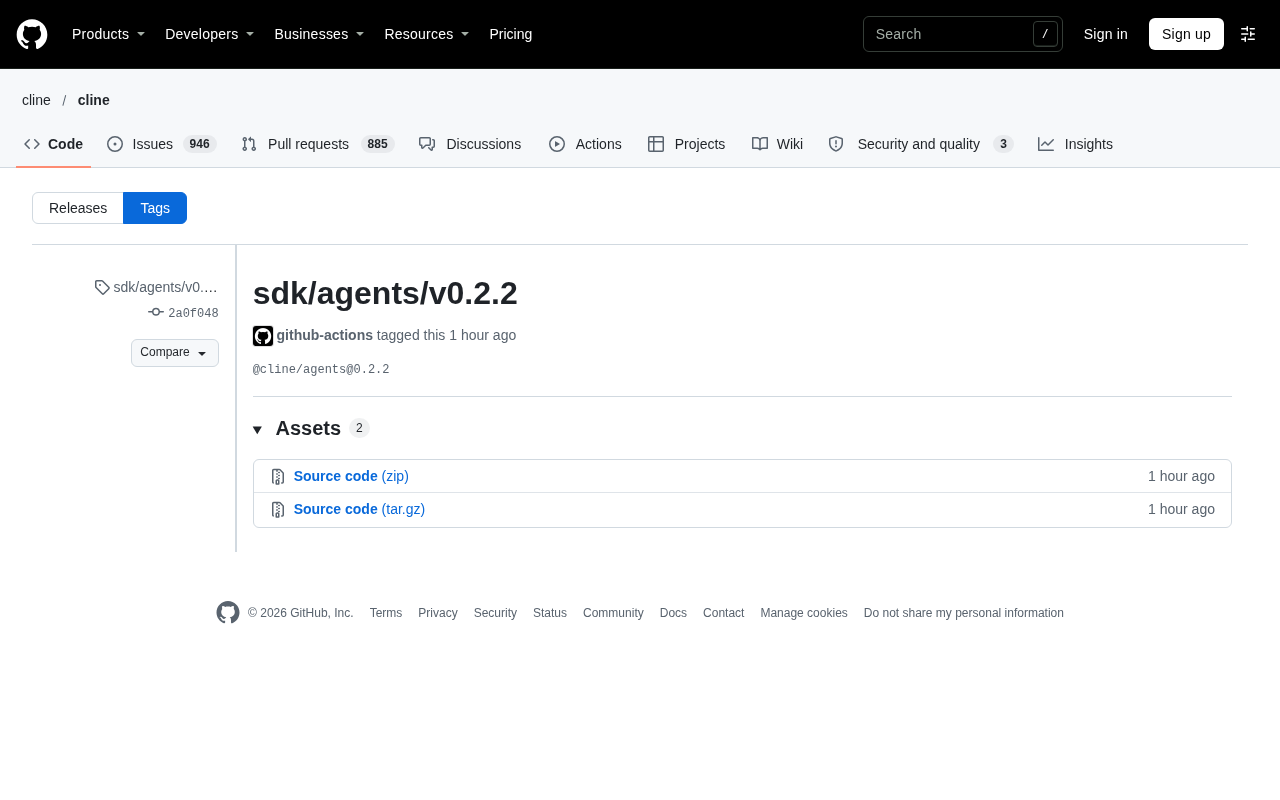
Judging from the release process, the Cline team uses an automated CI/CD pipeline to manage SDK version iterations. The github-actions bot automatically creates tags and uploads assets, meaning every release goes through a standardized build and test process.
The 0.x Stage in Semantic Versioning (SemVer)
Semantic Versioning specifies version numbers in the form MAJOR.MINOR.PATCH. When the major version is 0 (i.e., 0.y.z), it indicates the software is in initial development and its public API is not yet stable. The specification explicitly states that 0.x versions make no backward-compatibility guarantees: an increment in the MINOR position (e.g., 0.2.1 → 0.2.2) signals new features in the former case and may include breaking changes in the latter, while the PATCH position is typically used for bug fixes. So the fact that @cline/agents remains at 0.2.x means that while upgrading to a new patch version is generally lower risk, developers should still not assume the interface is entirely unchanged. This is also the specification basis for the article's emphasis on "verify in a test environment before upgrading."
Automated Release Pipeline and Release Assets Based on GitHub Actions
GitHub Actions is GitHub's built-in CI/CD service that defines build, test, packaging, and release steps through workflow files (.github/workflows/*.yml). The github-actions bot tagging mentioned in the article is typically performed using GITHUB_TOKEN or a dedicated bot account. Combined with tools like Changesets or semantic-release, it can automatically compute version numbers, create Git tags, generate Releases, and attach build artifacts after a PR is merged. So-called "asset files" are downloadable files attached to the Release page (such as tarballs, .tgz packages, or checksum files), available for direct download without going through a package manager. This pattern ensures the repeatability and consistency of releases, and also explains why the release record only shows information like tags and hashes.
Why SDK Versions Are Worth Watching
As an open-source AI coding assistant, one of Cline's core capabilities is its Agents SDK, which lets developers call and orchestrate agents programmatically. SDK version updates directly affect the following types of users:
- Plugin and extension developers: teams using the SDK to build custom workflows or integrate into their own IDEs or CI systems.
- Maintainers of automated coding pipelines: engineering teams embedding Cline Agents into code review, automated fixes, and similar stages.
- Researchers following the AI coding ecosystem: technical professionals tracking the iteration pace of open-source AI coding tools.
The version number continuing along the 0.2.x series indicates that the SDK is still in a rapid iteration phase. At this stage, interfaces and behavior may change, and developers need to pay attention to the changes to assess upgrade impact.
Agents SDK: A Toolkit for Orchestrating AI Agents Programmatically
"Agents SDK" refers to a set of libraries and interfaces for developers to define agents in code, configure their available tools, manage conversation or task state, and chain together multi-step automated workflows. Unlike manual operation in a chat interface, the SDK lets agents be embedded in scripts, services, or CI pipelines to implement orchestration logic such as automated code review, batch fixes, and task dispatch. Understanding this helps grasp the value for the three types of users described in the article: plugin developers use it to extend host tools, pipeline maintainers use it to connect agents into engineering workflows, and researchers can use the interfaces to observe the evolution of agent architecture. Changes in SDK versions therefore directly affect whether integration code runs smoothly.
Interpreting the Update and Recommendations
The currently public release information is fairly minimal, mainly presenting the version tag, commit hash, and automated release process. For developers currently using this SDK, the following actions are recommended:
- Check dependency versions: Check how the
@cline/agentsversion is pinned in your project and confirm whether you need to upgrade to 0.2.2. - Review commit records: Compare tag
2a0f048with the previous version to understand the specific scope of code changes. - Watch for compatibility: API stability is limited during the 0.x phase, so verify in a test environment that existing integrations work properly before upgrading.
For developers who haven't yet used this SDK, Cline's Agents SDK provides an entry point for embedding AI coding capabilities into your own toolchain. As versions iterate, its interfaces and features will gradually stabilize, and paying attention early helps you build integration experience before the ecosystem matures.
Comparing Change Scope via Git Tags and Commit Hashes
A Git tag is a named reference to a commit; the v0.2.2 tag under the sdk/agents path points to the code snapshot at release time. The 2a0f048 in the release record is the short form of the commit SHA, uniquely identifying that commit. In your local repository, you can use git diff <previous-version-tag> v0.2.2 or git log --oneline <previous-version-tag>..v0.2.2 to view the file and commit differences between the two versions; if your hosting platform offers a compare view, you can also view it directly in the browser. Note that if the repository uses a monorepo structure, you should limit the comparison to the sdk/agents subpath to avoid mixing changes from unrelated packages into your assessment.
Conclusion
Cline Agents SDK 0.2.2 is a routine version iteration that reflects the project team's rhythm of continuous delivery through automated processes. For developers who rely on this SDK, tracking version changes in a timely manner and assessing upgrade impact are necessary steps to keep the toolchain running smoothly.
One-line Summary
Cline Agents SDK releases 0.2.2, still in the 0.x rapid iteration phase; upgrades require compatibility assessment.
Paragraph Summary
Cline's Agents SDK (@cline/agents) has released version 0.2.2, with github-actions automatically creating tags and uploading release assets, reflecting the team's standardized CI/CD-based release rhythm. This version corresponds to the v0.2.2 tag under the sdk/agents path, with commit hash 2a0f048. The article notes that SDK updates mainly affect plugin and extension developers, maintainers of automated coding pipelines, and researchers following the AI coding ecosystem. Since the SDK is still in the 0.x phase, public interface stability is limited and version behavior may change. The article recommends that developers check dependency version pinning, compare the scope of code changes via tags and commit hashes, and verify existing integrations in a test environment before upgrading, while emphasizing to non-users that paying attention early helps build integration experience.
Related articles

Nothing CMF Buds 2A Drops to $17.89 on Black Friday: A New Low for ANC Earbuds
Nothing CMF Buds 2A wireless earbuds Black Friday deal: just $17.89 on Amazon, about $11 off retail and a record low. ANC earbuds at an entry-level price.

When AI Creation Gets Accused of "Spitting": Hacker News Heats Up Over the Glaude Controversy
A Hacker News post, "Spitting in the Face of Glaude," sparks debate on AI creation transparency and attribution ethics. This analysis examines the blurred creator identity behind the controversy and offers practical advice for AI content production.

Akai Embraces Custom Firmware: MPC Sample 1.4 Lets Users AI-Program Their Sampler
Akai embraces the modding community with MPC Sample 1.4 firmware, supporting vibe-coded custom firmware and effects. We analyze the impact of this open strategy on music hardware and AI-assisted programming.