Cline Core SDK Releases v0.2.1: Version Iteration of the AI Programming Toolchain
Cline's core SDK releases patch version 0.2.1, reflecting its evolution toward toolchain infrastructure.
The core SDK package of the Cline project, @cline/core, has released version 0.2.1, automatically tagged and published by GitHub Actions with 2 assets. As a patch-level update, it usually contains bug fixes and optimizations rather than breaking changes. Cline's independent release of the SDK marks its transition from an editor plugin to reusable toolchain infrastructure, allowing external developers to integrate its AI programming capabilities to build custom applications. However, 0.2.x is still in an early stage, with no strong commitment to API stability, so dependents should pin versions and watch the subsequent roadmap. The release page has loading issues, which can be bypassed via the GitHub API or by cloning the repository.
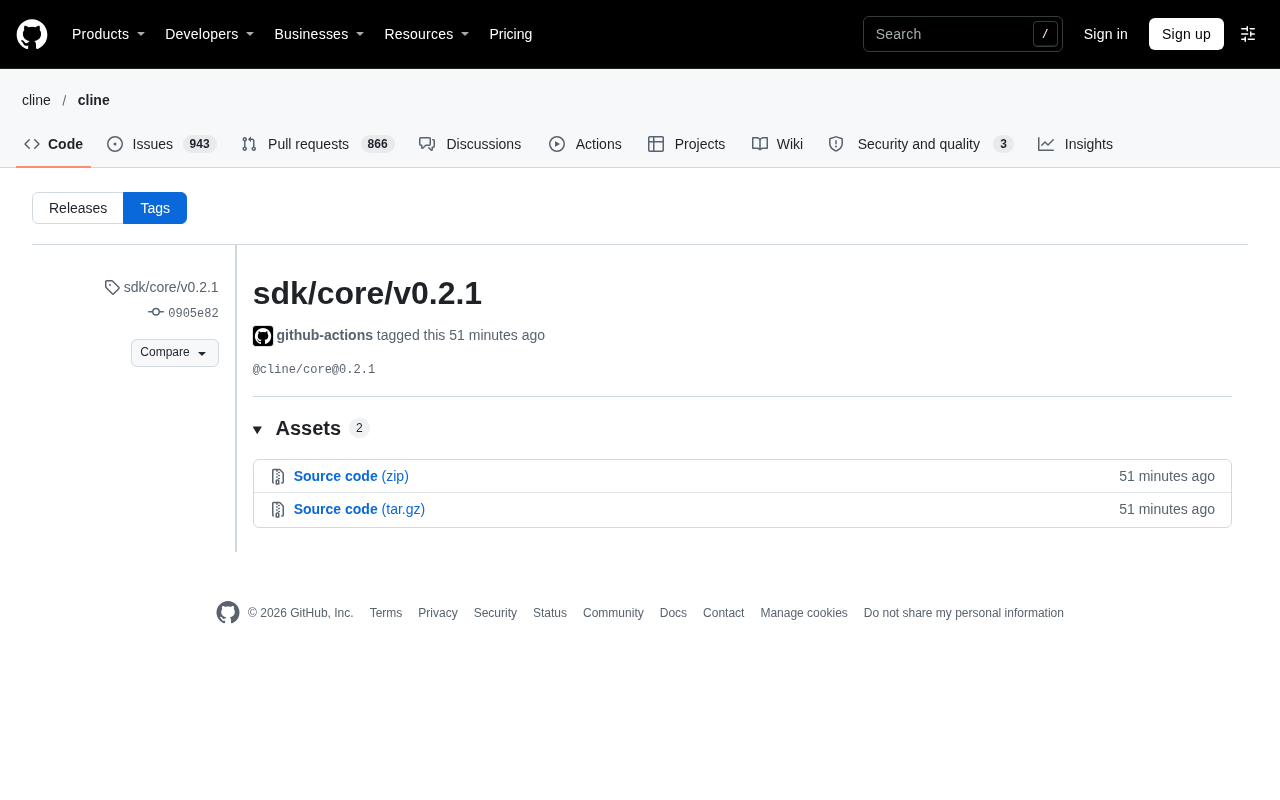
The core SDK package of the Cline project, @cline/core, has released version 0.2.1, with GitHub Actions automatically tagging it as sdk/core/v0.2.1. Judging from the release page, this update is a minor version iteration, and the official team did not attach a detailed changelog. The commit record only leaves a short commit hash 0905e82. For developers who are using the Cline SDK to build AI programming tools, this version is worth paying attention to, but you will need to check the code repository yourself to confirm the specific changes.
Signals in the Version Number: What a Minor Version Iteration Means
From the perspective of semantic versioning, moving from 0.2.0 to 0.2.1 is a patch-level update, usually used to fix defects, adjust dependencies, or make minor optimizations, rather than introducing breaking API changes. Cline has split the SDK into an independently released package, @cline/core, indicating that the team is decoupling its core capabilities from the editor plugin and evolving toward a reusable toolchain.
This split has practical significance for the ecosystem: external developers can move beyond Cline's VS Code plugin and directly integrate its AI programming capabilities into their own applications, such as building automated code review, intelligent completion within the terminal, or custom agent workflows. The frequent release of patch versions also suggests that this toolchain is still being rapidly refined, while the interface layer is gradually stabilizing.
Semantic Versioning (SemVer) is an industry-standard versioning specification with the format MAJOR.MINOR.PATCH. A MAJOR change indicates an incompatible API modification, MINOR indicates backward-compatible feature additions, and PATCH indicates backward-compatible bug fixes. Therefore, moving from 0.2.0 to 0.2.1 is a patch-level update and theoretically contains only bug fixes, dependency updates, or performance optimizations, without breaking existing interfaces. However, in the 0.x stage, SemVer allows MINOR versions to contain breaking changes, and many projects do not strictly follow it. For dependents, it is advisable to pin the version number even for patch versions and to use lockfiles (such as package-lock.json) to ensure reproducible builds, avoiding unexpected issues introduced by automatic upgrades.
Automated Release Process and Asset Information
This release was completed automatically by the github-actions bot, with the tagging time recorded as 21 Nov 05:19, and it came with 2 release assets. The Release page showed an error when loading the tag comparison and asset list, indicating that GitHub's frontend rendering failed to properly display all content, but this does not affect the validity of the tag itself.
For users, release assets usually include packaged npm tarballs or source archives, which can be pulled directly through a package manager. The maturity of the automated release process means that the Cline team has incorporated version delivery into the CI pipeline, reducing the risk of inconsistency caused by manual operations. When an open-source project reaches this stage, it usually means it has begun to take the upgrade experience of downstream dependents seriously.
GitHub Actions is a continuous integration and continuous delivery (CI/CD) platform provided by GitHub that allows developers to define automated workflows through YAML configuration files. In open-source projects, common uses include automatically running tests on code push, checking code style on merge requests, and automatically building and publishing artifacts when tags are created. The github-actions bot mentioned in this article automatically tagging and uploading release assets is a typical practice. Release Assets are files attached to a GitHub Release, which can be compiled binaries, npm package tarballs, source code archives, and so on, for users to download directly. Automated releases reduce manual errors, ensure consistency across each version delivery, and also require the project to have comprehensive testing and build scripts.
Impact on the AI Programming Tool Ecosystem
Cline is known in the AI programming assistant field for being open source and extensible. Independent version management of the core SDK shifts its positioning from "a plugin" to "a set of infrastructure." Compared with similar tools, most products only provide closed-source editor integrations, while Cline opens up the core layer, lowering the barrier to secondary development.
However, it should also be noted that 0.2.x is still in an early stage, and there is no strong commitment to API stability. Projects that depend on it should pin version numbers when upgrading and pay attention to the subsequent 0.3 or 1.0 roadmap. For teams that want to build differentiated products in the AI programming direction, now is a relatively low-cost time to get involved with the Cline SDK, but they need to bear the risk of interface changes.
The AI programming assistant ecosystem currently shows polarization: one category is closed-source editor integrations (such as GitHub Copilot), which provide an out-of-the-box experience but are difficult to customize; the other category is open-source toolchains represented by Cline, which allow developers to freely integrate and extend through an open core SDK. By releasing @cline/core as an independent package, Cline essentially turns AI programming capabilities into "infrastructure," enabling external projects to call its capabilities just like calling an ordinary npm package, thereby building applications such as automated code review, terminal intelligent completion, and custom agents. This model lowers the barrier to secondary development, but it also means the core team needs to maintain a stable API contract. In the 0.2.x stage, the API has not yet been frozen, so dependents need to bear the risk of interface changes, but at the same time they also gain the opportunity to influence the direction of the project's evolution.
How to Follow This Version
To confirm exactly what changed in 0.2.1, the most direct way is to compare the commit diff between 0905e82 and the previous version, or check the package metadata on npm. If your project already uses @cline/core, it is recommended to pin the version in CI, validate it first in a small-scale environment, and then gradually roll it out. The issue of abnormal loading on the release page can also be bypassed by directly accessing the GitHub API or cloning the repository.
Patch versions of open-source projects often do not contain much information, but continuously tracking the release cadence itself is an effective way to judge a project's activity and maturity.
One-line Summary
Cline's core SDK releases patch version 0.2.1, reflecting its evolution toward toolchain infrastructure.
Paragraph Summary
The core SDK package of the Cline project, @cline/core, has released version 0.2.1, automatically tagged and published by GitHub Actions with 2 assets. As a patch-level update, it usually contains bug fixes and optimizations rather than breaking changes. Cline's independent release of the SDK marks its transition from an editor plugin to reusable toolchain infrastructure, allowing external developers to integrate its AI programming capabilities to build custom applications. However, 0.2.x is still in an early stage, with no strong commitment to API stability, so dependents should pin versions and watch the subsequent roadmap. The release page has loading issues, which can be bypassed via the GitHub API or by cloning the repository.
Related articles

Jensen Huang Returns to Nvidia: The Power Game Behind an "Aggro Reset"
Nvidia's board reappointed Jensen Huang as CEO less than two weeks after his scandal-driven resignation. This analysis explores the board's decision-making, Trump's political intervention, media power failure, and market reaction behind the dramatic return.

Why Voice AI Can't Understand Kenyans' Everyday Conversations
Swahili speech recognition hits 3.24% error on read text, but everyday Kenyan speech mixes English, Sheng slang, and accents—leaving mainstream voice AI struggling.

Data Centers Build Their Own Natural Gas Plants: AI Compute's Breakout Around a Decade-Long Grid Wait
Grid interconnection approvals can take a decade, so xAI and others are building off-grid natural gas plants to power AI clusters. This article analyzes the drivers, costs, and impact of behind-the-meter generation on AI infrastructure.