Cline Core SDK v0.2.2 Released: A Small Step in the AI Coding Toolchain

Cline's core SDK ships patch release v0.2.2, auto-tagged by CI; low upgrade risk, but verify commit history yourself.
Cline's core SDK repository released sdk/core/v0.2.2, a SemVer patch update tagged by github-actions and bound to commit 2a0f048, showcasing a CI-driven repeatable release flow. With the release page changelog broken, the article advises checking nearby commits as the source of truth. Patch releases carry no breaking changes, so upgrades are low risk; 0.2.x users can upgrade safely and new projects can start here. Two release assets should be verified, and enterprises should mirror them internally.
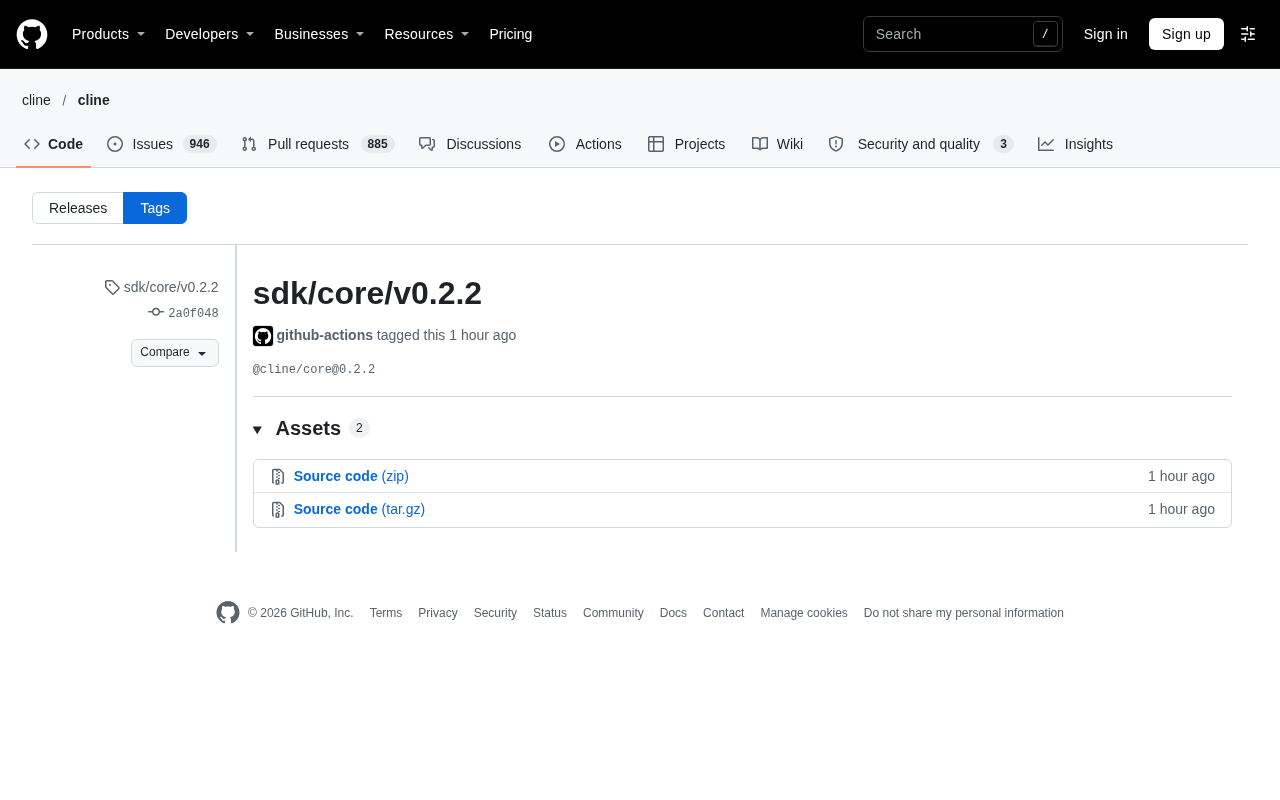
The Cline project has released version sdk/core/v0.2.2, a routine update to the core SDK repository aimed at AI coding scenarios. Judging from the tag information on the release page, this version was automatically tagged by github-actions, follows semantic versioning conventions, and is a patch-level corrective release. For teams using Cline to build AI coding assistants or automated development workflows, this kind of minor version iteration typically means stability fixes and continued alignment of the dependency chain.
Basic Release Information
Tag and Commit Identification
The release page shows the version tag as sdk/core/v0.2.2, bound to commit 2a0f048. GitHub's tag comparison feature reported a loading error, indicating that the changelog rendering on this release page is incomplete and that new features or fix lists cannot be read directly from the page. This state is not uncommon in automated release pipelines—after tagging by github-actions, the change description must be reconstructed from the repository's commit history.
Git tags and commit SHAs are the two-level identifiers used in Git to locate code snapshots. A tag is a readable name assigned to a commit (by a person or a pipeline), such as sdk/core/v0.2.2, usually annotated and optionally signed; a commit SHA (such as 2a0f048) is a hash computed from the commit's contents, unique and tamper-evident. The sdk/core/ prefix forms a namespaced tag pattern, commonly used in monorepos to version sub-packages independently. GitHub's tag comparison page essentially runs git log/git diff between two refs; when one tag has not been fetched correctly or repository history has been rewritten, a loading error occurs.
Semantic Versioning (SemVer) specifies versions as MAJOR.MINOR.PATCH: incrementing the patch digit indicates backward-compatible bug fixes with no new features and no API breakage. Therefore 0.2.1 → 0.2.2 is theoretically a safe replacement. Note that during the 0.x.y stage SemVer allows the minor digit to carry breaking changes, while the patch digit should still remain compatible.
Release Cadence and Automation
The tag was automatically created by github-actions at 08:39 on 26 Nov. This detail shows that Cline's core SDK has integrated a CI-based automated version release process: code merge, build, tagging, and asset publishing are executed in sequence by a bot. For developers depending on this SDK, this means version artifacts are generated repeatably and traceably, effectively reducing deviations introduced by manual operations.
CI-driven automated releases are typically implemented via GitHub Actions workflows: after merging into a release branch or pushing a specific commit, the workflow runs builds and tests, then calls the GitHub Releases API to create a tag and upload assets, with the actor shown as the github-actions bot. Such pipelines often work with tools like Changesets or semantic-release to automatically derive the next version number from conventional commit messages.
"Release assets" refer to binaries or archive files attached to a Release record, such as build outputs, checksums, and SBOMs. Assets are bound to the tag through the Release record, but download URLs and the tag are two separate objects; if a release is re-run or assets are replaced, the tag may remain unchanged while asset contents change—so enterprise environments commonly use checksums or artifact repositories to pin versions.
What It Means for Developers
The Value of Patch Releases Lies in Certainty
Patch versions typically introduce no breaking changes, making upgrade decisions low-cost. In projects that use Cline Core SDK as an underlying dependency, pinning to v0.2.2 delivers corrections to existing behavior rather than interface-level rewrites. For teams embedding AI coding capabilities into internal toolchains, this incremental upgrade is more controllable than migrating across major versions.
Breaking changes refer to modifications that cause existing caller code to fail compilation or change behavior, such as removing or renaming exported functions, changing parameter order, altering return value structures, or raising the minimum runtime version. SemVer requires such changes to increment the MAJOR digit, so patch versions are contractually promised not to contain them.
However, SemVer is a convention rather than an enforcement, and actual compatibility still depends on how strictly maintainers follow it. For AI coding SDKs, extra attention must be paid to implicit changes at the non-interface level: adjustments to prompt templates, default model parameters, and retry and timeout policies can change output quality without appearing in API signatures—such changes can often only be discovered through integration tests or comparative measurements.
Verify the Changes Yourself
Since no usable change list is available on the release page, before upgrading it is advisable to review the commits around 2a0f048 directly to confirm which modules and files are involved. This is a common habit under automated release pipelines: the tag tells you "there is a new version," the commit history tells you "what changed." In the absence of a changelog, treating commit messages as the source of truth is the most reliable path for assessing upgrade risk.
Usage and Integration Recommendations
Trade-offs in Dependency Management
If the project is already on an earlier 0.2.x version, upgrading to 0.2.2 is a low-risk operation. If the project has strict consistency requirements for SDK behavior, run the existing integration tests once before upgrading and use the results instead of relying on the changelog. Conversely, if the project has not yet adopted the SDK, starting directly with v0.2.2 avoids pitfalls already fixed in earlier patches.
Dependency pinning and version ranges determine upgrade behavior. In the npm ecosystem, ^0.2.2 allows the latest version within 0.2.x, ~0.2.2 allows only patch updates within 0.2.x, and the exact version 0.2.2 is fully pinned; lockfiles (package-lock.json, pnpm-lock.yaml) record the actually resolved versions and integrity hashes and are key to reproducing builds across a team.
For patch upgrades, the recommended practice is to explicitly modify the dependency declaration and commit the lockfile rather than deleting the lockfile and reinstalling. If the SDK has transitive dependencies, an upgrade may indirectly introduce new third-party versions, in which case npm ls or pnpm why can be used to inspect the dependency tree. Enterprise intranets can mirror assets and packages to private artifact repositories (such as Nexus or Artifactory) and enable integrity verification to avoid inconsistent build artifacts caused by multi-source distribution.
Pay Attention to Release Asset Integrity
The release page shows that this version includes 2 asset files. Before use, verify the correspondence between these assets and the tag, and confirm that the download source is the official repository, to avoid introducing inconsistent build artifacts through multi-source distribution. For enterprise intranet environments, it is recommended to mirror assets to an internal artifact repository for unified management, ensuring version consistency across the team.
Conclusion
v0.2.2 itself does not tell much of a story; what it reflects is the steady maintenance cadence of Cline's core SDK: automated releases, semantic versioning, and traceable commit binding. For developers, what truly deserves attention is not the change in version number, but incorporating such minor versions into a routine dependency upgrade process, keeping the foundation of the AI coding toolchain continuously aligned.
One-line Summary
Cline's core SDK releases patch version v0.2.2, auto-tagged by CI, with low upgrade risk but requiring self-checks of commit history.
Paragraph Summary
The core SDK repository of the Cline project has released sdk/core/v0.2.2, a patch-level update following semantic versioning, with the tag bound to commit 2a0f048 and automatically tagged by github-actions, reflecting a CI-driven, repeatable release process. Because changelog rendering on the release page failed, the change list cannot be read directly, so the article recommends reviewing commit history around that commit as the source of truth before upgrading. For developers, patch versions introduce no breaking changes and have low upgrade cost; projects already on 0.2.x can upgrade with low risk, and new projects can start directly with this version. The release includes 2 asset files whose source and integrity should be verified, and enterprise environments should mirror them to an internal artifact repository for unified management.
Related articles

Nothing CMF Buds 2A Drops to $17.89 on Black Friday: A New Low for ANC Earbuds
Nothing CMF Buds 2A wireless earbuds Black Friday deal: just $17.89 on Amazon, about $11 off retail and a record low. ANC earbuds at an entry-level price.

When AI Creation Gets Accused of "Spitting": Hacker News Heats Up Over the Glaude Controversy
A Hacker News post, "Spitting in the Face of Glaude," sparks debate on AI creation transparency and attribution ethics. This analysis examines the blurred creator identity behind the controversy and offers practical advice for AI content production.

Akai Embraces Custom Firmware: MPC Sample 1.4 Lets Users AI-Program Their Sampler
Akai embraces the modding community with MPC Sample 1.4 firmware, supporting vibe-coded custom firmware and effects. We analyze the impact of this open strategy on music hardware and AI-assisted programming.