Cline Releases @cline/llms 0.2.1: Minor LLM SDK Update

Cline's LLM SDK @cline/llms releases 0.2.1 patch version, automatically completed by GitHub Actions
The article reports that Cline's LLM calling SDK @cline/llms has released version 0.2.1. This version was automatically tagged by github-actions at 05:19 on the 21st, corresponding to commit 0905e82, with 2 asset files attached to the release page. Judging from the version number, 0.2.1 is a patch-level update within the 0.2.x series, typically used for bug fixes or minor adjustments rather than introducing breaking changes, making it a low-risk upgrade for integrators locked to 0.2.x. The article also notes that the release page does not directly list change details, and developers need to confirm specific changes through GitHub's Compare feature or repository commit history before deciding whether to upgrade. Overall, this is the output of a standard automated release process.
Cline, the AI coding assistant, has released version 0.2.1 of its LLM SDK, @cline/llms. This is a minor update automatically tagged by GitHub Actions, with the repository tag pointing to commit 0905e82.
Release Overview
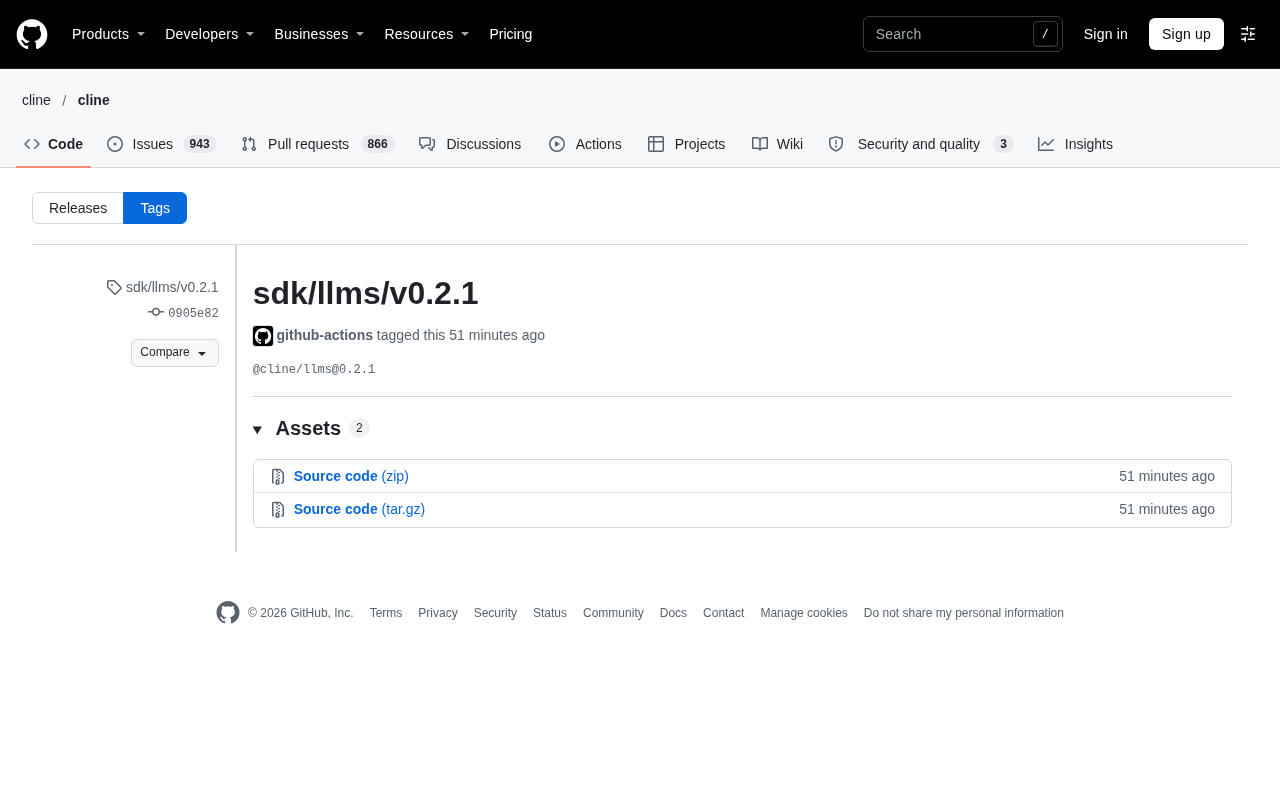
According to the GitHub release page, @cline/llms 0.2.1 was automatically tagged by github-actions at 05:19 on the 21st, corresponding to commit 0905e82. The release page includes 2 asset files for developers to download.
Judging from the version number, 0.2.1 is a patch-level update within the 0.2.x series, typically used for bug fixes or minor adjustments rather than introducing breaking changes.
Semantic Versioning (SemVer) splits version numbers into three parts: major.minor.patch. A major version change represents incompatible API modifications, a minor version change represents backward-compatible feature additions, and a patch version change only contains backward-compatible bug fixes. Therefore, 0.2.1 within the 0.2.x series is a patch-level release and theoretically should not introduce breaking changes. It's worth noting that projects in the 0.x stage are generally considered unstable versions under development, and SemVer's constraints on 0.x are relatively loose. Teams may still adjust interfaces in minor versions, so reviewing the commit diff before upgrading remains a prudent practice.
Significance for Developers
@cline/llms is Cline's SDK wrapper for large language model calls. Such minor version updates are typically low-risk upgrade options for integrators—if a project is locked to the 0.2.x series, upgrading to 0.2.1 generally does not require modifying existing calling code.
Developers who need to understand the specific changes can compare the commits between 0.2.1 and the previous version in the GitHub repository. The Compare feature on this release page provides a tag comparison entry point, but the page does not directly list the change details.
SDKs are typically wrappers around underlying HTTP APIs, abstracting details such as authentication, request construction, streaming response parsing, retries, and error handling into functions or classes. Taking LLM calls as an example, SDKs often unify request formats across different model providers and handle token billing fields, timeouts, and concurrency control. Common changes in patch-level SDK updates include fixing edge cases in streaming responses, updating built-in model name lists, and fixing type definitions—such changes generally do not require callers to modify code. However, if default timeout or retry policy adjustments are involved, behavioral changes may still occur, so it's recommended to validate in a test environment before deploying to production.
Summary
This is a standard automated release process output: tag creation and asset packaging are all handled by GitHub Actions. For developers following the Cline ecosystem, it's recommended to check the repository commit history directly to confirm the specific changes included in 0905e82 before deciding whether to upgrade.
GitHub Actions is GitHub's built-in continuous integration and continuous delivery service, where trigger conditions and execution steps are defined through workflow files in the repository. Common release automation workflows include: automatically running tests and builds when merging to a release branch or pushing semantic tags, calling package managers like npm to publish artifacts, and creating Releases via the GitHub API with build artifacts attached as Assets. This approach of tagging by bot accounts (such as github-actions) reduces manual errors, ensures traceability between version numbers and commits, and facilitates quick identification and rollback via tags.
One-line Summary
Cline's LLM SDK @cline/llms releases 0.2.1 patch version, automatically completed by GitHub Actions
Paragraph Summary
The article reports that Cline, the AI coding assistant, has released version 0.2.1 of its LLM calling SDK @cline/llms. This version was automatically tagged by github-actions at 05:19 on the 21st, corresponding to commit 0905e82, with 2 asset files attached to the release page. Judging from the version number, 0.2.1 is a patch-level update within the 0.2.x series, typically used for bug fixes or minor adjustments rather than introducing breaking changes, making it a low-risk upgrade for integrators locked to 0.2.x. The article also notes that the release page does not directly list change details, and developers need to confirm specific changes through GitHub's Compare feature or repository commit history before deciding whether to upgrade. Overall, this is the output of a standard automated release process.
Related articles

Nothing CMF Buds 2A Drops to $17.89 on Black Friday: A New Low for ANC Earbuds
Nothing CMF Buds 2A wireless earbuds Black Friday deal: just $17.89 on Amazon, about $11 off retail and a record low. ANC earbuds at an entry-level price.

When AI Creation Gets Accused of "Spitting": Hacker News Heats Up Over the Glaude Controversy
A Hacker News post, "Spitting in the Face of Glaude," sparks debate on AI creation transparency and attribution ethics. This analysis examines the blurred creator identity behind the controversy and offers practical advice for AI content production.

Akai Embraces Custom Firmware: MPC Sample 1.4 Lets Users AI-Program Their Sampler
Akai embraces the modding community with MPC Sample 1.4 firmware, supporting vibe-coded custom firmware and effects. We analyze the impact of this open strategy on music hardware and AI-assisted programming.