Cline Releases @cline/llms v0.0.93: An Analysis of the LLM SDK Update

Cline's underlying LLM SDK releases v0.0.93, with high-frequency small-step iterations reflecting the continuous delivery logic of the AI toolchain.
The Cline project's underlying dependency package @cline/llms has released v0.0.93, automatically tagged and published by the github-actions bot with commit hash 1a5c3f8 and 2 release assets, reflecting a highly automated CI/CD pipeline. The version is still in the 0.0.x stage while the patch number has reached 93, indicating that the project has not yet entered API stability and is adopting a high-frequency, small-step iteration strategy, which aligns with the frequent changes in underlying model APIs. The Release page has no changelog, so developers need to consult commit diffs to understand the specific changes. The article advises users to first check commit history and pin the version number in the lockfile, and projects with high stability requirements can wait one or two iteration cycles before following up.
Cline Releases @cline/llms v0.0.93: The Signal Behind a Lightweight LLM SDK Iteration
The AI coding tool race continues to heat up in 2026, and every release from the open-source project Cline is worth watching. Its underlying dependency package @cline/llms has shipped v0.0.93. Although the official Release page is extremely terse, the release cadence and project positioning still reveal some noteworthy clues for developers.
Release Overview
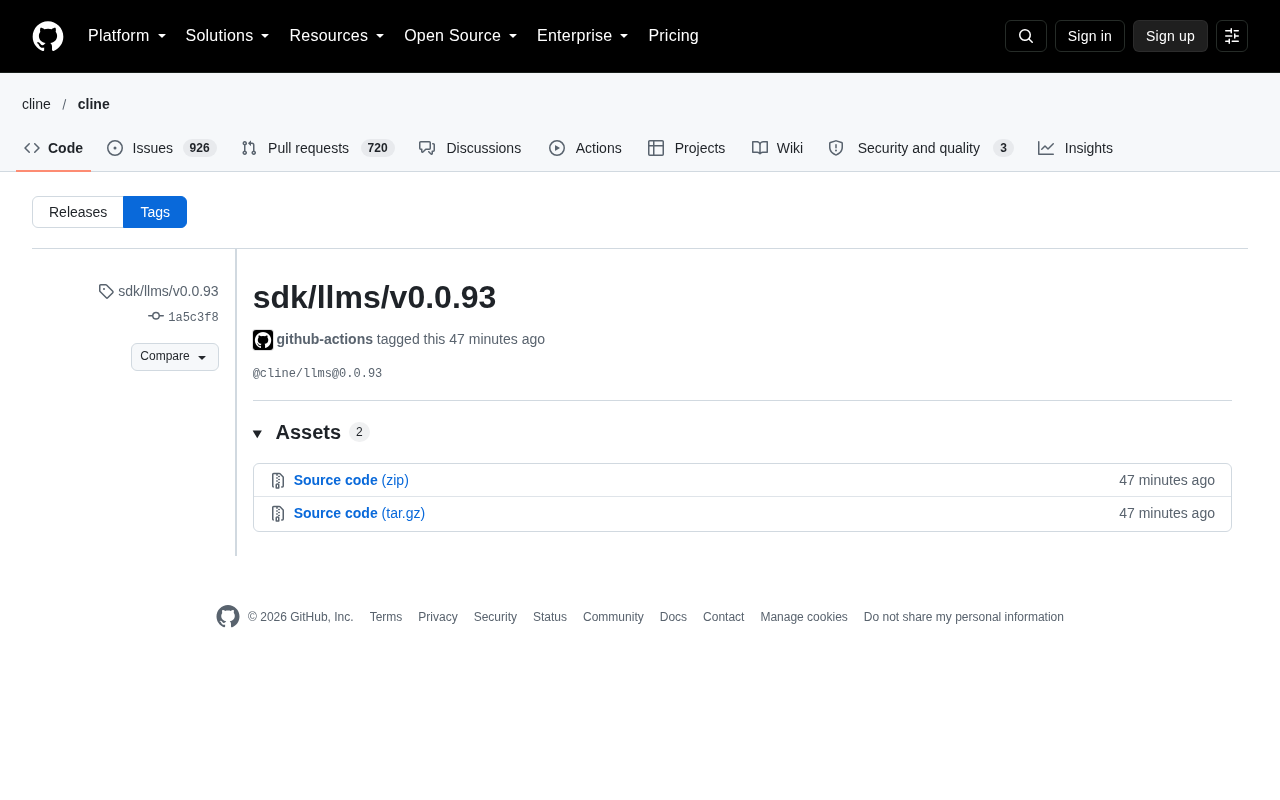
According to the GitHub Release page, @cline/llms v0.0.93 was automatically tagged and published by the github-actions bot at 08:26 on 13 Oct, corresponding to commit short hash 1a5c3f8. The release has 2 assets, which matches the typical form of an npm package publication that bundles a tarball and an integrity verification file.
This release method shows that the Cline team has folded SDK version management into a highly automated CI/CD pipeline. Triggering tags and releases directly from a bot account means that once code is merged into the main branch, the build and distribution complete without any manual intervention.
On automatic publishing by the github-actions bot: GitHub Actions is GitHub's built-in continuous integration and continuous delivery (CI/CD) service. Developers can define workflows in YAML files that automatically run build, test, packaging, and publishing tasks when triggered by events such as code pushes, merges, or tag creation. In this case, once code is merged into the main branch, the workflow reads the version number from package.json, automatically creates a Git tag, generates a GitHub Release, and pushes the npm package to the registry. This approach typically relies on Semantic Versioning (SemVer), where version numbers take the form MAJOR.MINOR.PATCH, representing incompatible breaking changes, backward-compatible feature additions, and backward-compatible bug fixes, respectively. Publishing via a bot rather than a human minimizes human error and keeps the release process idempotent and reproducible.
Iteration Strategy as Seen Through the Version Number
The version number v0.0.93 itself conveys important information. The major version is still 0, and the minor version is also 0, indicating that the project has not yet entered API stability—interfaces may still change at any time.
But the patch number has climbed to 93, reflecting a high-frequency, small-step iteration strategy—rather than holding out for a big release, the team prefers to fix fast and ship fast. This pattern is quite common in AI toolchain projects because underlying model providers' APIs change frequently and SDKs must keep pace.
For users, this means two things: upgrades are low-cost since each change is small in scope; but you shouldn't be complacent either, as breaking changes can still occur between minor versions.
On Semantic Versioning (SemVer) and the 0.x stage: The Semantic Versioning spec has a specific note about the 0.y.z stage—this is the initial development phase, where any version may introduce breaking changes and the public API should not be considered stable. So the fact that the patch number in 0.0.93 is as high as 93 does not mean it is more "mature" than 0.1.0; on the contrary, it shows the project is still very early and the interface has not yet been finalized. Many AI toolchain projects stay in 0.x for a long time precisely because the underlying large-model providers' interfaces, parameters, and even billing methods are evolving rapidly. If an SDK prematurely declares a stable 1.0, it would restrict its ability to follow upstream changes. For consumers, every upgrade should be evaluated as a potential breaking change.
Why the Release Information Is So Sparse
This Release page has almost no descriptive text—no changelog, no release notes, only the tag, time, and commit hash. This situation is not unusual in automated release pipelines: when a project primarily maintains change records in a CHANGELOG file or commit messages, the Release page often serves merely as a distribution entry point.
For developers relying on this SDK, if you want to know what v0.0.93 actually changed, the more reliable approach is to directly compare the commit diff between 1a5c3f8 and the previous tag, rather than waiting for the Release page to be updated.
On changelogs and commit diffs: In mature open-source projects, change records usually live in three places—GitHub Release Notes, a CHANGELOG.md in the repository root, and the commit messages themselves. Teams using the Conventional Commits convention can also leverage tools to auto-generate changelogs based on prefixes like feat: and fix:. When the Release page is empty, it means the project maintains change information in its commit history. Developers can use git log <old-tag>..<new-tag> --oneline or GitHub's compare page (of the form /compare/v0.0.92...v0.0.93) to quickly get all commits and file diffs between two versions—this is more timely and precise than waiting for Release notes to be written.
Practical Advice for Developers
If you use @cline/llms in your project, you can adopt the following strategy for this release:
- First check the commit history to confirm whether any API modules you use are affected
- Pin the version number in your lockfile to avoid unexpected changes from automatic upgrades
- If your project has high stability requirements, wait one or two iteration cycles before following up
As an open-source AI coding assistant, Cline's continuous SDK iteration is the foundation of the project's vitality. v0.0.93 is not a milestone release, but it confirms one fact: in the AI tooling space, continuous delivery capability is itself part of competitiveness.
On lockfiles and version pinning: A lockfile (such as npm's package-lock.json, pnpm's pnpm-lock.yaml, or yarn's yarn.lock) records the exact versions and integrity hashes of the dependency tree, ensuring that team members and CI environments install exactly the same dependencies. But note that a caret range like ^0.0.93 has special semantics during the 0.x stage: npm stipulates that when the major version is 0, the caret only matches the same patch number range—that is, ^0.0.93 effectively allows only 0.0.93 and will not automatically upgrade to 0.0.94. By comparison, ~0.0.93 also pins the patch position. To completely eliminate unexpected changes, use an exact version number or the npm ci command, which installs strictly according to the lockfile and is the recommended practice in CI scenarios.
Frequently Asked Questions
What is @cline/llms? It is the SDK package in the Cline project responsible for interacting with large language models, handling underlying capabilities such as model invocation and prompt organization.
Is v0.0.93 stable and usable? Judging by the version number, it is still in the early 0.x stage. We recommend deciding whether to upgrade based on your project's fault tolerance.
What if the Release has no update notes? You can directly compare the code differences between that commit and the previous version on GitHub—this is the most accurate source of information.
One-line Summary
Cline's underlying LLM SDK releases v0.0.93, with high-frequency small-step iterations reflecting the continuous delivery logic of the AI toolchain.
Paragraph Summary
The Cline project's underlying dependency package @cline/llms has released v0.0.93, automatically tagged and published by the github-actions bot with commit hash 1a5c3f8 and 2 release assets, reflecting a highly automated CI/CD pipeline. The version number is still in the 0.0.x stage while the patch number has reached 93, indicating that the project has not yet entered API stability and is adopting a high-frequency, small-step iteration strategy, which aligns with the frequent changes in underlying model APIs. The Release page has no changelog, so developers need to consult commit diffs to understand the specific changes. The article advises users to first check commit history and pin the version number in the lockfile, and projects with high stability requirements can wait one or two iteration cycles before following up.
Related articles

Should U.S. College Fraternities Be Banned? A Researcher's Incisive Observations
Why not just ban U.S. college fraternities? A researcher finds the key resistance comes from decision-makers' own fraternity identities and schools' "willful ignorance."

Microsoft Discovery: Accelerating Scientific Discovery with AI Agents
Microsoft's Discovery platform runs specialized AI agents to help researchers screen and prioritize the most promising compounds and experimental paths, reducing experiments and accelerating scientific discovery.

Cambridge Heavy Industries Secretly Develops Desktop-Scale Nuclear Fusion Device
Cambridge Heavy Industries is secretly developing a desktop-scale laser-driven nuclear fusion device, targeting the equipment supply market for fusion power plants. This article analyzes its miniaturization technology path, commercialization logic, and unique positioning in the fusion startup wave.