Cline Releases @cline/shared 0.2.2: SDK Shared Package Update
Cline's shared package @cline/shared releases patch version 0.2.2 as part of a routine automated iteration.
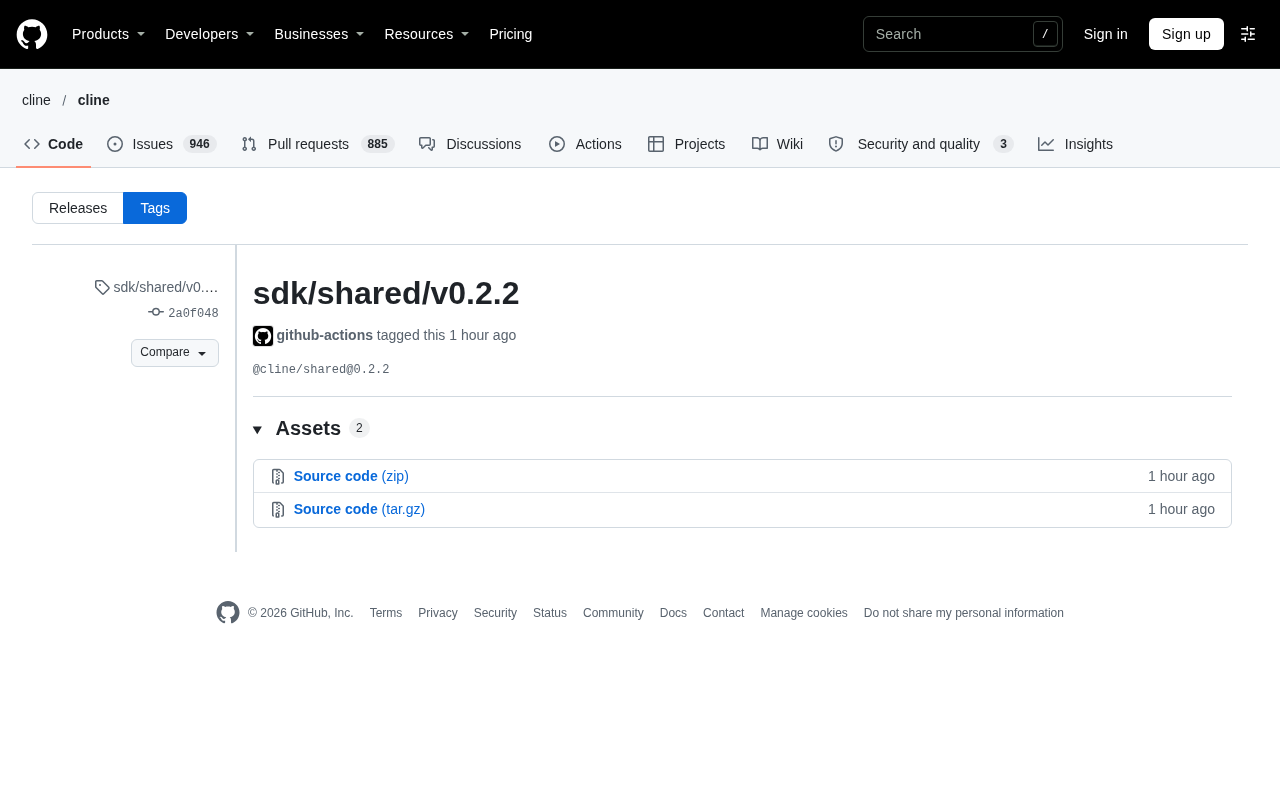
On November 26, the Cline team released version 0.2.2 of the @cline/shared package via GitHub Actions' automated workflow, tagged sdk/shared/v0.2.2, with commit hash 2a0f048. This package is a base module in the Cline SDK shared by multiple sub-packages, mainly carrying type definitions and common utility functions. In the monorepo architecture, the shared package plays the role of a "public contract," and the independent tagging release method allows downstream consumers to upgrade it separately as needed, reducing the risk of bundled upgrades. Version 0.2.x is still in an early iteration stage, and the patch-level update is expected to focus mainly on fixes and minor enhancements. Since the official release does not provide a detailed changelog, developers should use GitHub Compare to compare commits before upgrading, focusing on whether exported interfaces and type definitions contain breaking changes.
A Low-Key Version Iteration
The Cline team released version 0.2.2 of the @cline/shared package on November 26, tagged sdk/shared/v0.2.2, with commit hash 2a0f048. This information comes from GitHub's automated release workflow (github-actions) and represents a typical npm package version update.
Judging by the name, @cline/shared is a base module shared by multiple sub-packages in the Cline project, typically containing type definitions, utility functions, or common cross-module logic. The 0.2.x series is still in an early iteration stage, and the small version bump suggests this update likely consists mainly of fixes and minor enhancements.
The Role of the Shared Package in the SDK Architecture
In a typical TypeScript/JavaScript monorepo, the shared package serves as a "public contract"—other packages depend on it to ensure type consistency and uniform behavior. Cline splits its SDK into sub-packages such as shared and publishes them with independent tags, indicating that its toolchain has achieved fine-grained version management.
The advantage of this approach is that downstream consumers can upgrade only @cline/shared without having to upgrade the entire SDK, reducing upgrade risk. The automated tag workflow (triggered by github-actions) also ensures traceability of the release process, with each version corresponding to a specific commit and tag.
Monorepo refers to an engineering organization approach in which multiple related packages are managed within a single code repository, typically implemented using tools such as npm workspaces, pnpm workspaces, Yarn workspaces, Nx, or Turborepo. Compared with maintaining a separate repository for each package, a monorepo allows cross-package type definitions, build scripts, and dependency versions to be maintained in one place, so that after modifying the interface of the shared package, type checking can immediately be performed in the packages that depend on it, avoiding version drift. The cost is increased repository size and build complexity, which requires supporting incremental build and release tooling.
Fine-grained version management and independent tagging is a common release strategy for monorepos: each sub-package has its own version number and git tag (such as sdk/shared/v0.2.2 in this case), and only packages that have changed are version-bumped at release time. This contrasts with "fixed versioning" (where all packages share the same version number, as done by Babel and Jest). Independent versioning allows downstream consumers to upgrade individual packages as needed, but it also requires maintainers to clearly document changes for each package; otherwise, situations like this case—where the absence of a changelog makes it difficult to judge whether to upgrade—can easily arise.
How to Obtain and Verify
Developers can install this version via npm or view the comparison directly on GitHub's tag page. The release page provides two asset files, usually source code archives. To confirm the changes, it is recommended to use GitHub's Compare feature to compare commit 2a0f048 with the previous version's commit, focusing on changes to exported interfaces.
Since the official release does not include a detailed changelog, before upgrading you should watch for whether type definitions contain breaking changes, especially in projects that rely on @cline/shared for type inference.
Semantic Versioning (SemVer) follows the pattern MAJOR.MINOR.PATCH: a major version change indicates incompatible breaking changes, a minor version indicates backward-compatible new features, and a patch version indicates backward-compatible bug fixes. Accordingly, 0.2.1 → 0.2.2 is theoretically only a patch-level fix. However, note the special clause in the SemVer specification: when the major version is 0 (i.e., 0.y.z), the project is in "initial development," the public API is considered unstable, and any version may introduce breaking changes. This is the basis for the article's reminder that "0.2.x is in an early iteration stage, and type definition changes should be confirmed before upgrading."
How to identify breaking changes: For TypeScript packages, the most direct verification is to compare the .d.ts type declaration files of the previous and new versions. You can use npm diff --diff=@cline/shared@0.2.1 --diff=@cline/shared@0.2.2 to directly compare the tarball contents, or run tsc --noEmit in your project to observe type errors. Looking only at the patch number is not enough to determine compatibility, especially when exported type aliases, generic constraints, and function signatures are tightened.
Conclusion
@cline/shared 0.2.2 is a routine patch-level release that reflects Cline's continued investment in SDK modularization and automated publishing. For developers using the Cline SDK, keeping an eye on the release cadence of this shared package can help identify potential compatibility issues in advance.
One-line Summary
Cline's shared package @cline/shared releases patch version 0.2.2 as part of a routine automated iteration.
Paragraph Summary
On November 26, the Cline team released version 0.2.2 of the @cline/shared package through GitHub Actions' automated workflow, tagged sdk/shared/v0.2.2, with commit hash 2a0f048. This package is a base module in the Cline SDK shared by multiple sub-packages, mainly carrying type definitions and common utility functions. In the monorepo architecture, the shared package plays the role of a "public contract," and the independent tagging release method allows downstream consumers to upgrade it separately as needed, reducing the risk of bundled upgrades. Version 0.2.x is still in an early iteration stage, and the patch-level update is expected to focus mainly on fixes and minor enhancements. Since the official release does not provide a detailed changelog, developers should use GitHub Compare to compare commits before upgrading, focusing on whether exported interfaces and type definitions contain breaking changes.
Related articles

Nothing CMF Buds 2A Drops to $17.89 on Black Friday: A New Low for ANC Earbuds
Nothing CMF Buds 2A wireless earbuds Black Friday deal: just $17.89 on Amazon, about $11 off retail and a record low. ANC earbuds at an entry-level price.

When AI Creation Gets Accused of "Spitting": Hacker News Heats Up Over the Glaude Controversy
A Hacker News post, "Spitting in the Face of Glaude," sparks debate on AI creation transparency and attribution ethics. This analysis examines the blurred creator identity behind the controversy and offers practical advice for AI content production.

Akai Embraces Custom Firmware: MPC Sample 1.4 Lets Users AI-Program Their Sampler
Akai embraces the modding community with MPC Sample 1.4 firmware, supporting vibe-coded custom firmware and effects. We analyze the impact of this open strategy on music hardware and AI-assisted programming.