Cline SDK Core v0.0.90 Released: Open-Source AI Coding Assistant Keeps Iterating

Cline open-source AI coding assistant releases @cline/[email protected], advancing its modular Core SDK.
Cline is an open-source AI coding assistant with nearly 70,000 GitHub stars, running as a VS Code extension that supports multiple LLMs and can autonomously read/write files, execute terminal commands, and browse the web — requesting user confirmation at each step. The newly released @cline/[email protected] is a foundational SDK update, not an end-user extension release. The Core SDK handles model interaction, tool-calling frameworks, and context management. Decoupling it from the plugin reflects a move toward a modular, reusable architecture that enables third-party integrations. As it remains in 0.x early-stage development, production users should monitor Release Notes and carefully evaluate potential breaking changes.
Cline Releases SDK Core v0.0.90
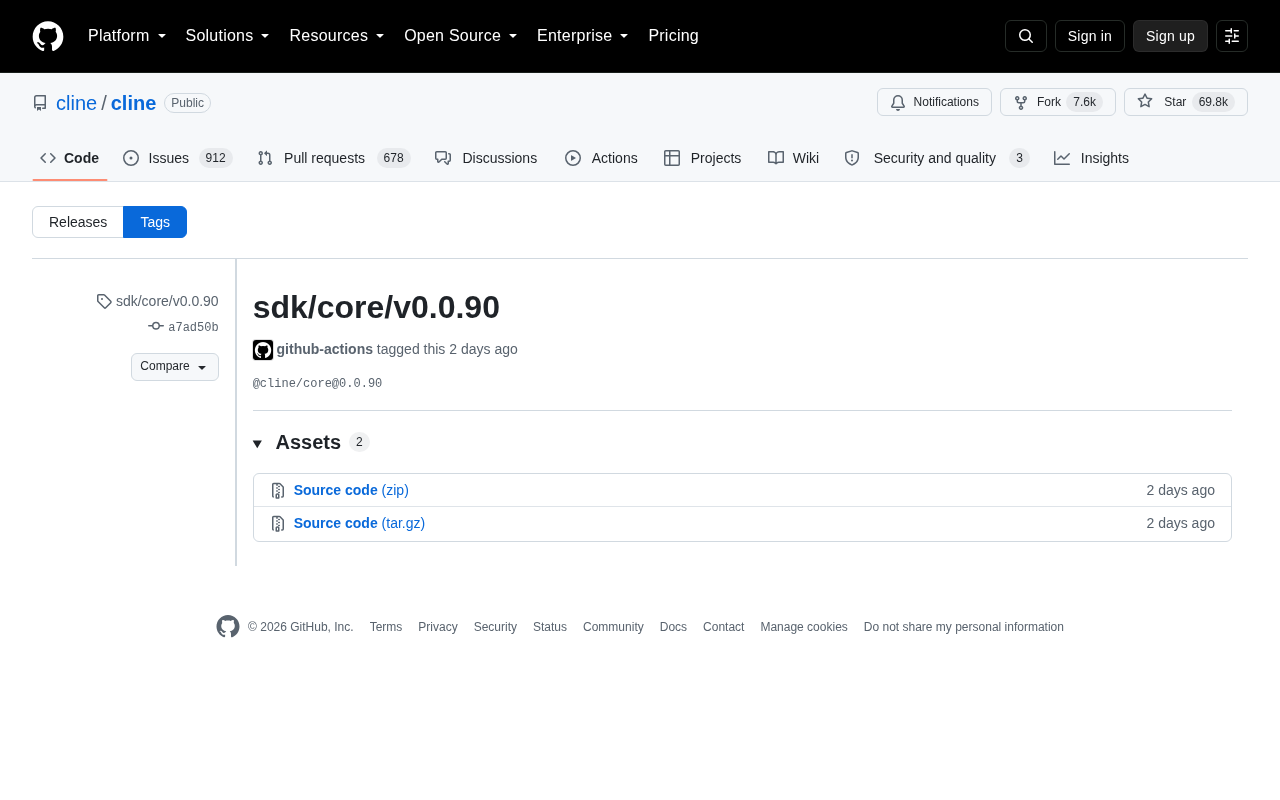
The Cline project has published the @cline/[email protected] release tag on its GitHub repository. With nearly 70,000 stars and over 7,600 forks on GitHub, every version update from Cline is worth the developer community's attention. This v0.0.90 release represents an iteration at the SDK Core level, signaling that the project's foundational capabilities are being continuously refined.
The version number indicates that Cline's Core SDK is still in early-stage 0.x development, but the high-frequency release cadence demonstrates that the team is actively pushing forward with feature improvements and bug fixes.
What Is Cline
Cline is an open-source AI coding assistant that runs primarily as a VS Code extension, capable of autonomously completing coding tasks within the editor. It supports multiple large language models and can read/write files, execute terminal commands, browse the web, and request user confirmation before each action — balancing automation with control.
Nearly 70,000 stars place Cline among the top-tier AI coding tools, reflecting strong developer demand for this type of "agent-style" coding assistant. Compared to closed commercial solutions, Cline's open-source nature lets users freely choose model providers, audit code behavior, and contribute to the project.
"Agent-style" coding assistants are fundamentally different from traditional code completion tools (such as GitHub Copilot's autocomplete). Traditional completion tools focus on generating single code snippets, while agent-style assistants can break down complex tasks, execute a series of operations across multiple files, and dynamically adjust strategies along the way. Cline's implementation relies on the Function Calling / Tool Use capabilities of LLMs: during inference, the model can actively "invoke" predefined tools — such as reading file contents, writing changes, executing shell commands, or making network requests. Each tool call result is fed back to the model as new context, forming a multi-turn reasoning-action loop. This architecture means a single task may trigger dozens of model requests and system operations, which is why Cline incorporates a step-by-step confirmation mechanism, giving users control at each critical action point to prevent runaway automation.
The Significance of the SDK Core
This release covers the sdk/core module, not the end-user extension itself. The Core SDK typically houses the project's foundational capabilities — such as model interaction logic, tool-calling frameworks, and context management. Extracting core capabilities from the plugin into a standalone SDK signals that Cline is evolving toward a more modular and reusable architecture.
This design has positive implications for the ecosystem: third-party developers can build their own integrations on top of the Core SDK without depending on a specific editor environment. The version number climbing to 0.0.90 also suggests that this layer's interfaces are still being frequently adjusted and have not yet been frozen into a stable API.
Extracting core logic into a standalone SDK is a common path large open-source projects take toward building an ecosystem. Notable examples include LangChain separating langchain-core from its main package, and Tree-sitter publishing its parsing kernel independently for use by various editor plugins. For Cline, once the model interaction and tool-calling frameworks in @cline/core stabilize, third parties will be able to directly reuse them in JetBrains plugins, CLI tools, Web IDEs, or custom workflows — without having to re-implement this foundational logic themselves. The 0.0.x version number follows Semantic Versioning (SemVer) conventions, where the leading zeros indicate that the public API is not yet stable and maintainers reserve the right to introduce breaking changes in any minor release. This is precisely why production environments should approach upgrades with caution.
Tips for Developers
For teams currently using Cline or considering adopting it, the continuous stream of version updates is good news — it means issues can be addressed quickly. However, since the project is still in the 0.x stage, it's advisable to upgrade cautiously in production environments. Keep a close eye on the official Release Notes for change details and assess whether any breaking changes are present.
Since the publicly available information for this release is limited, for specifics on new features, bug fixes, and interface changes, it's best to consult the commit history and changelog directly in the official Cline repository for the most accurate upgrade guidance.
Related articles

Multi-Agent Voice Command Center in Practice: Deconstructing the VAPI + Supabase Architecture
Deconstructing the Load Bearing Empire multi-agent voice command center: VAPI voice pipeline, Supabase Edge Functions for Webhooks, 8 Postgres tables tracking agent state, and Vercel-managed frontend design.

Astro 7 Rewrote Every Page, So IndexNow Now Hashes What a Crawler Reads
NeuraGrowth documents how an Astro 7 upgrade caused 273 pages to be misjudged as updated, and switched IndexNow hashing from file bytes to crawler-readable content—text, links, title, meta, and JSON-LD only.

From Python to AI Agents: A Full-Stack Learning Path with 488 Lessons and 23 Projects
A Udemy course covering Python, machine learning, deep learning, LLMs, RAG, and AI Agents, with 488 lessons and 23 real-world projects. This article analyzes the logic of this full-stack AI learning path, who it suits, and self-study advice.