CLM-8B Achieves 9x Inference Speedup, Gemini 4 Enters Post-Training: AI Daily Roundup

CLM-8B hits 9x inference speedup and new agent coding SOTA as Gemini 4 enters post-training.
Today's AI roundup follows two main threads: the ongoing race for inference efficiency and context window size, and the accelerating maturation of agent infrastructure. CLM-8B achieves up to 9x inference speedup via contrastive learning and sets a new 81.6% SOTA on DeepSWE after fine-tuning. Claude and Qwen 3.8 Max Prime both support million-token contexts, now becoming a baseline expectation. Google confirmed Gemini 4 has entered post-training, while DeepSeek launched elastic compute platform DSCC and NVIDIA open-sourced voice model PersonaPlex 7B.
A breakthrough in contrastive language model architecture, enterprise-grade frontier model launches, and leaked progress updates on next-generation models from major labs — these form the core of today's AI roundup. Here's a breakdown of the most information-dense developments, along with brief analysis of their technical significance.
CLM-8B: 9x Inference Speedup Through Contrastive Learning
The Contrastive Language Model (CLM) uses a contrastive learning objective to bridge "states" and "actions," positioning itself as an ultra-fast "System 1" model. According to its introduction, CLM-8B — trained on internet-scale data — can run inference up to 9x faster than comparable models while delivering equivalent performance on computer operation, gaming, and tool-calling tasks.
More noteworthy is its performance in agentic coding scenarios: after lightweight fine-tuning, CLM-8B set a new SOTA of 81.6% on agent coding benchmarks including DeepSWE. This demonstrates that the combination of "small model + fast inference + targeted fine-tuning" can fully compete with much larger models on specific Agent tasks. For agentic workflows requiring high-frequency calls and low-latency responses, a 9x inference speedup is nearly a decisive factor in product viability.
Contrastive Learning originated in self-supervised visual representation learning. Its core idea is to pull similar samples closer together in vector space while pushing dissimilar ones apart — using this "attract/repel" training signal in place of traditional token-by-token prediction. Applied to language models, "state-action" pairs (i.e., current environment observations paired with the appropriate action) serve as positive/negative samples, training the model to directly map "perception → decision" rather than generating a reasoning chain step-by-step like standard autoregressive models. This conceptually resembles the psychological "System 1" — fast, intuitive judgment — as opposed to the deliberate, multi-step reasoning of "System 2." By eliminating the generation of many intermediate tokens, inference latency is dramatically reduced. DeepSWE is a benchmark evaluating an AI's ability to autonomously complete real-world software engineering tasks (such as fixing bugs or implementing features). An 81.6% Pass@1 means the model produces code that passes tests on the first attempt in over 80% of tasks — a top-tier result in the agent coding domain.
Claude and Qwen: The Context Window Arms Race Escalates
Leaked model specs reveal that a Claude-series model (corresponding to the rumored Sonnet/Opus 5.5 series) features a 1 million token context window, a maximum output of 128K tokens, and an adaptive thinking mode that defaults to auto and can be toggled between low, medium, and high settings — with the high and max modes non-disableable. Pricing is set at $2 per million input tokens, $10 per million output tokens, and $0.20 per million cache read tokens. Partner access has been restricted to 24-hour windows with forced tool calling — restrictions that typically appear when a model is still in closed beta and the company wants to limit leak risk.
Alibaba's Qwen 3.8 Max Prime launched on Open Router the same day. As a high-throughput variant of Qwen 3.8 Max, it retains the flagship's 2.4 trillion parameters, supports 1 million context, accepts text, image, and video inputs, and offers adjustable-intensity reasoning, tool calling, and structured output. The million-token context window is transitioning from a flagship selling point to a baseline expectation — competitive focus is shifting toward throughput efficiency and completeness of multimodal input support.
Gemini 4 Enters Post-Training; Next-Gen Model Progress Surfaces Across the Board
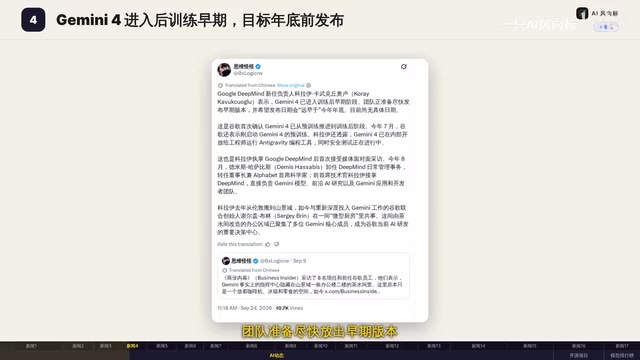
Google DeepMind's new head confirmed that Gemini 4 has entered the early stages of post-training, with the team aiming to release an early version as soon as possible — hoping for a launch well before the end of the year, though no specific date has been set. This marks the first official confirmation that Gemini 4 has advanced from pre-training to post-training, and the model is already available internally to engineers.
Rumors surrounding other next-generation models are equally dense: according to leaked information, an OpenAI internal model codenamed Bell is a pre-trained model with over 10 trillion parameters, reportedly surpassing the next flagship in capability, potentially ahead of what the industry broadly expects. Separately, there are claims that a certain Opus 5.5 release has put significant pressure on competing models and is priced considerably lower, prompting rivals to accelerate their own updates in response. These reports all come from single sources and should be treated with caution — but together they point to a clear trend: top-tier labs are compressing their release cadences tighter and tighter.
"Post-training" refers to the suite of alignment and capability reinforcement stages that follow pre-training, typically including supervised fine-tuning (SFT), reinforcement learning from human feedback (RLHF), and more recently popular process reward model-based reinforcement learning methods (such as GRPO and DAPO). Pre-training determines a model's baseline knowledge and world understanding; post-training determines whether the model is actually "usable" — whether it follows instructions, is safe, and performs reliably on reasoning tasks. A model entering post-training means its underlying parameters are largely fixed, and the team's focus shifts to shaping behavior and eliciting capabilities. For external observers, "entering post-training" is one of the most reliable signals for gauging a model's release timeline — typically weeks to months before public launch.
Engineering Moves from Meta, DeepSeek, and NVIDIA
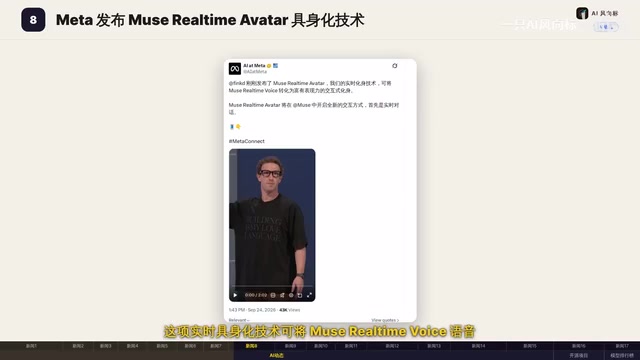
Meta's Super Intelligence Lab frontier model Muse Spark 1.3 has landed on the Gemini Enterprise platform, allowing enterprise users to deploy and call it directly on Google Cloud's secure infrastructure. Meta also released Muse Real-Time Avatar, which translates its real-time voice capabilities into an interactive virtual persona, and announced a new VR headset running an AI-native operating system with deep Muse assistant integration — supporting combined eye-tracking, gesture, and voice control.
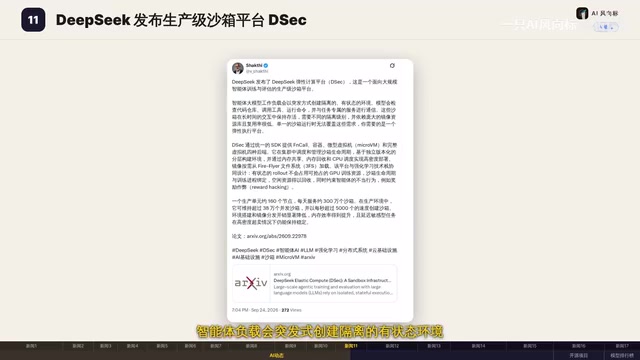
DeepSeekAd's moves lean toward engineering infrastructure: the company launched desktop clients for both Windows and Mac with direct installer packages, significantly lowering the barrier compared to the previous requirement of installing Node and running terminal commands. More significantly, DeepSeek released DSCC, an elastic compute platform positioned as a production and sandbox environment for large-scale agent training and evaluation. During a session, agents spontaneously create isolated stateful environments, need to inspect code repositories, call tools, and run commands — a workload that a single runtime cannot handle, necessitating an elastic execution platform. Maturing infrastructure of this kind is typically a prerequisite for Agent capabilities to scale from demo to real-world deployment.
The necessity of elastic compute platforms for agent scenarios stems from a fundamental difference between agent workloads and traditional inference requests. A standard LLM call is a stateless, short request that a single container can handle; but when an agent executes a task, it often needs to continuously read and write files, run scripts, and call external APIs within the same session, with different subtasks potentially triggering new compute needs concurrently. "Isolated stateful environments" means each agent instance has its own filesystem, process space, and network namespace — ensuring concurrent tasks don't interfere with each other, while allowing resources to be quickly reclaimed after a session ends. This mirrors cloud-native container orchestration thinking, but with far stricter requirements for startup latency, state persistence, and real-time resource scheduling. The release of DSCC signals that DeepSeek is opening up infrastructure capabilities previously used for its own model training, lowering the barrier for external developers building large-scale agent systems.
Voice and Open Source: NVIDIA PersonaPlex and AI Builder

NVIDIA released PersonaPlex 7B, a real-time conversational AI voice model, made freely available as open source. Fish Audio also released a preview of Drama 3, a voice model focused on finer-grained voice control — describe tone, pacing, and character in natural language to generate speech, support in-story voice switching, generate multi-character dialogue in a single pass, and re-generate only a single word you're unhappy with rather than the entire segment.
On the open-source application side, the PUTER team open-sourced AI Builder under the Apache 2.0 license, positioning it against products like Lovable, V0, and Replit — it garnered 112 GitHub stars within three days of launch. It supports plain-language requirement descriptions, real-time preview, click-to-edit elements, one-click public URL publishing, and version rollback, built on top of the open-source web operating system PUTER.
Model Capability Leaderboard
On today's AI Builder model intelligence leaderboard, the top three are: Claude Opus 5.5 Max (with Fallback) takes the top spot with 58 points; Claude Fable 5.1 Max and GPT-6 Astra Max tie for second with 53 points each. Domestic open-source models also perform well: Xiaomi MiMo V2.6 Pro ranks 9th with 46 points, and Qwen 3.8 Max ranks 10th with 45 points — trailing the leaders by 12 to 13 points.
Overall, the day's developments follow two main threads: the continued race to optimize inference efficiency and context windows, and the accelerating maturation of agent infrastructure (sandboxes, desktop clients, enterprise deployment). The former determines the ceiling of model capability; the latter determines whether those capabilities can actually be put to use.
Related articles

A Single Prompt Triggers a Global PHP Security Storm: Is AI a Savior or a Hidden Risk?
A single AI prompt triggered a global PHP security crisis affecting Wikipedia and the Internet Archive. This article reviews the incident, analyzes the OpenAI-Amazon controversy, and explores the security paradox of lowered vulnerability discovery barriers in the AI era and developer response strategies.

When AI Is Taken Away: How Reliance on Shortcuts Undermines Your Problem-Solving Resilience
A study of 1,222 people found that after using AI to answer questions, once AI was removed, people gave up on more problems than a control group that never used AI. The article analyzes the impact of AI reliance on learning resilience and metacognition, and explores design implications for AI learning tools.

Carta and NewView Partner to Let Startup Employees Cash Out Equity Early
Carta and NewView Capital partner to simplify startup tender offers, helping employees sell equity early. Analysis of the mechanism, liquidity pain points, and impact.