Cloning Successful Apps to $35K/Month: A Complete Monetization Playbook for Indie Developers

An indie developer's complete playbook for cloning proven products and earning $35K/month.
Indie developer Samuel Londo went from zero coding experience to $35K/month running three SaaS products, leveraging AI coding tools and a "clone and improve" strategy. His core method: discover proven, simple products on Twitter, validate them through a four-step screening process (personal use, proven success, low marketing spend, easy maintenance), build quickly, and validate market demand through paid ads to create a growth flywheel.
Introduction: You Don't Need to Be Original — Just 1% Better
Indie developer Samuel Londo runs three SaaS apps generating $35,000 per month. His core strategy is surprisingly simple: find apps that are already successful, then make them 1% better.
SaaS (Software as a Service) is a business model that delivers cloud-based software to users through subscriptions. Unlike traditional one-time purchase software, SaaS generates recurring revenue (MRR — Monthly Recurring Revenue) through monthly or annual fees, enabling even solo developers to build businesses with stable cash flow. The rise of the indie hacker community is largely thanks to SaaS's low marginal cost structure — a single codebase can serve thousands of users without proportionally increasing labor costs.
This isn't simple copy-paste. It's a proven, systematic approach — from discovering ideas and rapid validation to growth and monetization — with a clear framework at every step. This article breaks down his complete strategy and shows how AI tools can accelerate the process.
From Zero Coding Experience to $35K/Month: The AI-Era Learning Path
Samuel was previously a fitter with zero programming experience. He got started through a 15-hour coding course on YouTube, with one key strategy: learn by doing — immediately applying every new concept to the tool he was building.
But his advice for people starting today is different:
"If I were 18 right now, I wouldn't learn to code the traditional way. I'd use AI coding tools — AI can build 90% of an app today."
Large Language Models (LLMs) like GPT-4 and Claude have dramatically lowered the barrier to software development. AI coding tools such as GitHub Copilot, Cursor, and v0.dev can generate complete code snippets — even entire feature modules — from natural language descriptions. Next.js, Samuel's recommended tech stack, is a full-stack React framework supporting server-side rendering (SSR) and static generation, with one-click deployment via platforms like Vercel. For zero-experience developers, the greatest value of AI tools is transforming the "I don't know how to code this" barrier into a conversational process of "tell the AI what you want," dramatically compressing the time from idea to working product.
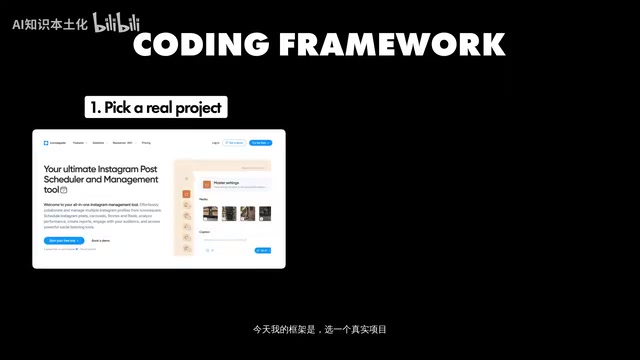
His recommended modern learning framework has three steps:
- Pick a real project and ask GPT what you need to learn to build it
- Screenshot product pages you like and ask GPT how to implement them step by step (e.g., start with the login page)
- Ask GPT for help at every obstacle, using a modern tech stack like Next.js
The advantage of this approach is that it's goal-driven, avoiding the classic learning trap of "I studied it but don't know where to use it." For indie developers looking to get started quickly with AI-assisted coding, this is currently the most efficient path.
The Four-Step Screening Method: How to Find Products Worth Cloning
Samuel admits he's "a bit lazy with limited energy," so he established one critical rule: never build something that doesn't already exist and hasn't been proven successful.
Idea Sources: Where to Spot Opportunities
His primary source of ideas is Twitter (X), especially the indie developer community and the "Build in Public" crowd. He looks for products that are already working or tools he's personally interested in.
Build in Public is a transparency-driven startup culture that emerged from the indie developer community, where founders share product data, revenue screenshots, growth strategies, and even failures in real time on Twitter/X, YouTube, and other platforms. Popularized by well-known indie developers like Pieter Levels, it has created an ecosystem of mutual validation and learning. For developers seeking clone targets, this public data is an incredibly valuable market signal — when someone is willing to share their Stripe revenue screenshots, it means the product's commercial viability has been tested by the real market.
Four Key Screening Criteria
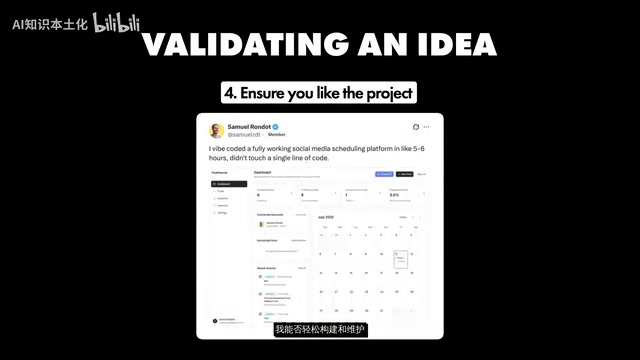
- I would use it myself — Ensures long-term motivation to maintain it
- Already proven to work — Someone is sharing revenue screenshots or Stripe data
- No big marketing spend — Indicates genuine demand rather than paid-for traction
- Simple and easy to maintain — No desire to stay up late wrestling with complex backends
Deep Validation: Confirming It's Worth the Investment
After passing the initial screen, Samuel digs deeper:
- Look for momentum: The best signal on Twitter is founders sharing revenue screenshots — people willing to pay is the ultimate proof a product works
- Analyze acquisition channels: Use Ahrefs to check traffic sources; if both ads and SEO are growing, demand is strong
- Assess technical difficulty: Can it be easily built and maintained? Simplicity is crucial
- Confirm personal interest: Working on a product you don't care about leads to zero long-term motivation
Ahrefs is one of the most widely used competitive intelligence tools in the SEO industry. Its core features include backlink analysis (seeing which external links competitors have earned), keyword ranking tracking, traffic estimation, and paid ad keyword analysis. For indie developers evaluating clone targets, Ahrefs' traffic trend charts are especially critical — if a product's organic search traffic and paid ad spend are both growing simultaneously, it signals real, sustained market demand rather than a fleeting trend. Tools like these compress months of market research into minutes.
This product validation method has helped him avoid countless wasted efforts, focusing his limited energy on high-probability projects.
Three SaaS Product Case Studies: From Failure to Tens of Thousands per Month
Samuel currently runs three products:
| Product | Type | Monthly Revenue | Customers |
|---|---|---|---|
| Usertimes.co | LinkedIn automation tool | ~$15,000 | ~10,000 |
| StoryShort.ai | AI video generator | ~$20,000 | ~4,000 |
| Capacity.co | AI coding tool | ~$900 | ~50 |
Lessons from Failure: His First Product, Resortms
His first app, Resortms, was an email finder tool built before he developed his screening strategy. The result? He was competing against giants like Apollo and Lemmy, and maintenance was extremely difficult. This failure cemented his "simple and easy to maintain" principle.
Success Story: How StoryShort Grew Rapidly to $20K/Month
He spotted someone who had launched a tool that automatically generates faceless videos and publishes them to YouTube/TikTok — the metrics were impressive. Samuel immediately investigated:
- Is it hard to build? — Technically feasible
- Where's the traffic coming from? — Entirely from Facebook ads
- What does that mean? — The acquisition model could be replicated within a week
He built the tool, ran ads, and StoryShort grew incredibly fast — following his validation process to the letter. This case perfectly demonstrates the power of the cloning strategy — it's not blind copying, but rapid execution after validating demand.
Growth Strategy: From Paid Ads to an Automated Flywheel
Samuel's growth playbook follows a clear priority order, forming a replicable SaaS growth system:
Step One: Paid Ads to Quickly Validate Market Demand
Run ads on Google and Meta, choosing the platform based on product characteristics. This is the fastest way to validate market demand — skip the "boring parts" like password resets and settings pages.
Related articles
 Tutorials
ChatGPT Plus Subscription Guide: Are GPT-5.5, image-2, and Codex Worth the Upgrade?
A detailed look at ChatGPT Plus features — GPT-5.5, image-2, and Codex — with a Plus vs Pro comparison and a complete step-by-step subscription guide for users outside the US.
 Tutorials
Harness AI Engineering in Practice: Using Claude Code to Master Enterprise-Level E-Commerce Development
Deep dive into Harness AI Engineering: master enterprise e-commerce development with Claude Code using the Rules, Skills, Wiki, and Changes framework.
 Tutorials
Cursor + Codex Dual-IDE Collaboration: A Practical Methodology for Open-Source Project Customization
A complete methodology for open-source project customization based on real-world experience, detailing the Cursor+Codex dual-IDE workflow, seven-stage process, MVP validation, and AI source code reading techniques.