CodeCrucible: A New Paradigm for LLM-Driven Static Code Security Analysis

CodeCrucible proposes using LLMs as reasoning engines to transform static code security analysis beyond rule-based approaches.
CodeCrucible introduces a blueprint for LLM-driven Static Application Security Testing (SAST) that moves beyond traditional rule-based pattern matching. By leveraging LLMs' semantic understanding capabilities through a hybrid analysis pipeline, it aims to reduce false positives, detect complex business logic vulnerabilities, and provide natural-language remediation guidance—while navigating challenges like hallucination, context window limits, and reproducibility.
Introduction: When LLMs Meet Static Code Analysis
Static Application Security Testing (SAST) has long been a cornerstone of software security. SAST is a white-box testing methodology that complements Dynamic Application Security Testing (DAST)—while DAST discovers vulnerabilities by simulating attacks on running applications, SAST examines source code before or during compilation. Traditional SAST tools analyze source code, bytecode, or binaries without executing the code to uncover potential security vulnerabilities. Core techniques include Abstract Syntax Tree (AST) parsing, Control Flow Analysis (CFA), Data Flow Analysis (DFA), and symbolic execution. Well-known tools like Checkmarx, Fortify, SonarQube, and Semgrep offer solid coverage for OWASP Top 10 standard vulnerability types. However, these tools have long been plagued by high false-positive rates, weak contextual understanding, and expensive rule maintenance.
CodeCrucible proposes a compelling approach: using Large Language Models (LLMs) to drive the SAST process, building an entirely new blueprint for code security analysis. This isn't merely about using AI as an auxiliary tool—it's about rethinking the fundamental logic of vulnerability detection.
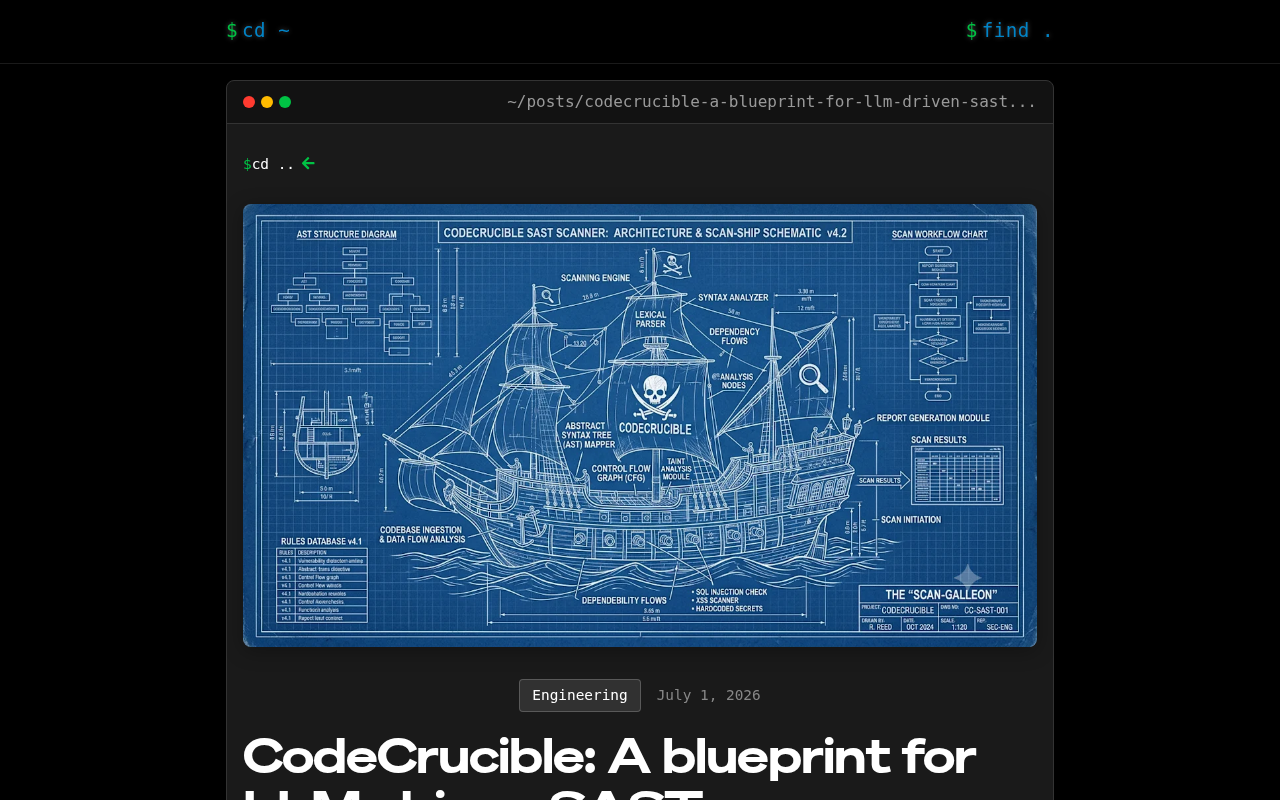
Core Pain Points of Traditional SAST Tools
To appreciate the value of LLM-driven SAST, we first need to understand the limitations of traditional approaches.
The Inherent Bottleneck of Rule-Driven Analysis
Traditional SAST tools mostly rely on predefined rule sets and pattern matching. This means:
- Rampant false positives: Tools cannot truly "understand" code intent and often flag safe code as vulnerabilities, leaving developers exhausted from triaging. Industry statistics show that some traditional SAST tools have false-positive rates of 40%-60%, severely draining development team resources.
- False negative risks: For novel vulnerability types or variants not covered by the rule base, tools are essentially blind.
- Missing context: While techniques like taint analysis can track data flow, they struggle to understand complex business logic spanning multiple functions and modules.
Taint analysis, the most important data flow tracking technique in SAST, works by marking user-controllable inputs as "sources," labeling sensitive operations (such as SQL queries, file writes, command execution) as "sinks," and then tracking whether tainted data can reach a sink without passing through a sanitizer. However, the technique faces challenges including path explosion (analysis complexity grows exponentially when code branches proliferate), the precision-performance tradeoff in interprocedural analysis, and difficulties handling dynamic features like reflection and callbacks.
Soaring Security Rule Maintenance Costs
Security rules require experts to continuously write and update them to keep pace with evolving attack techniques and emerging programming frameworks. This model feels cumbersome and lagging in today's fast-iterating development environments. Whenever a new framework (such as a new web framework or RPC framework) or programming paradigm (like reactive programming or serverless architecture) emerges, security teams must write corresponding analysis rules from scratch—a process that often takes weeks or even months.
CodeCrucible's Core Technical Approach
CodeCrucible positions LLMs as the "reasoning engine" for code security analysis, leveraging large models' deep understanding of code semantics.
From Pattern Matching to Semantic Understanding
Unlike traditional tools that rely on fixed rules, LLMs can "read" code like a senior security engineer, understanding variable purposes, data flow directions, and inter-function call relationships. This semantic-level comprehension enables tools to potentially reduce false-positive rates dramatically and identify hidden vulnerabilities that rule bases struggle to cover. The LLM's capability in code security fundamentally derives from pre-training on massive code corpora (including known vulnerability code examples, security audit reports, CVE descriptions, etc.), which allows it to internalize extensive knowledge of security patterns and anti-patterns.
An Extensible Analysis Architecture Blueprint
As a "blueprint," CodeCrucible emphasizes methodology and architectural design rather than a single finished tool. It explores how to effectively integrate LLMs into the SAST workflow, including:
- How to chunk code and build context to accommodate LLM context window limitations;
- How to design prompts to guide models toward accurate vulnerability reasoning;
- How to combine traditional static analysis techniques with LLM strengths to form a hybrid analysis pipeline.
The Hybrid Analysis Pipeline is the core design pattern of this architecture. A typical implementation contains three stages: the first stage uses traditional AST parsing and data flow analysis for rapid initial screening, flagging suspicious code regions and data flow paths; the second stage constructs structured prompts from screening results and relevant code context, handing them to the LLM for deep semantic reasoning to determine whether findings represent real vulnerabilities; the third stage has the LLM generate natural-language vulnerability descriptions, risk ratings, and remediation recommendations. This layered architecture leverages traditional tools' efficiency and determinism while harnessing LLMs' semantic understanding advantages, all while effectively controlling computational costs.
Opportunities and Challenges of LLM-Driven SAST
Potential Advantages
Stronger contextual reasoning capability is the LLM's greatest value proposition. When facing complex business logic vulnerabilities (such as privilege escalation bypasses or logic flaws), traditional tools are often helpless, while LLMs can potentially discover these issues through semantic reasoning. Additionally, LLMs inherently possess natural language explanation capabilities, providing clear descriptions and remediation suggestions for each discovered vulnerability, significantly improving developer efficiency.
Real-World Challenges That Cannot Be Ignored
However, introducing LLMs into security-critical scenarios also faces practical challenges:
- Hallucination: LLMs may "fabricate" non-existent vulnerabilities or provide incorrect explanations of vulnerability causes—unacceptable in the security domain. In code security analysis, hallucinations may manifest as fabricating non-existent API call chains, incorrectly judging data flow paths, misidentifying safe coding patterns as vulnerabilities, or providing erroneous root cause analysis for real vulnerabilities. Current mitigation strategies include multi-round verification (having the model self-check its reasoning process), confidence scoring, cross-validation with deterministic analysis tools, and Chain-of-Thought prompting techniques that force models to show reasoning steps for human review.
- Context window limitations: Large codebases often exceed a model's processing capacity, making effective code segmentation and organization an engineering challenge. Current mainstream LLMs have context windows ranging from thousands to millions of tokens (e.g., GPT-4 Turbo supports 128K tokens, Claude supports 200K tokens, Gemini 1.5 Pro supports up to 2M tokens), yet even medium-sized codebases can contain hundreds of thousands of lines of code. Engineering strategies include intelligent code slicing based on call graphs, hierarchical summarization techniques, and RAG (Retrieval-Augmented Generation) approaches that vectorize the codebase and retrieve relevant context on demand.
- Cost and performance: The computational cost of invoking large models for full codebase scans is substantial, and real-time performance within CI/CD pipelines requires careful tradeoffs.
- Reproducibility: The non-deterministic nature of LLM outputs poses challenges for security audit consistency. The same code scanned at different times may produce different results, creating practical barriers for enterprise environments requiring compliance audits and result traceability.
Industry Significance and Future Outlook
The direction CodeCrucible represents reflects a profound transformation underway across the entire software security industry. AI-driven code analysis is not meant to completely replace traditional SAST but rather to complement it: traditional tools provide deterministic, high-efficiency baseline scanning, while LLMs handle deep semantic reasoning and complex vulnerability identification.
From a broader perspective, as AI programming tools like GitHub Copilot and Cursor become widespread, code generation speed has dramatically increased, bringing with it a surge in security review pressure. According to official GitHub data, Copilot users have over 40% of their code generated by AI on average. A 2023 Stanford University study showed that developers using AI programming assistants are more likely to introduce security vulnerabilities, partly due to over-reliance on generated code, while the training data itself contains large amounts of open-source code with security flaws. Using AI to review AI-generated code is becoming a logically coherent and necessary closed loop.
Interestingly, as a technical share from the community (Hacker News), CodeCrucible is currently more of an exploratory blueprint that still awaits large-scale validation in real production environments. Yet it undoubtedly provides security practitioners and tool developers with an extremely valuable thinking framework. Notably, the industry already has similar commercial attempts, such as Snyk's DeepCode AI, Google's experiments combining the AI-powered fuzzing project OSS-Fuzz with LLMs, and Microsoft's code analysis capabilities integrated into Security Copilot—these practices continue to validate the feasibility of LLM-driven security analysis.
Conclusion
LLM-driven SAST represents a new paradigm in code security analysis. It carries enormous potential to dramatically improve vulnerability detection accuracy and reduce false-positive rates, while also needing to confront real-world obstacles like hallucination, cost, and reproducibility. As a blueprint, CodeCrucible's value lies not in providing the ultimate answer, but in clearly outlining this evolutionary path. For developers interested in the intersection of AI and security, this is a direction worth following closely.
Related articles
Researchers Claim AI Agents Being Tested by OpenAI Were Involved in a Cyberattack
Security researchers allege OpenAI-tested AI agents were involved in a cyberattack. We analyze the security risks, accountability gaps, and safeguards the industry needs.

James Webb Telescope Reveals: Extreme Star-Forming Galaxies Masquerading as Faint Quasars
JWST finds some objects mistaken for faint quasars are actually extreme star-forming galaxies, potentially revising estimates of early-universe supermassive black holes.
Why So Many AI Researchers Fear Machines Could Destroy Humanity
Why do so many AI researchers fear machines could destroy humanity? This article breaks down the alignment problem, capability leaps, and interpretability issues driving existential AI risk debates.