Codemany: Making GitHub Actions 3x Faster and Cutting CI Bills from $215 to $4

Codemany runs GitHub Actions on your own infrastructure with a fresh VM per job, claiming 3x speedup and no per-minute billing.
Codemany is a CI tool gaining attention on Product Hunt that runs GitHub Actions on your own cloud account or local servers. Its orchestration layer spins up a fresh VM for each job, ensuring complete isolation and shifting billing from GitHub's per-minute charges to actual cloud resource costs. Official case data shows one team's CI bill dropping from $215 to $4 with roughly 3x speedup. The article analyzes its cost-effectiveness logic, speed sources, and suitable scenarios, noting it fits teams with heavy CI loads, high environment consistency requirements, and existing cloud infrastructure—but self-hosting brings operational and security burdens, so calculate job volume and cloud unit prices before migrating.
From $215 to $4: How Codemany Is Reshaping the Cost-Effectiveness of GitHub Actions
On Product Hunt, a tool called Codemany attracted 96 upvotes with the tagline "Run GitHub Actions 3x faster," ranking third for the day. It targets a critical yet costly part of developers' daily work: continuous integration (CI). Codemany lets you run GitHub Actions on your own infrastructure, with the platform handling runner orchestration and provisioning a fresh VM for each job. According to official figures, it delivers a 3x speedup with no per-minute billing. The most striking case: one team's CI bill dropped from $215 in October to just $4 from November to date.
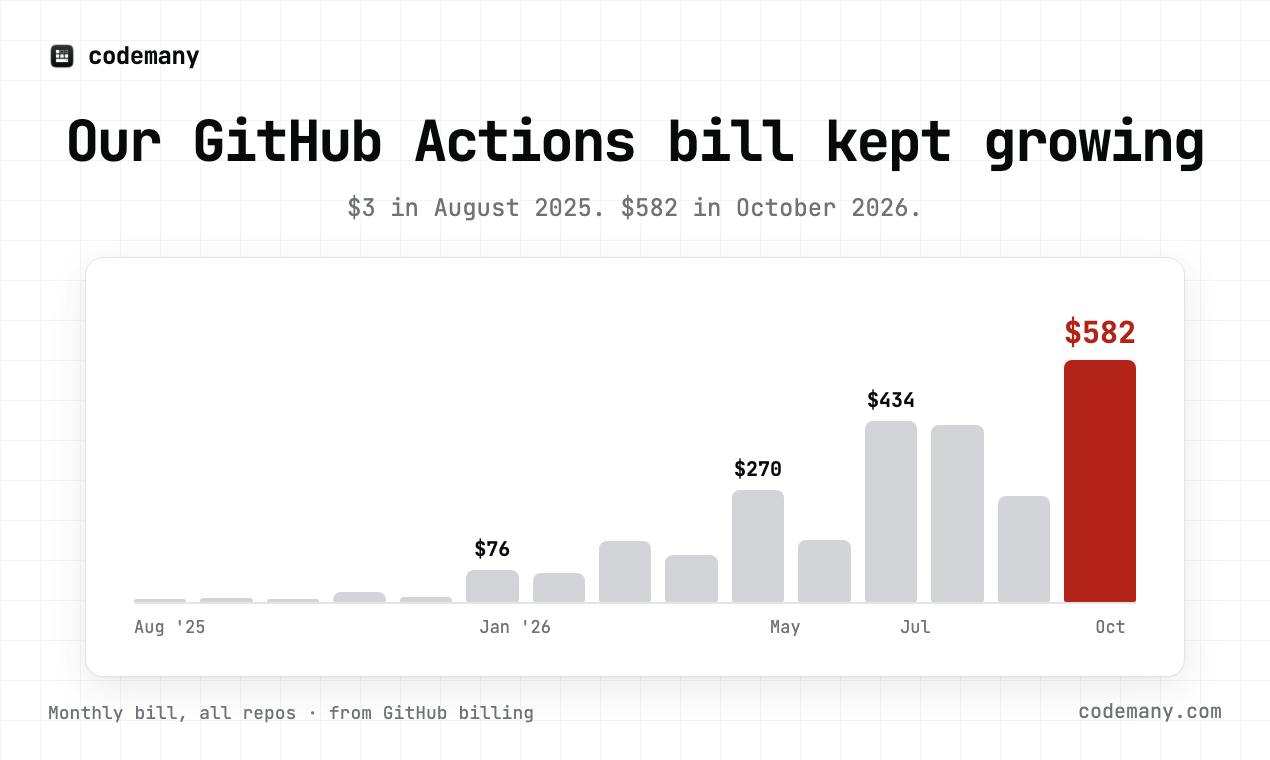
Behind these numbers lies widespread frustration with the cost and performance of GitHub-hosted runners. Rather than optimizing caching or parallelization strategies, Codemany changes where jobs run—placing them in your own cloud account to bypass the per-minute billing model.
The Cost-Effectiveness Logic of Self-Hosted Runners
Codemany's core mechanism is straightforward: it provides an orchestration layer that connects to your infrastructure (such as AWS, GCP, or local servers) and spins up a fresh VM for each GitHub Actions job. This means complete isolation between jobs, eliminating dependency conflicts or residual state from reused environments. And since compute comes from your own cloud account, the cost structure shifts from "buying GitHub compute by the minute" to "paying for actual cloud resources used."
The official bill comparison ($215 in October vs. $4 from November to date) is only a single case, but it points to a clear trend: for teams with heavy CI workloads, self-hosted runners can significantly reduce direct costs. Especially when job volume is high and individual runs are long, GitHub's per-minute billing accumulates quickly, while the marginal cost of self-built VMs is lower.
GitHub-hosted runner billing model: GitHub offers free minutes for public repositories and bills private repositories by runtime minutes (rates vary by OS—Linux is cheapest, Windows/macOS more expensive), with a certain number of free minutes included depending on your account plan. Beyond that, costs accumulate per minute; large matrix builds or long-running tests can quickly exhaust the quota. Self-hosted runners themselves incur no GitHub minute fees, but the underlying cloud resources (e.g., EC2, GCE instances) are billed per second/hour, plus storage and egress traffic. So the cost comparison is essentially "GitHub minute rate × total minutes" versus "cloud instance rate × actual runtime + idle/orchestration overhead." Codemany's "start/stop VM per job" avoids the idle waste common with self-hosted runners, but cloud provider startup latency and minimum billing granularity still need to be factored in.
Where Does the Speedup Come From?
"3x faster" is Codemany's most prominent claim. Architecturally, the speed gains may come from several factors: no waiting in GitHub's shared pool queue at job startup; fresh VMs avoiding redundant downloads or builds caused by cache pollution; and the ability to choose higher-performance instance types. Although Codemany hasn't disclosed detailed benchmarking methodology, the "one new VM per job" design does reduce environment preparation time, especially for projects with complex dependencies and many build steps.
It's worth noting that speed and cost often involve trade-offs. Using higher-performance cloud instances raises the unit price, but if total job duration drops significantly, the overall cost may still fall. In Codemany's case, the bill dropped from $215 to $4—a dramatic difference—but the specific configuration and job volume aren't public, so readers should evaluate based on their own situation.
Fresh VMs and cache pollution: GitHub Actions' hosted runners also provide a clean environment for each job, but self-hosted runners that reuse the same machine long-term leave workspace, dependency caches, Docker layers, and system state across jobs, potentially causing slow builds or mysterious failures. Codemany spins up a fresh VM for each job, eliminating residue at the root—at the cost of cold starts and re-pulling dependencies every time. So "3x faster" isn't unconditional: if a project relies heavily on local caches (e.g., Maven/Gradle caches, Docker layer caches), fresh VMs may actually increase download time. Codemany may balance this through pre-warmed images or snapshot restoration, but the official mechanism isn't disclosed, so cold-start time and caching strategy deserve attention when evaluating.
Who Should Try Codemany?
This tool clearly isn't aimed at small projects that run CI occasionally. It's better suited to:
- Teams with heavy CI workloads: many workflows run daily, and per-minute billing has become a significant expense;
- Projects with high requirements for build environment consistency: fresh VMs each time eliminate "works on my machine" issues;
- Teams with existing cloud infrastructure: existing cloud accounts and network configurations can be reused, lowering migration costs.
Codemany offers a 14-day free trial with no credit card required, lowering the barrier to entry. However, self-hosted runners also mean you bear responsibility for infrastructure operations, including security updates, network configuration, and troubleshooting. Codemany's orchestration layer simplifies this work but doesn't eliminate it entirely.
The Self-Hosted CI Trend from Multiple Perspectives
Codemany isn't the first product to propose self-hosted GitHub Actions. Open-source solutions like Act and nektos already exist, along with GitHub's official self-hosted runners. Codemany's differentiator is its encapsulation of "orchestration" and the "per-job independent VM" experience. According to the Product Hunt page, maker Arpit Agarwal positions the product as "run GitHub Actions on your infrastructure," emphasizing no per-minute fees.
From community discussion (though there are only 4 comments), early users expressed interest in cost savings and speed gains, but some voices raised concerns about the security and maintenance burden of self-hosting. This feedback aligns with industry consensus: self-hosted CI has clear advantages in cost control but requires teams to have some operational capability.
GitHub's official self-hosted runners and orchestration layers: GitHub natively supports registering self-hosted runners, but you must install the agent on target machines yourself and handle scaling, isolation, and cleanup. Official runners execute multiple jobs sequentially on the same machine by default, with weak isolation and no built-in "per-job independent VM" capability. Codemany's orchestration layer essentially sits on top of GitHub's self-hosted mechanism, automatically creating/destroying VMs on demand and registering them as ephemeral runners—filling the "elastic provisioning" gap. Unlike local simulation tools like Act and nektos, Codemany targets real CI workloads rather than local debugging. Understanding this layering helps determine whether Codemany replaces GitHub-hosted runners or merely wraps the self-hosted workflow.
Conclusion
Codemany taps into the real pain point of CI cost optimization with "3x speed and zero per-minute billing." Though its case data comes from a single team, it's enough to prompt reflection on the cost model of hosted runners. If you're struggling with your GitHub Actions bill and your team is willing to operate self-built infrastructure, the 14-day free trial is worth a shot. Before migrating, however, it's advisable to calculate your own job volume and cloud resource unit prices to avoid having speed gains offset by operational costs.
Related articles

Nothing CMF Buds 2A Drops to $17.89 on Black Friday: A New Low for ANC Earbuds
Nothing CMF Buds 2A wireless earbuds Black Friday deal: just $17.89 on Amazon, about $11 off retail and a record low. ANC earbuds at an entry-level price.

When AI Creation Gets Accused of "Spitting": Hacker News Heats Up Over the Glaude Controversy
A Hacker News post, "Spitting in the Face of Glaude," sparks debate on AI creation transparency and attribution ethics. This analysis examines the blurred creator identity behind the controversy and offers practical advice for AI content production.

Akai Embraces Custom Firmware: MPC Sample 1.4 Lets Users AI-Program Their Sampler
Akai embraces the modding community with MPC Sample 1.4 firmware, supporting vibe-coded custom firmware and effects. We analyze the impact of this open strategy on music hardware and AI-assisted programming.