Codex Beginner's Guide: Understanding the Difference Between OpenAI's Coding Agent and ChatGPT
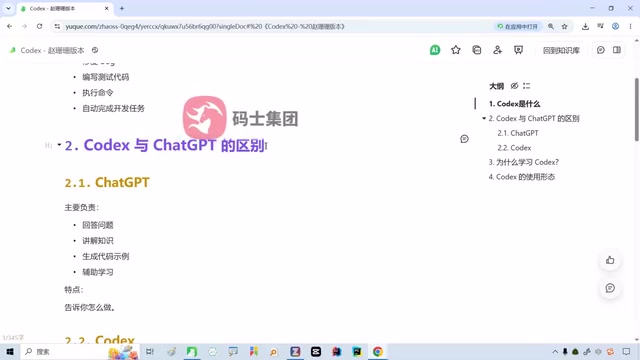
A beginner's guide explaining OpenAI Codex as a coding agent and how it fundamentally differs from ChatGPT.
This guide introduces OpenAI's Codex as an AI coding agent that autonomously writes, debugs, and tests code — unlike ChatGPT which only generates text for you to copy. It explains the architectural differences, why Codex represents a shift from conversational AI to autonomous development agents, and why developers should learn to direct AI tools now.
What is Codex: More Than Just a Code Generator
Codex is an AI Coding Agent developed by OpenAI. Unlike ordinary chat tools, it's positioned as a tool that "does the work for developers," capable of autonomously completing a series of programming-related tasks.
The term "AI Coding Agent" represents a new paradigm that goes beyond traditional code completion tools. Unlike "inline completion" tools such as GitHub Copilot, an Agent possesses autonomous planning, tool invocation, and environment interaction capabilities. It's based on the ReAct (Reasoning + Acting) architecture, able to iteratively complete complex tasks through a "think-act-observe" loop. Codex runs in an isolated sandbox environment where it can execute shell commands, read and write files, and run test suites — capabilities that come from deeply integrating large language models with code execution environments.
Specifically, Codex's capabilities go far beyond simply generating code. It can:
- Generate code
- Read and understand existing code
- Fix bugs
- Run tests
- Execute commands and scripts
In other words, Codex isn't a chatbot that "finishes talking and leaves you to copy-paste on your own" — it's a tool capable of taking over the development workflow end-to-end. For programmers, this type of AI coding agent is evolving from a "nice-to-have" to a "daily essential."
Core Differences Between Codex and ChatGPT
Many people encountering Codex for the first time have a question: since it relies on ChatGPT models under the hood, what exactly makes them different? Why not just use ChatGPT to write code?
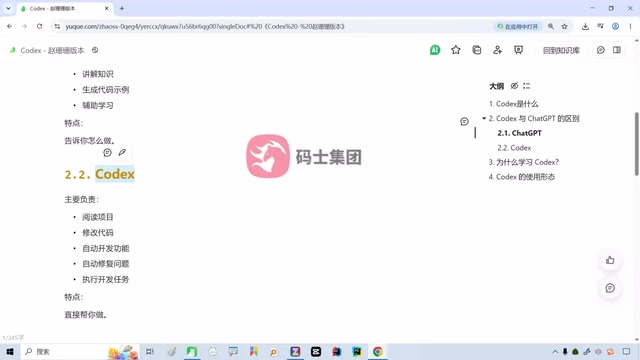
From a technical perspective, while both Codex and ChatGPT are based on OpenAI's large language models, Codex uses a model version specifically optimized for code tasks (such as codex-1, which is fine-tuned from the o3 model through reinforcement learning for programming scenarios). The more critical difference lies in the system architecture: ChatGPT is a stateless conversation system that ends after each response, while Codex has a persistent working environment that can maintain project context, file states, and execution history. This "stateful" design enables it to handle complex development tasks spanning multiple files and steps.
Let's use a vivid analogy to distinguish the positioning of both.
ChatGPT: Like a Teacher Who "Talks"
If you ask ChatGPT: "How do I implement a login feature in Spring Boot?" it will explain the principles and tell you how to write the code. But after generating the code, you need to Ctrl+C / Ctrl+V it yourself, paste it into your development environment, and then debug and run it on your own.
ChatGPT excels at answering questions, explaining concepts, and aiding learning — it's responsible for "talking."
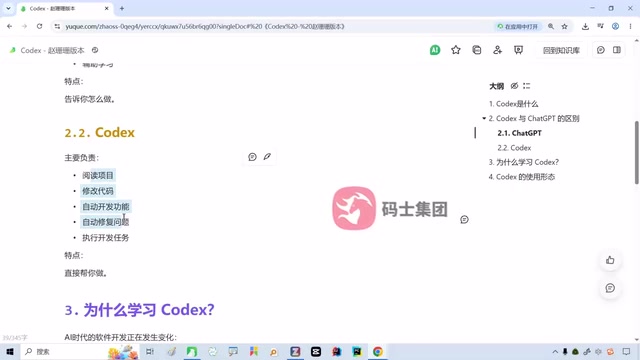
Codex: Like a Programmer Who "Does the Work"
Codex is completely different. You just need to tell it: "Build the login feature for me." And it will:
- Examine the entire project structure on its own
- Autonomously modify and generate code
- Test and debug by itself
- Tell you "It's done" once everything passes
To summarize in one sentence: ChatGPT talks, Codex acts. This is the most fundamental difference between the two.
If you just want to chat, generate a small snippet of code, and paste it yourself, then tools like Doubao, DeepSeek, or ChatGPT are sufficient. But if you want an "assistant" that can truly complete development tasks for you, coding agents like Codex are the more suitable choice.
Why Developers Should Learn Codex Now
The paradigm of software development is undergoing fundamental change. The earlier you master AI programming tools, the better positioned you'll be during this industry transformation.
This shift is referred to in the industry as "AI-Native Development." According to GitHub's 2024 developer survey, 92% of developers are already using AI coding tools, and the proportion using Agent-type tools to complete end-to-end tasks is growing rapidly. Gartner predicts that by 2028, 75% of enterprise software engineers will use AI coding assistants. This means "human-AI collaborative programming" is no longer optional — it's becoming an industry standard.
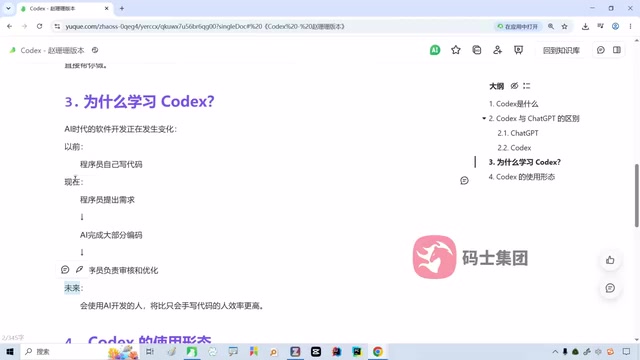
From "Writing Code by Hand" to "Directing AI to Write Code"
In the past, developers needed to manually type code line by line. Now, the mainstream workflow is shifting to: Programmer provides requirements → AI tools complete most of the code → Programmer reviews and optimizes.
There's a key point worth emphasizing here: tools like Codex, Claude Code, and Trae will not replace programmers. Reviewing and optimizing AI-generated code inherently requires solid programming fundamentals. If you know nothing about programming, you can neither review nor optimize effectively.
The Most Valuable Future Skill: Knowing How to Give Requirements to AI
The most capable developers of the future won't be those who "type the fastest and can write 5,000 lines a day," but rather those who are best at communicating requirements to AI.
The ability to give requirements to AI is essentially a combination of "Prompt Engineering" and "software engineering thinking." Excellent requirement expression includes: clear task boundary definitions, precise descriptions of expected behavior, explicit declaration of constraints, and quantified acceptance criteria. This is highly related to the requirements analysis capability in traditional software engineering — people who can write good PRDs (Product Requirements Documents) often can also write good instructions for AI.
This means developers' core competitiveness is shifting from "coding speed" to "requirement expression ability" and "solution review ability." Those who can use AI-assisted programming will have work efficiency far exceeding those who write code purely by hand. This is precisely the most important reason to learn coding agent tools like Codex and Claude Code.
Summary
Codex represents an important direction for AI programming tools — evolving from a "conversational assistant" to an "autonomous coding agent." For developers, understanding how it differs from traditional chat tools like ChatGPT and mastering the ability to "direct AI development" as early as possible will be a critical step in adapting to the AI era.
This article helped you clarify three core questions: What is Codex, how is it different from ChatGPT, and why is it worth learning. The hands-on sections that follow — from environment setup, core features, and usage tips to project practice — are where the real learning begins.
Key Takeaways
Related articles

The Truth Behind Codex 'Build a Website in 5 Minutes': AI Isn't Creating Sites—It's Helping You Copy Them
Exposing the truth behind viral Codex 5-minute website videos: creators aren't building original sites with AI—they're copying shared prompts or scraping others' work. Learn AI coding tools' real limits.

Getting Started with AI Agent Development: A Complete Guide from Concept to Practice
A comprehensive guide to AI Agent architecture and development, covering automated marketing, intelligent customer service, and investment analysis scenarios with single and multi-agent collaboration.

The Truth Behind Codex 'Build a Website in 5 Minutes': AI Isn't Creating Sites — It's Helping You Copy Them
Exposing the truth behind viral Codex 5-minute website videos: creators aren't building original sites with AI — they're copying shared prompts or scraping others' work.